Du Xue, Spatz Erica S, Dreyer Rachel P, Hu Shuang, Wu Chaoqun, Li Xi, Li Jing, Wang Sisi, Masoudi Frederick A, Spertus John A, Nasir Khurram, Krumholz Harlan M, Jiang Lixin
National Clinical Research Center of Cardiovascular Diseases, State Key Laboratory of Cardiovascular Disease, Fuwai Hospital, National Center for Cardiovascular Diseases, Chinese Academy of Medical Sciences and Peking Union Medical College, Beijing, China.
Center for Outcomes Research and Evaluation (CORE), Yale-New Haven Hospital, New Haven, CT Section of Cardiovascular Medicine, Department of Internal Medicine, Yale School of Medicine, New Haven, CT Department of Internal Medicine, Yale School of Medicine, New Haven, CT.
J Am Heart Assoc. 2016 Feb 22;5(2):e002157. doi: 10.1161/JAHA.115.002157.
China is experiencing a marked increase in ST-segment elevation myocardial infarction hospitalizations, with 30% occurring among women and higher risk of in-hospital death in relatively younger age groups (<70). Yet, little is known about sex differences in ST-segment elevation myocardial infarction presentation and management.
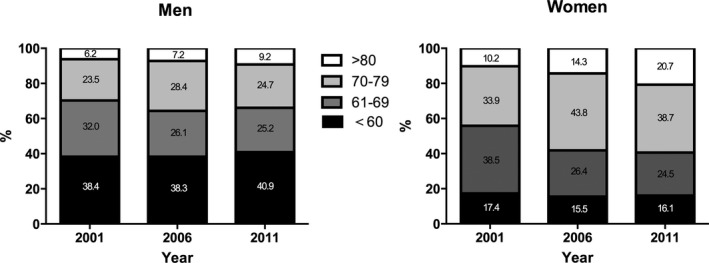
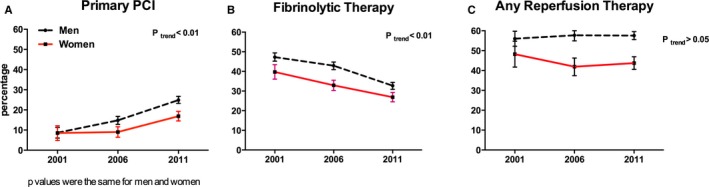
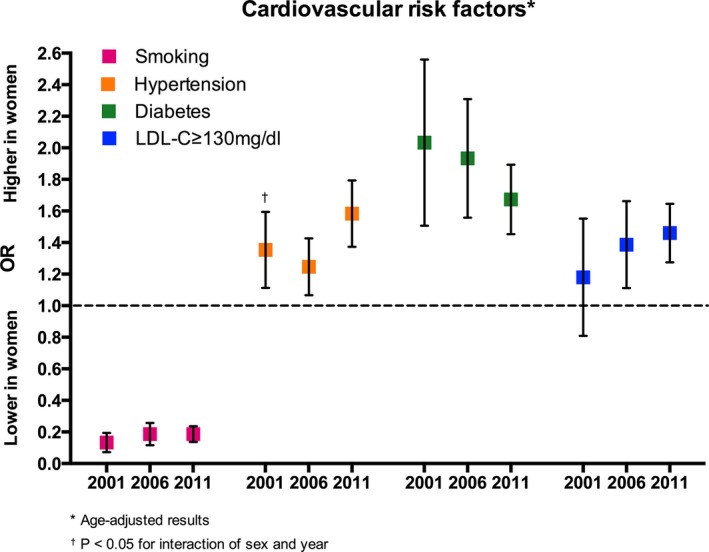
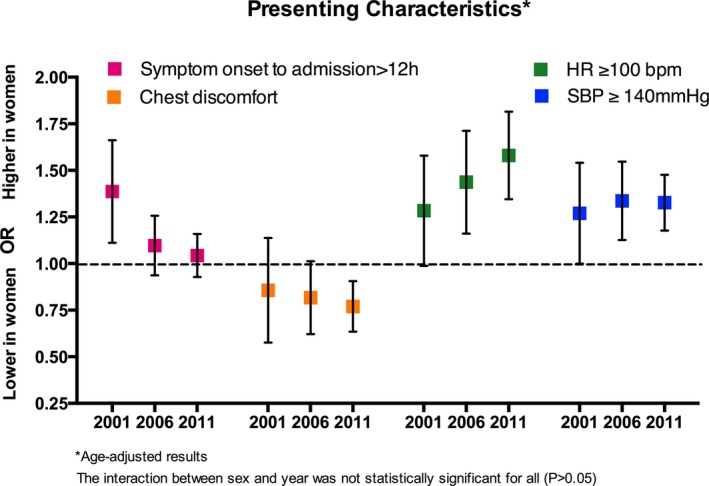
In a nationally representative sample of patients with ST-segment elevation myocardial infarction admitted to 162 Chinese hospitals in 2001, 2006, and 2011, we examined sex differences in hospitalization rates, clinical profiles, and quality of care. Among 11 986 patients, the proportion of women was unchanged between 2001 and 2011. The estimated national rates of hospital admission per 100 000 people increased from 4.6 in 2001 to 18.0 in 2011 among men (3.9-fold increase) and from 1.9 to 8.0 among women (4.2-fold increase) (Ptrend<0.0001). The median age of women increased from 68 years in 2001 to 72 years in 2011 (Ptrend<0.001); however, there was no age change in men (63 years in 2011) (Ptrend=0.48). After accounting for age, women had a higher frequency of comorbidities. Although there were significant sex differences in the time interval of >12 hours between symptom onset and admission time in 2001, since 2006 delays in presentation were comparable between women and men. Fewer women without contraindications received evidence-based therapies than men, including reperfusion (57.5% versus 44.2%), early aspirin (88.8% versus 85.9%), and clopidogrel (56.9% versus 52.5%, P<0.001 for all) and the differences were largely unchanged over time.
Women experienced a higher increase in hospitalization rates for ST-segment elevation myocardial infarction in China between 2001 and 2011 and were less likely to receive evidence-based therapies, especially reperfusion. In addition to efforts to improve quality of care generally, understanding the reasons for this sex disparity and addressing these differences in care should be a priority.
URL: https://www.clinicaltrials.gov. Unique identifier: NCT01624883.
中国ST段抬高型心肌梗死住院人数显著增加,其中30%为女性,且相对年轻年龄组(<70岁)的院内死亡风险更高。然而,关于ST段抬高型心肌梗死的表现及治疗方面的性别差异却知之甚少。
在2001年、2006年和2011年全国162家医院收治的具有全国代表性的ST段抬高型心肌梗死患者样本中,我们研究了住院率、临床特征及医疗质量方面的性别差异。在11986例患者中,2001年至2011年间女性所占比例未变。每10万人的预计全国住院率,男性从2001年的4.6升至2011年的18.0(增长3.9倍),女性从1.9升至8.0(增长4.2倍)(P趋势<0.0001)。女性的年龄中位数从2001年的68岁增至2011年的72岁(P趋势<0.001);然而,男性年龄无变化(2011年为63岁)(P趋势=0.48)。校正年龄后,女性合并症的发生率更高。尽管在2001年症状发作至入院时间间隔超过12小时方面存在显著性别差异,但自2006年起,女性和男性在就诊延迟方面相当。无禁忌证的女性接受循证治疗的比例低于男性,包括再灌注治疗(57.5%对44.2%)、早期阿司匹林治疗(88.8%对85.9%)及氯吡格雷治疗(56.9%对52.5%,所有P<0.001),且这些差异随时间基本未变。
2001年至2011年间,中国女性ST段抬高型心肌梗死的住院率增长更高,且接受循证治疗的可能性更小,尤其是再灌注治疗。除了普遍努力提高医疗质量外,了解这种性别差异的原因并解决治疗中的这些差异应成为优先事项。