Schneider Bruna Celestino, Dumith Samuel de Carvalho, Lopes Carla, Severo Milton, Assunção Maria Cecília Formoso
Post-Graduate Program in Epidemiology, Federal University of Pelotas, Pelotas, Brazil.
Post-Graduate Program in Public Health, Federal University of Rio Grande, Rio Grande, Brazil.
PLoS One. 2016 Feb 23;11(2):e0149299. doi: 10.1371/journal.pone.0149299. eCollection 2016.
Few studies have addressed the influence of dietary patterns (DP) during adolescence on the amount of body fat in early adulthood.
To analyze the associations between DP tracking and changes in the period between 15 and 18 years of age and the percentage of body fat (%BF) at age 18 years.
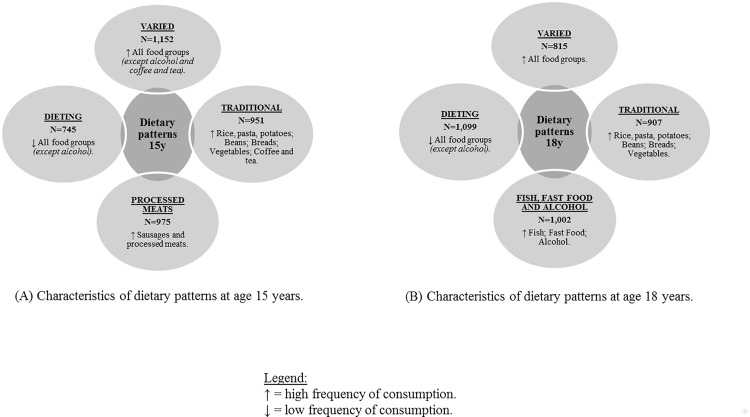
We used data from 3,823 members of the 1993 Pelotas (Brazil) birth cohort. Body density was measured at age 18 years by air displacement plethysmograph (BOD POD) and the %BF was calculated applying the Siri equation. Based on the estimates from the FFQ, we identified DP at ages 15 ("Varied", "Traditional", "Dieting" and "Processed meats") and 18 years ("Varied", "Traditional", "Dieting" and "Fish, fast food and alcohol"). The DP tracking was defined as the individual's adherence to the same DP at both ages. Associations were tested using multiple linear regression models stratified by sex.
The mean %BF was 25.0% (95% CI: 24.7 to 25.4), significantly greater for girls than boys (p<0.001). The adherence to any DP at age 15 years was not associated with the %BF at age 18 years. However, individuals who adhered to a "Dieting" DP at age 18 years showed greater %BF (1.30 and 1.91 percentage points in boys and girls, respectively) in comparison with those who adhered to a "Varied" DP. Boys who presented tracking of a "Dieting" DP presented greater average %BF in comparison with others DP, as well as girls who changed from the "Traditional" or "Processed meats" DP to a "Dieting" DP.
These results may support public health policies and strategies focused on improving dietary habits of adolescents and young adults and preventing accumulation of body fat, especially among the adolescents with restrictive dietary habits.
很少有研究探讨青少年时期的饮食模式(DP)对成年早期体脂量的影响。
分析15至18岁期间DP追踪情况与18岁时体脂百分比(%BF)之间的关联。
我们使用了1993年巴西佩洛塔斯出生队列中3823名成员的数据。18岁时通过空气置换体积描记法(BOD POD)测量身体密度,并应用 Siri 方程计算%BF。根据食物频率问卷(FFQ)的估计值,我们确定了15岁(“多样化”、“传统”、“节食”和“加工肉类”)和18岁(“多样化”、“传统”、“节食”以及“鱼类、快餐和酒精”)时的DP。DP追踪定义为个体在两个年龄段都坚持相同的DP。使用按性别分层的多元线性回归模型检验关联。
平均%BF为25.0%(95%可信区间:24.7至25.4),女孩显著高于男孩(p<0.001)。15岁时坚持任何一种DP与18岁时的%BF均无关联。然而,18岁时坚持“节食”DP的个体与坚持“多样化”DP的个体相比,%BF更高(男孩和女孩分别高1.30和1.91个百分点)。与其他DP相比,坚持“节食”DP追踪的男孩平均%BF更高,从“传统”或“加工肉类”DP转变为“节食”DP的女孩也是如此。
这些结果可能支持旨在改善青少年和年轻人饮食习惯以及预防体脂堆积的公共卫生政策和策略,尤其是在有限制性饮食习惯的青少年中。