Kensinger Elizabeth A, Choi Hae-Yoon, Murray Brendan D, Rajaram Suparna
Department of Psychology, Boston College, McGuinn Hall Rm. 300, 140 Commonwealth Avenue., Chestnut Hill, MA, 02467, USA.
Department of Psychology|, Stony Brook University, Stony Brook, NY, USA.
Mem Cognit. 2016 Jul;44(5):706-16. doi: 10.3758/s13421-016-0597-8.
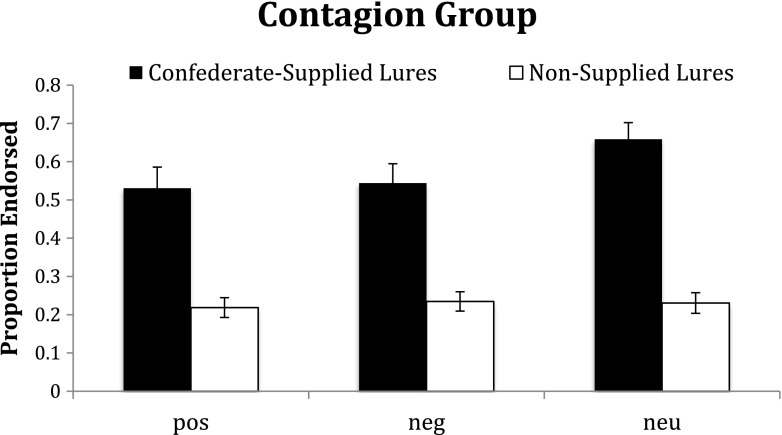
In daily life, emotional events are often discussed with others. The influence of these social interactions on the veracity of emotional memories has rarely been investigated. The authors (Choi, Kensinger, & Rajaram Memory and Cognition, 41, 403-415, 2013) previously demonstrated that when the categorical relatedness of information is controlled, emotional items are more accurately remembered than neutral items. The present study examined whether emotion would continue to improve the accuracy of memory when individuals discussed the emotional and neutral events with others. Two different paradigms involving social influences were used to investigate this question and compare evidence. In both paradigms, participants studied stimuli that were grouped into conceptual categories of positive (e.g., celebration), negative (e.g., funeral), or neutral (e.g., astronomy) valence. After a 48-hour delay, recognition memory was tested for studied items and categorically related lures. In the first paradigm, recognition accuracy was compared when memory was tested individually or in a collaborative triad. In the second paradigm, recognition accuracy was compared when a prior retrieval session had occurred individually or with a confederate who supplied categorically related lures. In both of these paradigms, emotional stimuli were remembered more accurately than were neutral stimuli, and this pattern was preserved when social interaction occurred. In fact, in the first paradigm, there was a trend for collaboration to increase the beneficial effect of emotion on memory accuracy, and in the second paradigm, emotional lures were significantly less susceptible to the "social contagion" effect. Together, these results demonstrate that emotional memories can be more accurate than nonemotional ones even when events are discussed with others (Experiment 1) and even when that discussion introduces misinformation (Experiment 2).
在日常生活中,人们经常会与他人讨论情感事件。这些社会互动对情感记忆准确性的影响却鲜有研究。作者(崔、肯辛格和拉贾拉姆,《记忆与认知》,第41卷,第403 - 415页,2013年)之前曾证明,在信息的类别相关性得到控制的情况下,情感项目比中性项目的记忆更准确。本研究考察了当个体与他人讨论情感和中性事件时,情感是否会继续提高记忆的准确性。采用了两种涉及社会影响的不同范式来研究这个问题并比较证据。在这两种范式中,参与者研究了被分组为积极(如庆祝)、消极(如葬礼)或中性(如天文学)效价概念类别的刺激物。经过48小时的延迟后,对所研究的项目和类别相关的诱饵进行识别记忆测试。在第一个范式中,比较了单独测试记忆和在三人协作小组中测试记忆时的识别准确性。在第二个范式中,比较了单独进行先前的检索环节或与提供类别相关诱饵的同谋一起进行检索环节时的识别准确性。在这两种范式中,情感刺激的记忆都比中性刺激更准确,并且当发生社会互动时,这种模式得以保留。事实上,在第一个范式中,存在一种协作会增加情感对记忆准确性有益影响的趋势,而在第二个范式中,情感诱饵对“社会传染”效应的敏感度显著更低。总之,这些结果表明,即使与他人讨论事件(实验1),甚至当讨论引入错误信息时(实验2),情感记忆也可能比非情感记忆更准确。