Chong Shu-Ling, Chew Su Yah, Feng Jasmine Xun Yi, Teo Penny Yun Lin, Chin Sock Teng, Liu Nan, Ong Marcus Eng Hock
Department of Emergency Medicine, KK Women's and Children's Hospital, Duke-NUS Medical School, Singapore.
Department of Paediatrics, Yong Loo Lin School of Medicine, National University of Singapore, Khoo Teck Puat-National University Children's Medical Institute, National University Health System, Singapore.
BMJ Open. 2016 Feb 23;6(2):e010618. doi: 10.1136/bmjopen-2015-010618.
To study the causes of head injuries among the paediatric population in Singapore, and the association between causes and mortality, as well as the need for airway or neurosurgical intervention.
This is a prospective observational study utilising data from the trauma surveillance system from January 2011 to March 2015.
Paediatric emergency departments (EDs) of KK Women's and Children's Hospital and the National University Health System.
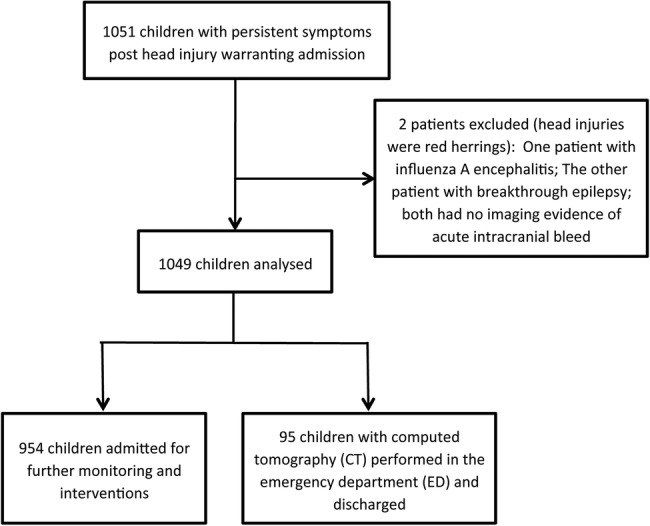
We included children aged <16 years presenting to the paediatric EDs with head injuries who required a CT scan, admission for monitoring of persistent symptoms, or who died from the head injury. We excluded children who presented with minor mechanisms and those whose symptoms had spontaneously resolved.
Primary composite outcome was defined as death or the need for intubation or neurosurgical intervention. Secondary outcomes included length of hospital stay and type of neurosurgical intervention.
We analysed 1049 children who met the inclusion criteria. The mean age was 6.7 (SD 5.2) years. 260 (24.8%) had a positive finding on CT. 17 (1.6%) children died, 52 (5.0%) required emergency intubation in the ED and 58 (5.5%) underwent neurosurgery. The main causes associated with severe outcomes were motor vehicle crashes (OR 7.2, 95% CI 4.3 to 12.0) and non-accidental trauma (OR 5.8, 95% CI 1.8 to 18.6). This remained statistically significant when we stratified to children aged <2 years and performed a multivariable analysis adjusting for age and location of injury. For motor vehicle crashes, less than half of the children were using restraints.
Motor vehicle crashes and non-accidental trauma causes are particularly associated with poor outcomes among children with paediatric head injury. Continued vigilance and compliance with injury prevention initiatives and legislature are vital.
研究新加坡儿童人群头部损伤的原因,以及原因与死亡率之间的关联,以及气道或神经外科干预的必要性。
这是一项前瞻性观察性研究,利用了2011年1月至2015年3月创伤监测系统的数据。
KK妇女儿童医院和国立大学卫生系统的儿科急诊科。
我们纳入了年龄小于16岁、因头部损伤到儿科急诊科就诊、需要进行CT扫描、因持续症状入院监测或因头部损伤死亡的儿童。我们排除了受伤机制轻微以及症状已自行缓解的儿童。
主要综合结局定义为死亡或需要插管或神经外科干预。次要结局包括住院时间和神经外科干预类型。
我们分析了1049名符合纳入标准的儿童。平均年龄为6.7(标准差5.2)岁。260名(24.8%)CT检查结果呈阳性。17名(1.6%)儿童死亡,52名(5.0%)在急诊科需要紧急插管,58名(5.5%)接受了神经外科手术。与严重结局相关的主要原因是机动车碰撞(比值比7.2,95%置信区间4.3至12.0)和非意外创伤(比值比5.8,95%置信区间1.8至18.6)。当我们将年龄小于2岁的儿童分层并进行调整年龄和损伤部位的多变量分析时,这一结果仍具有统计学意义。对于机动车碰撞,不到一半的儿童使用了安全带。
机动车碰撞和非意外创伤原因尤其与小儿头部损伤儿童的不良结局相关。持续保持警惕并遵守伤害预防倡议和立法至关重要。