Di Xiaotang, Takken Frank L W, Tintor Nico
Molecular Plant Pathology, Faculty of Science, Swammerdam Institute for Life Sciences, University of Amsterdam Amsterdam, Netherlands.
Front Plant Sci. 2016 Feb 16;7:170. doi: 10.3389/fpls.2016.00170. eCollection 2016.
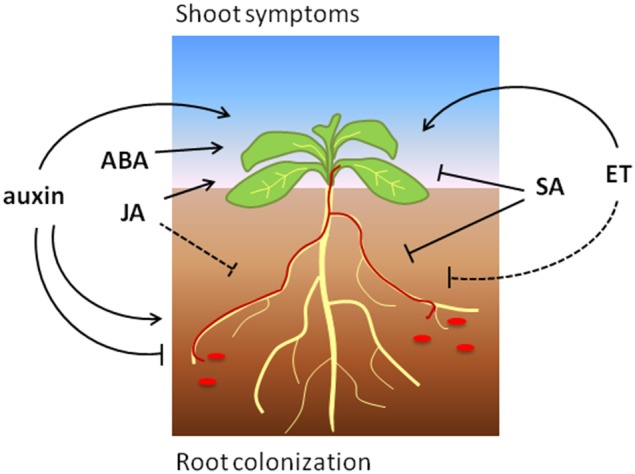
Plants interact with a huge variety of soil microbes, ranging from pathogenic to mutualistic. The Fusarium oxysporum (Fo) species complex consists of ubiquitous soil inhabiting fungi that can infect and cause disease in over 120 different plant species including tomato, banana, cotton, and Arabidopsis. However, in many cases Fo colonization remains symptomless or even has beneficial effects on plant growth and/or stress tolerance. Also in pathogenic interactions a lengthy asymptomatic phase usually precedes disease development. All this indicates a sophisticated and fine-tuned interaction between Fo and its host. The molecular mechanisms underlying this balance are poorly understood. Plant hormone signaling networks emerge as key regulators of plant-microbe interactions in general. In this review we summarize the effects of the major phytohormones on the interaction between Fo and its diverse hosts. Generally, Salicylic Acid (SA) signaling reduces plant susceptibility, whereas Jasmonic Acid (JA), Ethylene (ET), Abscisic Acid (ABA), and auxin have complex effects, and are potentially hijacked by Fo for host manipulation. Finally, we discuss how plant hormones and Fo effectors balance the interaction from beneficial to pathogenic and vice versa.
植物与种类繁多的土壤微生物相互作用,从致病微生物到互利共生微生物都有。尖孢镰刀菌(Fo)物种复合体由广泛存在于土壤中的真菌组成,这些真菌可感染包括番茄、香蕉、棉花和拟南芥在内的120多种不同植物并引发疾病。然而,在许多情况下,Fo定殖并无症状,甚至对植物生长和/或胁迫耐受性有有益影响。在致病相互作用中,通常在疾病发展之前会有一段漫长的无症状期。所有这些都表明Fo与其宿主之间存在复杂且精细调节的相互作用。这种平衡背后的分子机制尚不清楚。一般来说,植物激素信号网络是植物与微生物相互作用的关键调节因子。在本综述中,我们总结了主要植物激素对Fo与其不同宿主之间相互作用的影响。一般而言,水杨酸(SA)信号传导降低植物易感性,而茉莉酸(JA)、乙烯(ET)、脱落酸(ABA)和生长素具有复杂的影响,并且可能被Fo利用来操纵宿主。最后,我们讨论了植物激素和Fo效应子如何平衡从有益到致病以及反之亦然的相互作用。