de Lamo Francisco J, Takken Frank L W
Molecular Plant Pathology, Faculty of Science, Swammerdam Institute for Life Sciences, University of Amsterdam, Amsterdam, Netherlands.
Front Plant Sci. 2020 Feb 6;11:37. doi: 10.3389/fpls.2020.00037. eCollection 2020.
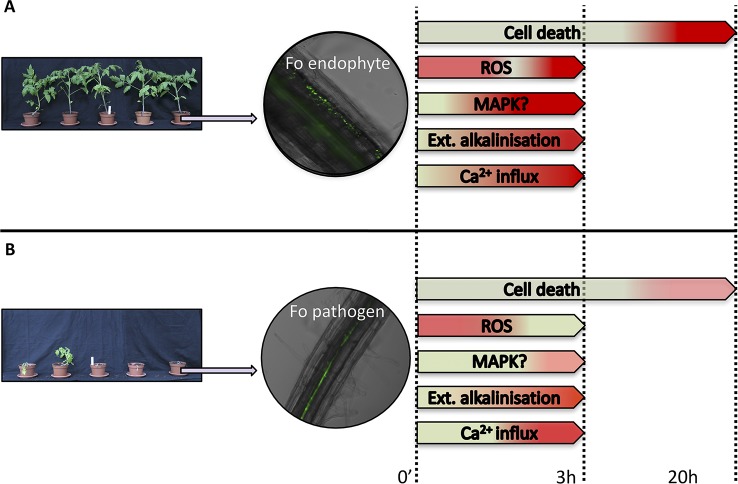
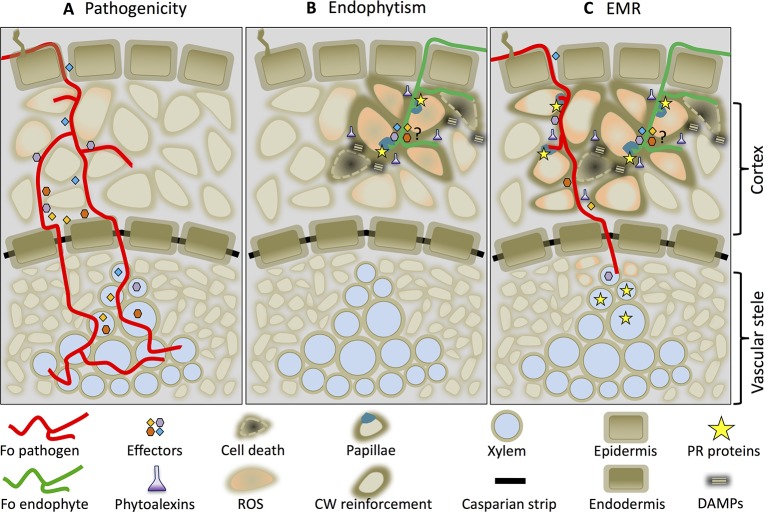
Interactions between plants and the root-colonizing fungus (Fo) can be neutral, beneficial, or detrimental for the host. Fo is infamous for its ability to cause wilt, root-, and foot-rot in many plant species, including many agronomically important crops. However, Fo also has another face; as a root endophyte, it can reduce disease caused by vascular pathogens such as and pathogenic Fo strains. Fo also confers protection to root pathogens like , but typically not to pathogens attacking above-ground tissues such as or . Endophytes confer biocontrol either directly by interacting with pathogens mycoparasitism, antibiosis, or by competition for nutrients or root niches, or indirectly by inducing resistance mechanisms in the host. Fo endophytes such as Fo47 and CS-20 differ from Fo pathogens in their effector gene content, host colonization mechanism, location in the plant, and induced host-responses. Whereas endophytic strains trigger localized cell death in the root cortex, and transiently induce immune signaling and papilla formation, these responses are largely suppressed by pathogenic Fo strains. The ability of pathogenic strains to compromise immune signaling and cell death is likely attributable to their host-specific effector repertoire. The lower number of effector genes in endophytes as compared to pathogens provides a means to distinguish them from each other. Co-inoculation of a biocontrol-conferring Fo and a pathogenic Fo strain on tomato reduces disease, and although the pathogen still colonizes the xylem vessels this has surprisingly little effect on the xylem sap proteome composition. In this tripartite interaction the accumulation of just two PR proteins, NP24 (a PR-5) and a β-glucanase, was affected. The Fo-induced resistance response in tomato appears to be distinct from induced systemic resistance (ISR) or systemic acquired resistance (SAR), as the phytohormones jasmonate, ethylene, and salicylic acid are not required. In this review, we summarize our molecular understanding of Fo-induced resistance in a model and identify caveats in our knowledge.
植物与定殖于根部的真菌(Fo)之间的相互作用对宿主而言可能是中性、有益或有害的。Fo因能在包括许多具有重要农业经济价值的作物在内的多种植物物种中引发枯萎病、根腐病和基腐病而声名狼藉。然而,Fo也有另一面;作为一种根内生菌,它可以减轻由诸如[未提及具体病原体名称]等维管束病原体以及致病性Fo菌株引起的病害。Fo还能为诸如[未提及具体病原体名称]等根部病原体提供保护,但通常不能保护攻击地上组织的病原体,如[未提及具体病原体名称]或[未提及具体病原体名称]。内生菌通过与病原体直接相互作用(如菌寄生、抗生作用,或通过争夺养分或根际生态位)或间接通过诱导宿主的抗性机制来实现生物防治。像Fo47和CS - 20这样的Fo内生菌在效应子基因含量、宿主定殖机制、在植物中的位置以及诱导的宿主反应方面与Fo病原体不同。内生菌菌株会在根皮层引发局部细胞死亡,并短暂诱导免疫信号传导和乳突形成,而这些反应在很大程度上会被致病性Fo菌株抑制。致病性菌株破坏免疫信号传导和细胞死亡的能力可能归因于它们宿主特异性的效应子库。与病原体相比,内生菌中效应子基因数量较少,这为区分它们提供了一种方法。将具有生物防治作用的Fo和致病性Fo菌株共同接种到番茄上可减轻病害,尽管病原体仍定殖于木质部导管,但令人惊讶的是,这对木质部汁液蛋白质组组成几乎没有影响。在这种三方相互作用中,仅两种病程相关蛋白NP24(一种PR - 5)和一种β - 葡聚糖酶的积累受到了影响。番茄中Fo诱导的抗性反应似乎不同于诱导系统抗性(ISR)或系统获得性抗性(SAR),因为不需要茉莉酸、乙烯和水杨酸等植物激素。在这篇综述中,我们总结了我们对模型中Fo诱导抗性的分子理解,并指出了我们知识中的注意事项。