Ito Kimihiro, Mitsunaga Makoto, Nishimura Takashi, Kobayashi Hisataka, Tajiri Hisao
Division of Gastroenterology and Hepatology, Department of Internal Medicine, The Jikei University School of Medicine, Minato, Tokyo 105-8461, Japan.
Molecular Imaging Program, Center for Cancer Research, National Cancer Institute, Bethesda, MD 20892, USA.
Oncotarget. 2016 Mar 22;7(12):14143-52. doi: 10.18632/oncotarget.7490.
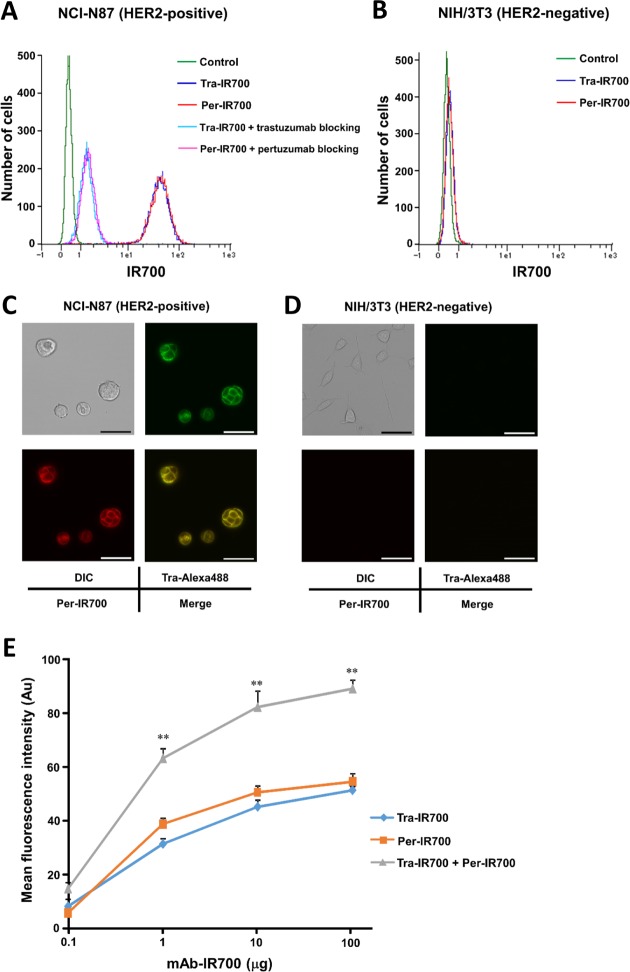
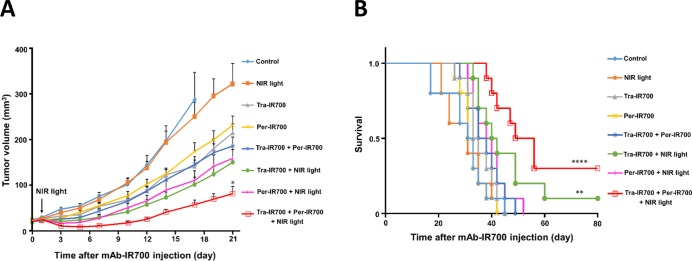
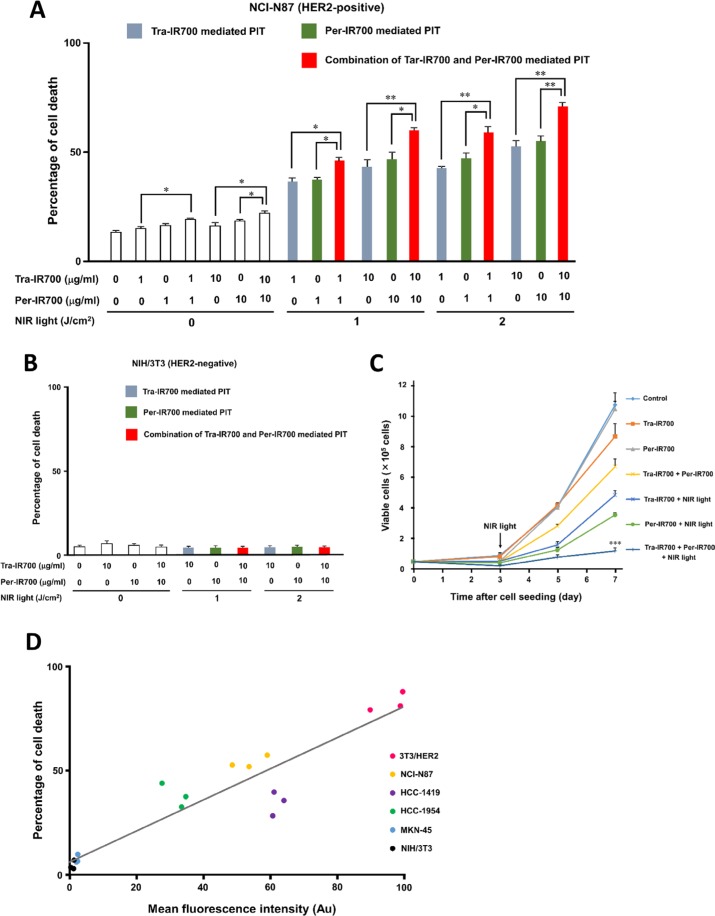
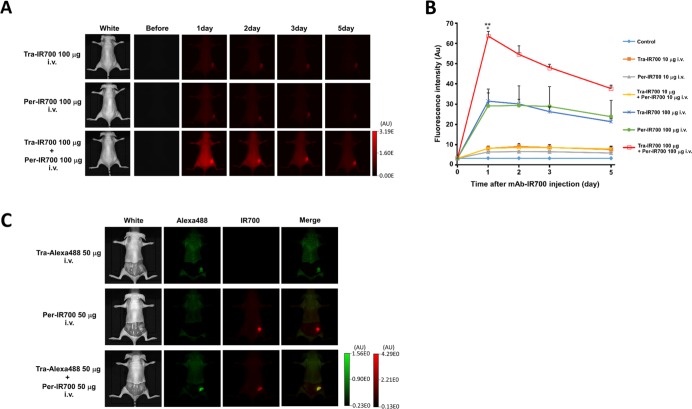
Photoimmunotherapy is a new class of molecular targeted cancer therapy based on a monoclonal antibody (mAb) conjugated to a photosensitizer and irradiation with near-infrared (NIR) light for both imaging and therapy. Here, we sought to determine the feasibility of combining photoimmunotherapy using conjugates of human epidermal growth factor receptor 2 (HER2)-specific mAb-photosensitizer IR700, trastuzumab-IR700 and pertuzumab-IR700. HER2-expressing and non-expressing cells were treated with mAb-IR700 conjugates and irradiated with NIR light. Fluorescence imaging and cytotoxic effects were examined in cultured HER2-expressng cancer cell lines and in a mouse tumor xenograft model. Trastuzumab-IR700 and pertuzumab-IR700 could specifically bind to HER2 without competing, and the combination treatment of both agents yielded stronger HER2-specific IR700 fluorescence signals than with the treatment with either agent singly. A cytotoxicity assay showed that the combination treatment of both trastuzumab-IR700 and pertuzumab-IR700 followed by NIR light irradiation induced stronger cytotoxic effect than with treatment of either agent plus NIR light irradiation. Furthermore, the phototoxic and cytotoxic effects of mAb depended on HER2-specific IR700 signal intensities. Consistent with in vitro studies, in xenograft tumor models also, IR700 fluorescence imaging-guided NIR light irradiation after the combination treatment of trastuzumab-IR700 and pertuzumab-IR700 led to stronger antitumor effects than by treatment with either agent followed by NIR light irradiation. In conclusion, fluorescence molecular imaging can facilitate the assessment of treatment outcomes of molecular targeted photoimmunotherapy, which holds great potential in facilitating better outcomes in cancer patients.
光免疫疗法是一类新型的分子靶向癌症治疗方法,它基于与光敏剂偶联的单克隆抗体(mAb),并使用近红外(NIR)光进行成像和治疗。在此,我们试图确定将使用人表皮生长因子受体2(HER2)特异性单克隆抗体-光敏剂IR700、曲妥珠单抗-IR700和帕妥珠单抗-IR700的偶联物进行光免疫治疗相结合的可行性。用单克隆抗体-IR700偶联物处理HER2表达和不表达的细胞,并用近红外光照射。在培养的HER2表达癌细胞系和小鼠肿瘤异种移植模型中检测荧光成像和细胞毒性作用。曲妥珠单抗-IR700和帕妥珠单抗-IR700可以特异性地结合HER2而不相互竞争,两种药物联合治疗产生的HER2特异性IR700荧光信号比单独使用任何一种药物治疗时更强。细胞毒性试验表明,曲妥珠单抗-IR700和帕妥珠单抗-IR700联合治疗后再进行近红外光照射比单独使用任何一种药物加近红外光照射诱导的细胞毒性作用更强。此外,单克隆抗体的光毒性和细胞毒性作用取决于HER2特异性IR700信号强度。与体外研究一致,在异种移植肿瘤模型中,曲妥珠单抗-IR700和帕妥珠单抗-IR700联合治疗后进行IR700荧光成像引导的近红外光照射比单独使用任何一种药物后进行近红外光照射产生更强的抗肿瘤作用。总之,荧光分子成像可以促进分子靶向光免疫治疗的治疗效果评估,这在促进癌症患者获得更好的治疗结果方面具有巨大潜力。