Hiroshima Yukihiko, Maawy Ali, Zhang Yong, Sato Sho, Murakami Takashi, Yamamoto Mako, Uehara Fuminari, Miwa Shinji, Yano Shuya, Momiyama Masashi, Chishima Takashi, Tanaka Kuniya, Bouvet Michael, Endo Itaru, Hoffman Robert M
AntiCancer, Inc., San Diego, California, United States of America; Department of Surgery, University of California San Diego, San Diego, California, United States of America; Yokohama City University Graduate School of Medicine, Yokohama, Japan.
Department of Surgery, University of California San Diego, San Diego, California, United States of America.
PLoS One. 2014 Jun 12;9(6):e99977. doi: 10.1371/journal.pone.0099977. eCollection 2014.
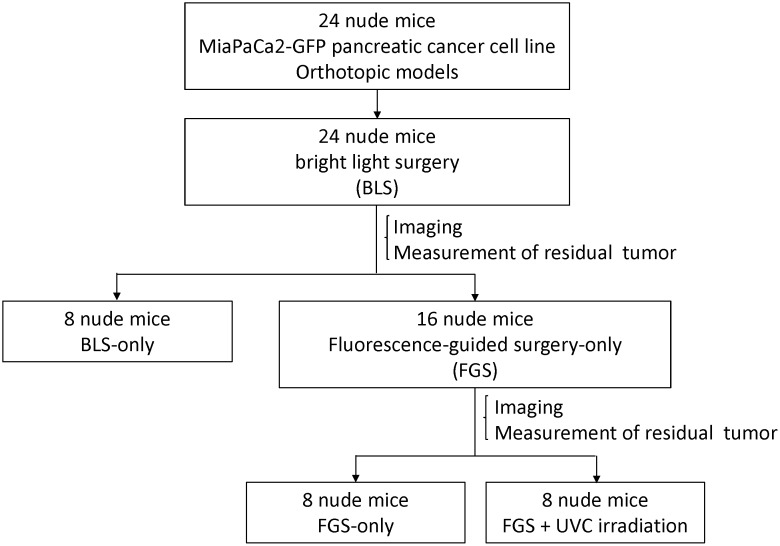
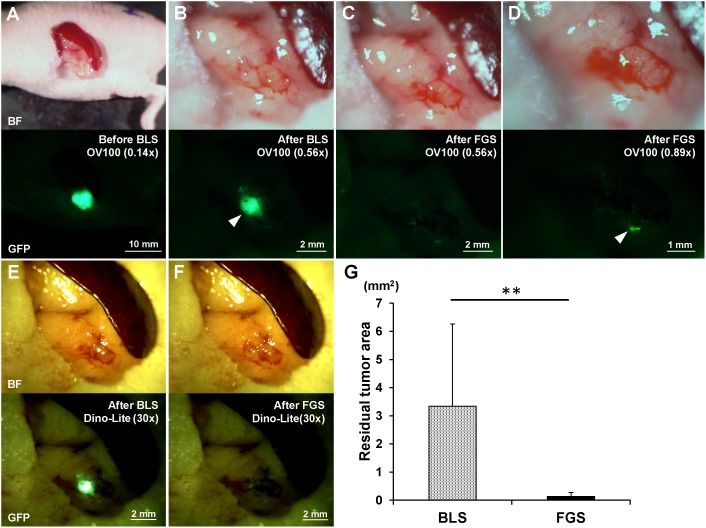
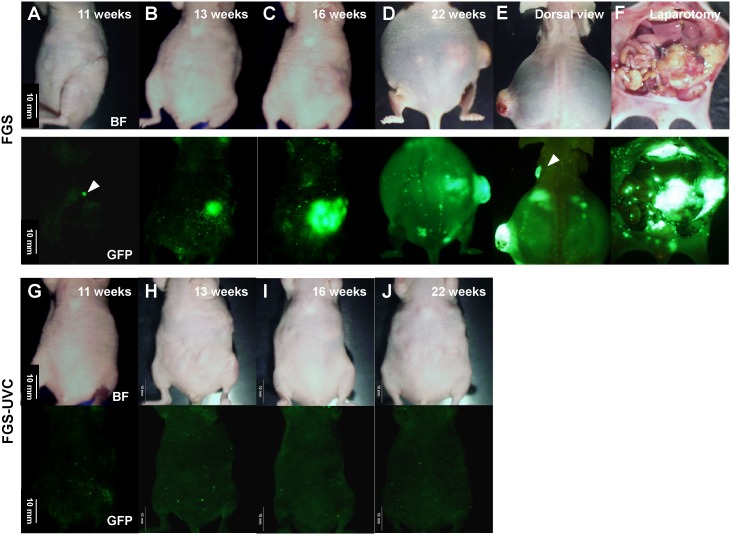
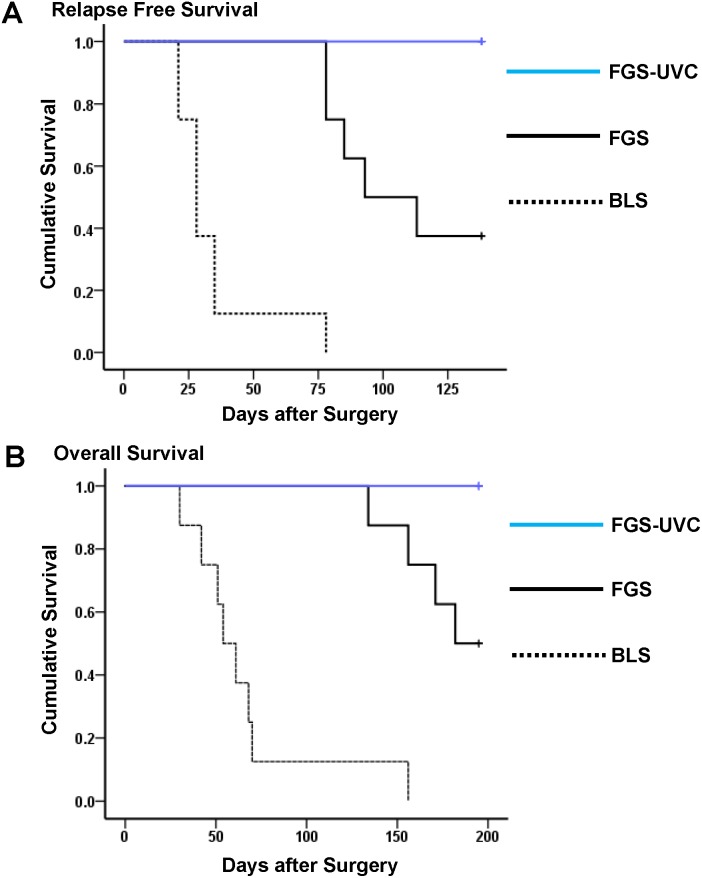
The aim of this study is to determine if ultraviolet light (UVC) irradiation in combination with fluorescence-guided surgery (FGS) can eradicate metastatic human pancreatic cancer in orthotopic nude-mouse models. Two weeks after orthotopic implantation of human MiaPaCa-2 pancreatic cancer cells, expressing green fluorescent protein (GFP), in nude mice, bright-light surgery (BLS) was performed on all tumor-bearing mice (n = 24). After BLS, mice were randomized into 3 treatment groups; BLS-only (n = 8) or FGS (n = 8) or FGS-UVC (n = 8). The residual tumors were resected using a hand-held portable imaging system under fluorescence navigation in mice treated with FGS and FGS-UVC. The surgical resection bed was irradiated with 2700 J/m2 UVC (254 nm) in the mice treated with FGS-UVC. The average residual tumor area after FGS (n = 16) was significantly smaller than after BLS only (n = 24) (0.135±0.137 mm2 and 3.338±2.929 mm2, respectively; p = 0.007). The BLS treated mice had significantly reduced survival compared to FGS- and FGS-UVC-treated mice for both relapse-free survival (RFS) (p<0.001 and p<0.001, respectively) and overall survival (OS) (p<0.001 and p<0.001, respectively). FGS-UVC-treated mice had increased RFS and OS compared to FGS-only treated mice (p = 0.008 and p = 0.025, respectively); with RFS lasting at least 150 days indicating the animals were cured. The results of the present study suggest that UVC irradiation in combination with FGS has clinical potential to increase survival.
本研究的目的是确定紫外线C(UVC)照射联合荧光引导手术(FGS)能否根除原位裸鼠模型中的转移性人胰腺癌。在裸鼠原位植入表达绿色荧光蛋白(GFP)的人MiaPaCa-2胰腺癌细胞两周后,对所有荷瘤小鼠(n = 24)进行强光手术(BLS)。BLS后,将小鼠随机分为3个治疗组;仅BLS组(n = 8)或FGS组(n = 8)或FGS-UVC组(n = 8)。在接受FGS和FGS-UVC治疗的小鼠中,使用手持式便携式成像系统在荧光导航下切除残留肿瘤。在接受FGS-UVC治疗的小鼠中,用2700 J/m2 UVC(254 nm)照射手术切除床。FGS后(n = 16)的平均残留肿瘤面积明显小于仅BLS后(n = 24)(分别为0.135±0.137 mm2和3.338±2.929 mm2;p = 0.007)。对于无复发生存期(RFS)(分别为p<0.001和p<0.001)和总生存期(OS)(分别为p<0.001和p<0.001),BLS治疗的小鼠与FGS和FGS-UVC治疗的小鼠相比,生存期显著缩短。与仅FGS治疗的小鼠相比,FGS-UVC治疗的小鼠RFS和OS增加(分别为p = 0.008和p = 0.025);RFS持续至少150天表明动物已治愈。本研究结果表明,UVC照射联合FGS具有提高生存率的临床潜力。