Freeman Jason A, Bauldry Shawn, Volpe Vanessa V, Shanahan Michael J, Shanahan Lilly
From the Departments of Sociology (Freeman, M.J. Shanahan) and Psychology and Neuroscience (Volpe, L. Shanahan), University of North Carolina at Chapel Hill, Chapel Hill, North Carolina; and University of Alabama at Birmingham (Bauldry), Birmingham, Alabama.
Psychosom Med. 2016 Jun;78(5):542-51. doi: 10.1097/PSY.0000000000000309.
In middle-aged and older samples, perceived subjective socioeconomic status (SSS) is a marker of social rank that is associated with elevated inflammation and cardiovascular disease risk independent of objective indicators of SES (oSES). Whether SSS is uniquely associated with elevated inflammation during young adulthood and whether these linkages differ by sex have not been studied using a nationally representative sample of young adults.
Data came from the National Longitudinal Study of Adolescent to Adult Health. At Wave IV, young adults aged mostly 24 to 32 years reported their SSS, oSES, and a range of covariates of both SES and elevated inflammation. Trained fieldworkers assessed medication use, body mass index, and waist circumference, and also collected bloodspots from which high-sensitivity C-reactive protein (hs-CRP) was assayed. The sample size for the present analyses was n = 13,236.
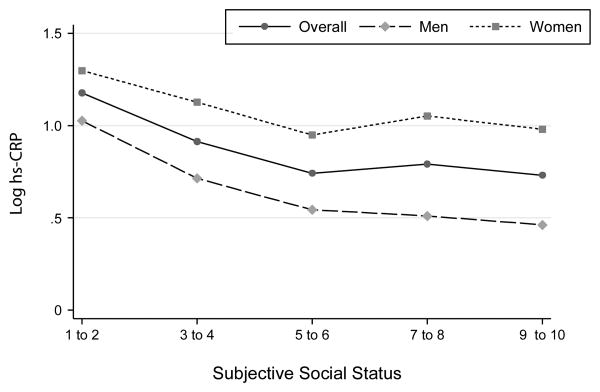
Descriptive and bivariate analyses revealed a graded association between SSS and hs-CRP (b = -0.072, standard error [SE] = 0.011, p < .001): as SSS declined, mean levels of hs-CRP increased. When oSES indicators were taken into account, this association was no longer significant in women (b = -0.013, SE = 0.019, p = .514). In men, a small but significant SSS-hs-CRP association remained after adjusting for oSES indicators and additional potential confounders of this association in the final models (b = -0.034, SE = 0.011 p = .003; p < .001 for the sex by SSS interaction).
SSS is independently associated with elevated inflammation in young adults. The associations were stronger in men than in women. These data suggest that subjective, global assessments of social rank might play a role in developing adverse health outcomes.
在中年及老年样本中,感知到的主观社会经济地位(SSS)是社会阶层的一个标志,它与炎症加剧和心血管疾病风险升高相关,且独立于社会经济地位(SES)的客观指标(oSES)。尚未使用具有全国代表性的年轻成人样本研究SSS是否与青年期炎症加剧存在独特关联,以及这些关联是否因性别而异。
数据来自青少年到成人健康的全国纵向研究。在第四次随访时,大多年龄在24至32岁的年轻成人报告了他们的SSS、oSES以及一系列SES和炎症加剧的协变量。训练有素的现场工作人员评估了药物使用情况、体重指数和腰围,并采集了血斑,用于检测高敏C反应蛋白(hs-CRP)。本次分析的样本量为n = 13236。
描述性和双变量分析显示SSS与hs-CRP之间存在分级关联(b = -0.072,标准误[SE] = 0.011,p <.001):随着SSS下降,hs-CRP的平均水平升高。当考虑oSES指标时,这种关联在女性中不再显著(b = -0.013,SE = 0.019,p =.514)。在男性中,在最终模型中调整oSES指标和该关联的其他潜在混杂因素后,SSS与hs-CRP之间仍存在小但显著的关联(b = -0.034,SE = 0.011,p =.003;SSS与性别的交互作用p <.001)。
SSS与年轻成人炎症加剧独立相关。男性中的关联比女性更强。这些数据表明,对社会阶层的主观、整体评估可能在不良健康结果的发展中起作用。