Lee Joo-Hyun, Sung Yoon-Kyoung, Choi Chan-Bum, Cho Soo-Kyung, Bang So-Young, Choe Jung-Yoon, Hong Seung-Jae, Jun Jae-Bum, Kim Tae-Hwan, Lee Jisoo, Lee Hye-Soon, Yoo Dae-Hyun, Yoon Bo Young, Bae Sang-Cheol
Department of Rheumatology, Inje University Ilsan Paik Hospital, Goyang, Republic of Korea.
Department of Rheumatology, Hanyang University Hospital for Rheumatic Diseases, Seoul, 133-792, Republic of Korea.
BMC Musculoskelet Disord. 2016 Feb 24;17:98. doi: 10.1186/s12891-016-0952-8.
The aim of this study was to investigate the prevalence of osteoporosis in rheumatoid arthritis (RA) patients and to analyze the risk factors in these patients using the KORean Observational study Network for Arthritis (KORONA) database.
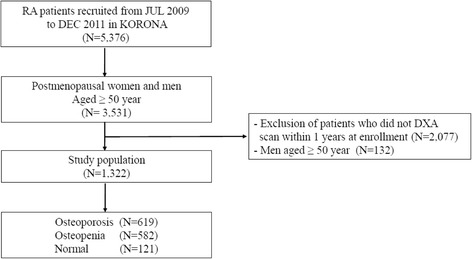
Among the RA patients in the KORONA who were recruited between July 2009 and December 2011, postmenopausal women with bone mineral density (BMD) results within one year from the time of KORONA enrollment were included in this study. The baseline characteristics of patients in three groups, defined by BMD results, were compared. The BMD measurement rates and prevalence of osteoporosis in the study patients were calculated in accordance with age and gender subgroups. Multivariable logistic regression analysis was used to explore the association between osteoporosis and demographics and disease-related risk factors.
Of 1322 postmenopausal woman patients with RA in whom BMD was measured within one year of study enrollment, 619 patients (46.8 %) were in the osteoporosis group (T-score ≤ -2.5 SD). RA patients with osteoporosis had a higher frequency of previous fractures than those in other groups, especially fractures of the femur (p = 0.004) and wrist (p = 0.042). Advanced age (≥70 years; OR = 2.28, 95 % CI: 1.40-3.58), lower body mass index (<25; OR = 2.14, 95 % CI:1.52-3.02), longer disease duration (≥10 years; OR = 1.46, 95 % CI: 1.07-2.00), higher cumulative glucocorticoid dose (OR = 1.03, 95 % CI: 1.01-1.05), and higher Health Assessment Questionnaire score (OR = 1.37, 95 % CI:1.11-1.69) were independent risk factors for osteoporosis.
A large percentage (90.8 %) of RA patients enrolled in the KORONA cohort had osteoporosis and osteopenia. Nevertheless, BMD measurement rates in this population remained low, despite high risk groups of fractures.
本研究旨在通过韩国关节炎观察研究网络(KORONA)数据库调查类风湿关节炎(RA)患者骨质疏松症的患病率,并分析这些患者的危险因素。
在2009年7月至2011年12月招募的KORONA中的RA患者中,纳入在KORONA登记后一年内有骨密度(BMD)结果的绝经后女性。比较根据BMD结果定义的三组患者的基线特征。根据年龄和性别亚组计算研究患者的BMD测量率和骨质疏松症患病率。采用多变量逻辑回归分析探讨骨质疏松症与人口统计学和疾病相关危险因素之间的关联。
在研究入组后一年内测量了BMD的1322例绝经后RA女性患者中,619例患者(46.8%)属于骨质疏松组(T值≤-2.5标准差)。患有骨质疏松症的RA患者既往骨折的发生率高于其他组,尤其是股骨骨折(p = 0.004)和腕部骨折(p = 0.042)。高龄(≥70岁;OR = 2.28,95%可信区间:1.40 - 3.58)、较低的体重指数(<25;OR = 2.14,95%可信区间:1.52 - 3.02)、较长的病程(≥10年;OR = 1.46,95%可信区间:1.07 - 2.00)、较高的累积糖皮质激素剂量(OR = 1.03,95%可信区间:1.01 - 1.05)和较高的健康评估问卷评分(OR = 1.37,95%可信区间:1.11 - 1.69)是骨质疏松症的独立危险因素。
纳入KORONA队列的RA患者中很大一部分(90.8%)患有骨质疏松症和骨质减少症。然而,尽管该人群骨折风险较高,但BMD测量率仍然较低。