Han Jing, Li Longlong, Wang Dian, Ma Haitian
Key Laboratory of Animal Physiology and Biochemistry, College of Veterinary Medicine, Nanjing Agricultural University, Nanjing, 210095, China.
School of Life Science and Technology, China Pharmaceutical University, Nanjing, 210009, China.
Lipids Health Dis. 2016 Feb 24;15:37. doi: 10.1186/s12944-016-0208-5.
Chicken as a delicious food for a long history, and it is well known that excess fat deposition in broiler chickens will not only induced metabolic diseases, but also lead to adverse effect in the consumer's health. (-)-Hydroxycitric acid (HCA), a major active ingredient of Garcinia Cambogia extracts, had shown to suppress fat accumulation in animals and humans. While, the precise physiological mechanism of HCA has not yet been full clarified, especially its action in broiler chickens. Thus, this study aimed to assess the effect of (-)-HCA on lipid metabolism in broiler chickens.
A total of 120 1-day-old broiler chickens were randomly allocated to four groups, with each group was repeated three times with 10 birds. Birds received a commercial diet supplemented with (-)-HCA at 0, 1000, 2000 or 3000 mg/kg, respectively, for a period of 4 weeks ad libitum.
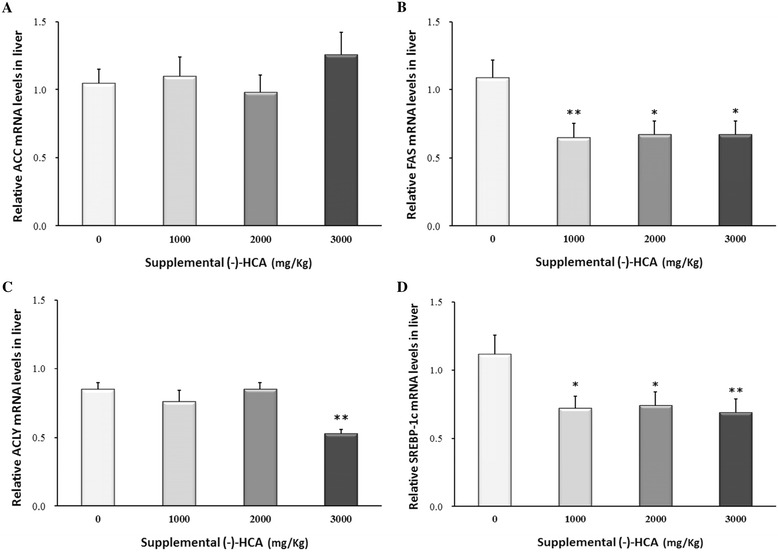
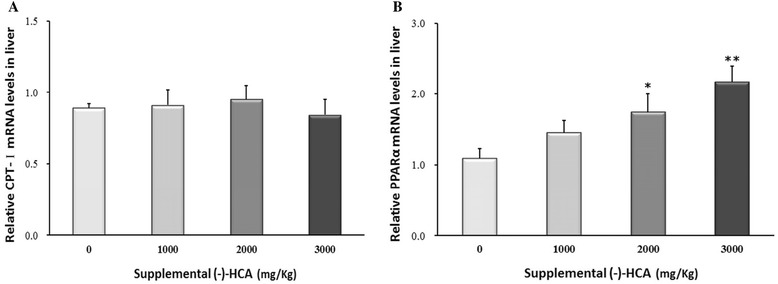
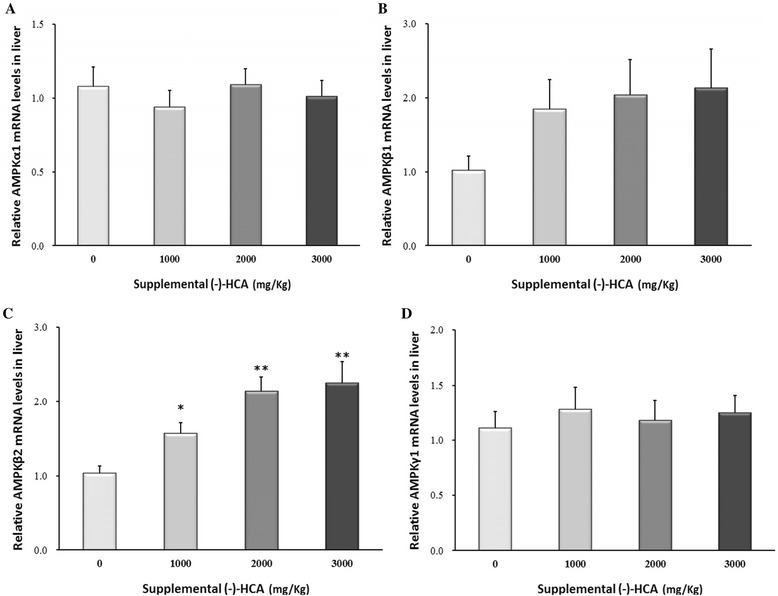
Body weight (BW) in the 2000 and 3000 mg/kg (-)-HCA groups was significantly decreased (P < 0.05) than that in control group. A significantly decreased of serum triglyceride (TG) and density lipoprotein-cholesterol (LDL-C) content were observed in 3000 mg/kg (-)-HCA group (P < 0.05). Broiler chickens supplmented with 2000 and 3000 mg/kg (-)-HCA had pronouncedly higher hepatic lipase (HL) activity, hepatic glycogen and non-esterified fatty acid (NEFA) contents in liver (P < 0.05). Serum free triiodothyronine (FT3) and thyroxin (T4) contents were significantly higher in 3000 mg/kg (-)-HCA group (P < 0.05) compared with the control group. Supplemental (-)-HCA markedly decreased fatty acid synthase (FAS) and sterol regulatory element binding protein-1c (SREBP-1c) (P < 0.05) mRNA levels, while the mRNA abundance of adenosine 5'-monophosphate-activated protein kinaseβ2 (AMPKβ2) (P < 0.05) was significantly increased. In addition, ATP-citrate lyase (ACLY) mRNA level (P < 0.05) was significantly decreased in broiler chickens supplemented with 3000 mg/kg (-)-HCA. No differences was observed on carnitine palmitoyl transferase-I(CPT-I), while peroxisome proliferators-activated receptor α (PPARα) mRNA level (P < 0.05) was significantly increased in broiler chickens supplemented with 2000 and 3000 mg/kg (-)-HCA.
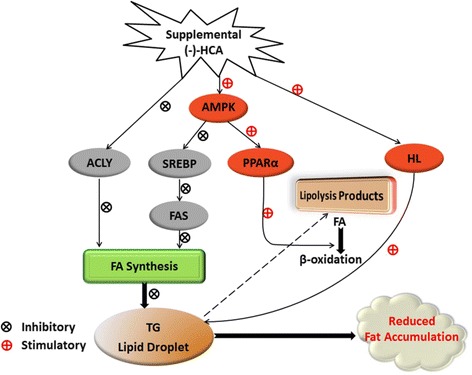
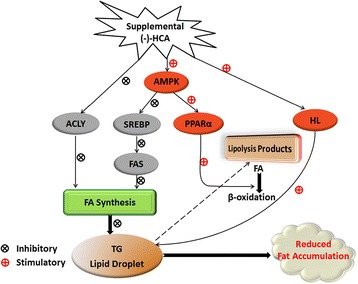
Supplemental (-)-HCA inhibited lipogenesis by inhibiting ACLY, SREBP-1c and FAS expression, and accelerated lipolysis through enhancing HL activity and PPARα expression, which eventually led to the reduced abdominal fat deposition in broiler chickens. Graphical abstract Mechanism of (-)-HCA effect on hepatic lipids metabolism.
鸡肉作为一种美味食品已有很长历史,众所周知,肉鸡体内过多的脂肪沉积不仅会引发代谢性疾病,还会对消费者健康产生不利影响。(-)-羟基柠檬酸(HCA)是藤黄果提取物的主要活性成分,已被证明可抑制动物和人类的脂肪积累。然而,HCA的确切生理机制尚未完全阐明,尤其是其在肉鸡中的作用。因此,本研究旨在评估(-)-HCA对肉鸡脂质代谢的影响。
总共120只1日龄肉鸡被随机分为四组,每组10只,重复三次。分别给鸡自由采食补充了0、1000、2000或3000mg/kg(-)-HCA的商业饲料,持续4周。
2000和3000mg/kg(-)-HCA组的体重(BW)显著低于对照组(P<0.05)。3000mg/kg(-)-HCA组的血清甘油三酯(TG)和低密度脂蛋白胆固醇(LDL-C)含量显著降低(P<0.05)。补充2000和3000mg/kg(-)-HCA的肉鸡肝脏中肝脂酶(HL)活性、肝糖原和非酯化脂肪酸(NEFA)含量明显更高(P<0.05)。与对照组相比,3000mg/kg(-)-HCA组的血清游离三碘甲状腺原氨酸(FT3)和甲状腺素(T4)含量显著更高(P<0.05)。补充(-)-HCA显著降低了脂肪酸合酶(FAS)和固醇调节元件结合蛋白-1c(SREBP-1c)(P<0.05)的mRNA水平,而腺苷5'-单磷酸激活蛋白激酶β2(AMPKβ2)(P<0.05)的mRNA丰度显著增加。此外,补充3000mg/kg(-)-HCA的肉鸡中ATP-柠檬酸裂解酶(ACLY)mRNA水平(P<0.05)显著降低。肉碱棕榈酰转移酶-I(CPT-I)未观察到差异,而补充2000和3000mg/kg(-)-HCA的肉鸡中过氧化物酶体增殖物激活受体α(PPARα)mRNA水平(P<0.05)显著增加。
补充(-)-HCA通过抑制ACLY、SREBP-1c和FAS的表达来抑制脂肪生成,并通过增强HL活性和PPARα表达来加速脂肪分解,最终导致肉鸡腹部脂肪沉积减少。图摘要(-)-HCA对肝脏脂质代谢的作用机制。