Sawhney Neha, Crooks Casey, Chow Virginia, Preston James F, St John Franz J
Department of Microbiology and Cell Science, University of Florida, Gainesville, FL, 32611, USA.
Institute for Microbial and Biochemical Technology, Forest Products Laboratory, USDA Forest Service, Madison, WI, 53726, USA.
BMC Genomics. 2016 Feb 24;17:131. doi: 10.1186/s12864-016-2436-5.
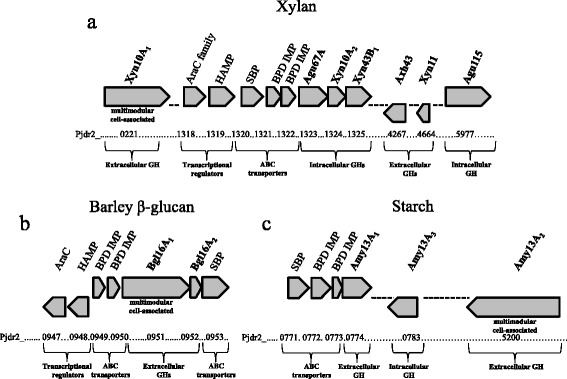
Polysaccharides comprising plant biomass are potential resources for conversion to fuels and chemicals. These polysaccharides include xylans derived from the hemicellulose of hardwoods and grasses, soluble β-glucans from cereals and starch as the primary form of energy storage in plants. Paenibacillus sp. JDR-2 (Pjdr2) has evolved a system for bioprocessing xylans. The central component of this xylan utilization system is a multimodular glycoside hydrolase family 10 (GH10) endoxylanase with carbohydrate binding modules (CBM) for binding xylans and surface layer homology (SLH) domains for cell surface anchoring. These attributes allow efficient utilization of xylans by generating oligosaccharides proximal to the cell surface for rapid assimilation. Coordinate expression of genes in response to growth on xylans has identified regulons contributing to depolymerization, importation of oligosaccharides and intracellular processing to generate xylose as well as arabinose and methylglucuronate. The genome of Pjdr2 encodes several other putative surface anchored multimodular enzymes including those for utilization of β-1,3/1,4 mixed linkage soluble glucan and starch.
To further define polysaccharide utilization systems in Pjdr2, its transcriptome has been determined by RNA sequencing following growth on barley-derived soluble β-glucan, starch, cellobiose, maltose, glucose, xylose and arabinose. The putative function of genes encoding transcriptional regulators, ABC transporters, and glycoside hydrolases belonging to the corresponding substrate responsive regulon were deduced by their coordinate expression and locations in the genome. These results are compared to observations from the previously defined xylan utilization systems in Pjdr2. The findings from this study show that Pjdr2 efficiently utilizes these glucans in a manner similar to xylans. From transcriptomic and genomic analyses we infer a common strategy evolved by Pjdr2 for efficient bioprocessing of polysaccharides.
The barley β-glucan and starch utilization systems in Pjdr2 include extracellular glycoside hydrolases bearing CBM and SLH domains for depolymerization of these polysaccharides. Overlapping regulation observed during growth on these polysaccharides suggests they are preferentially utilized in the order of starch before xylan before barley β-glucan. These systems defined in Pjdr2 may serve as a paradigm for developing biocatalysts for efficient bioprocessing of plant biomass to targeted biofuels and chemicals.
构成植物生物质的多糖是转化为燃料和化学品的潜在资源。这些多糖包括源自阔叶树和草类半纤维素的木聚糖、谷物中的可溶性β-葡聚糖以及作为植物主要能量储存形式的淀粉。类芽孢杆菌属的菌株 JDR-2(Pjdr2)已经进化出一套处理木聚糖的系统。该木聚糖利用系统的核心组件是一种多模块糖苷水解酶家族 10(GH10)内切木聚糖酶,它带有用于结合木聚糖的碳水化合物结合模块(CBM)和用于细胞表面锚定的表层同源(SLH)结构域。这些特性使得通过在细胞表面附近生成寡糖以实现快速同化,从而高效利用木聚糖。响应木聚糖生长时基因的协同表达已确定了有助于解聚、寡糖导入以及细胞内加工以生成木糖以及阿拉伯糖和甲基葡萄糖醛酸的调控子。Pjdr2 的基因组编码了其他几种假定的表面锚定多模块酶,包括那些用于利用β-1,3/1,4 混合连接可溶性葡聚糖和淀粉的酶。
为了进一步确定 Pjdr2 中的多糖利用系统,在其以源自大麦的可溶性β-葡聚糖、淀粉、纤维二糖、麦芽糖、葡萄糖、木糖和阿拉伯糖为碳源生长后,通过 RNA 测序确定了其转录组。通过相应底物响应调控子中编码转录调节因子、ABC 转运蛋白和糖苷水解酶的基因的协同表达及其在基因组中的位置,推断出它们的假定功能。将这些结果与先前在 Pjdr2 中定义的木聚糖利用系统的观察结果进行比较。本研究的结果表明,Pjdr2 以类似于木聚糖的方式有效利用这些葡聚糖。从转录组学和基因组分析中,我们推断出 Pjdr2 进化出的一种用于多糖高效生物加工的通用策略。
Pjdr2 中的大麦β-葡聚糖和淀粉利用系统包括带有 CBM 和 SLH 结构域的胞外糖苷水解酶,用于这些多糖的解聚。在这些多糖上生长期间观察到的重叠调控表明,它们按照淀粉优先于木聚糖优先于大麦β-葡聚糖的顺序被优先利用。在 Pjdr2 中定义的这些系统可作为开发用于将植物生物质高效生物加工为目标生物燃料和化学品的生物催化剂的范例。