Thakker Suhani, Verma Subhash C
University of Nevada School of Medicine Reno, NV, USA.
Front Microbiol. 2016 Feb 15;7:151. doi: 10.3389/fmicb.2016.00151. eCollection 2016.
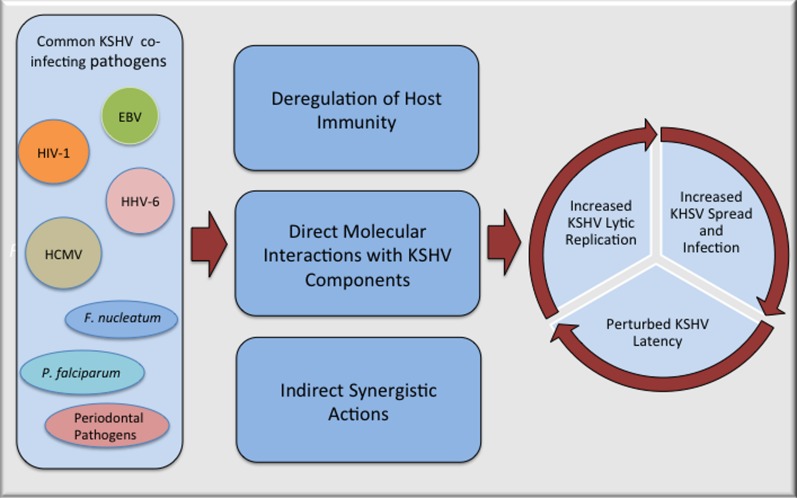
Kaposi's sarcoma-associated herpesvirus (KSHV), also known as human herpes virus 8 (HHV-8) is one of the several carcinogenic viruses that infect humans. KSHV infection has been implicated in the development of Kaposi's sarcoma (KS), primary effusion lymphoma, and multicentric Castleman's Disease. While KSHV infection is necessary for the development of KSHV associated malignancies, it is not sufficient to induce tumorigenesis. Evidently, other co-factors are essential for the progression of KSHV induced malignancies. One of the most important co-factors, necessary for the progression of KSHV induced tumors, is immune suppression that frequently arises during co-infection with HIV and also by other immune suppressants. In this mini-review, we discuss the roles of co-infection with HIV and other pathogens on KSHV infection and pathogenesis.
卡波西肉瘤相关疱疹病毒(KSHV),也称为人类疱疹病毒8型(HHV - 8),是几种感染人类的致癌病毒之一。KSHV感染与卡波西肉瘤(KS)、原发性渗出性淋巴瘤和多中心Castleman病的发生有关。虽然KSHV感染是KSHV相关恶性肿瘤发生所必需的,但它不足以诱导肿瘤发生。显然,其他辅助因素对于KSHV诱导的恶性肿瘤进展至关重要。KSHV诱导的肿瘤进展所必需的最重要辅助因素之一是免疫抑制,这在与HIV共同感染期间以及由其他免疫抑制剂频繁引发。在本综述中,我们讨论了与HIV和其他病原体共同感染对KSHV感染和发病机制的作用。