Jónasson Páll Sigurgeir, Ekström Lars, Hansson Hans-Arne, Sansone Mikael, Karlsson Jón, Swärd Leif, Baranto Adad
SportsMed, Gothenburg, Sweden.
Department of Orthopaedics, Institute of Clinical Sciences at Sahlgrenska Academy, University of Gothenburg, and Sahlgrenska University Hospital, Gothenburg, Sweden.
J Exp Orthop. 2015 Dec;2(1):6. doi: 10.1186/s40634-015-0022-4. Epub 2015 Mar 8.
The repetitive load to which the adolescent athlete's body is exposed during training and competition affects bone growth. In previous studies, abnormalities of the spine and extremities of adolescent athletes have been described on radiographs and this also applies to the hip. The cam deformity of the hip is an extension of the physeal plate and develops during the adolescent athlete's growth. Studies of the porcine spine have shown that the vertebral endplates, apophyseal rings and intervertebral discs are susceptible to both static and repetitive loads. The proximal physeal plate of the porcine femur is susceptible to static loads, but no studies have been performed on its susceptibility to repetitive loads. The purpose of this study was to investigate the susceptibility of the proximal porcine femur to repetitive loads.
Descriptive laboratory study. Seven proximal femurs from four young (5 months) pigs were loaded repetitively (50,000 cycles) using a previously developed model. Three were loaded vertically, three antero-superiorly and one was used as a control. All femurs were examined macroscopically, histologically and with MRI after loading.
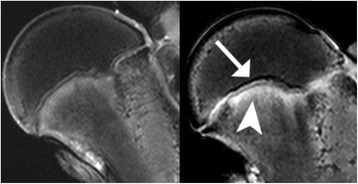
No macroscopic injuries were detected on any of the femurs after loading. Fluid redistribution was seen in all femurs on MRI compared with the unloaded control. Injuries were seen in all loaded femurs on microscopic examination of histological samples. Injuries, perpendicularly to the physeal plate and fractures adjacent to the plate, were seen in the vertically loaded specimens. In the antero-superiorly loaded specimen, the injury in the growth plate was parallel to the plate.
Repeated loading of the young porcine hip leads to histological injuries in and adjacent to the physeal plate. These injuries are likely to cause growth disturbances in the proximal femur. We propose that such injuries may be induced in adolescent athletes and offer a plausible explanation for the development of the cam deformity.
青少年运动员在训练和比赛中身体承受的重复性负荷会影响骨骼生长。在以往研究中,已在X线片上描述了青少年运动员脊柱和四肢的异常情况,这同样适用于髋关节。髋关节的凸轮畸形是骨骺板的一种延伸,在青少年运动员生长过程中形成。对猪脊柱的研究表明,椎体终板、骨骺环和椎间盘易受静态和重复性负荷的影响。猪股骨近端骨骺板易受静态负荷影响,但尚未有关于其对重复性负荷敏感性的研究。本研究的目的是调查猪股骨近端对重复性负荷的敏感性。
描述性实验室研究。使用先前开发的模型对来自4只5个月大幼猪的7个近端股骨进行重复性加载(50,000次循环)。3个垂直加载,3个前上方向加载,1个作为对照。加载后对所有股骨进行宏观、组织学和MRI检查。
加载后所有股骨均未发现宏观损伤。与未加载的对照相比,MRI显示所有股骨均有液体再分布。组织学样本的显微镜检查发现所有加载的股骨均有损伤。垂直加载标本中可见垂直于骨骺板的损伤和靠近骨骺板的骨折。在前上方向加载的标本中,生长板的损伤与骨骺板平行。
幼猪髋关节的重复加载会导致骨骺板及其附近的组织学损伤。这些损伤可能会导致股骨近端生长紊乱。我们认为这种损伤可能在青少年运动员中发生,并为凸轮畸形的发展提供了一个合理的解释。