Choi Byoung Ho, Ro Han, Jung Eul Sik, Kim Ae Jin, Chang Jae Hyun, Lee Hyun Hee, Chung Wookyung, Jung Ji Yong
Division of Nephrology, Department of Internal Medicine, Gachon University of Gil Medical Center, Incheon, Korea.
Gachon University School of Medicine, Incheon, Korea.
PLoS One. 2016 Feb 25;11(2):e0150145. doi: 10.1371/journal.pone.0150145. eCollection 2016.
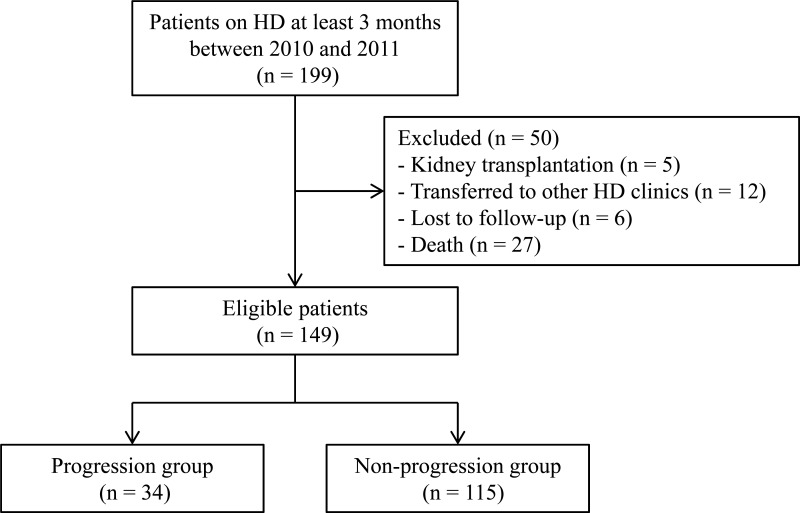
Vascular calcification is an important factor associated with mortality in dialysis patients. Recently, soluble receptor for advanced glycation end product (sRAGE) and extracellular RAGE binding protein S100A12 (EN-RAGE) have been reported to be involved in the process of vascular calcification. Therefore, we investigated whether sRAGE and S100A12 are useful indicators of progression of abdominal aortic calcification in hemodialysis (HD) patients. We analyzed annual changes in vascular calcification score (VCS) for up to 4 years, compared to clinical and biological parameters in 149 HD patients. VCS was assessed annually using plain X-ray images of the lateral lumbar spine. The progression group was defined as patients with an increase in VCS more than 1 point each year on average during the observation period. Time-averaged concentrations were also evaluated to examine the association between biological parameters and changes in VCS. The patients had a mean age of 58.59 ± 12.93 years; 53.7% were male, and 45% were diabetic. The VCS increased in 55 patients; the mean increase was 1.60 ± 2.91 points. In a stepwise multivariate logistic analysis, we found that higher levels of S100A12 were significantly associated with progression of VCS (odds ratio [OR], 2.622; 95% confidence interval [CI], 1.371-5.016; P = 0.004). The relationship between sRAGE and VCS was not statistically significant (OR, 0.644; 95% CI, 0.302-1.374; P = 0.255). Our findings suggest that serum levels of S100A12 are associated with progression of abdominal aortic calcification in HD patients, independent of sRAGE level.
血管钙化是与透析患者死亡率相关的一个重要因素。最近,有报道称晚期糖基化终产物可溶性受体(sRAGE)和细胞外RAGE结合蛋白S100A12(EN-RAGE)参与了血管钙化过程。因此,我们研究了sRAGE和S100A12是否是血液透析(HD)患者腹主动脉钙化进展的有用指标。我们分析了149例HD患者长达4年的血管钙化评分(VCS)年度变化情况,并与临床和生物学参数进行了比较。每年使用腰椎侧位平片评估VCS。进展组定义为在观察期内平均每年VCS增加超过1分的患者。还评估了时间平均浓度,以检查生物学参数与VCS变化之间的关联。患者的平均年龄为58.59±12.93岁;53.7%为男性,45%患有糖尿病。55例患者的VCS增加;平均增加1.60±2.91分。在逐步多因素逻辑分析中,我们发现较高水平的S100A12与VCS进展显著相关(优势比[OR],2.622;95%置信区间[CI],1.371 - 5.016;P = 0.004)。sRAGE与VCS之间的关系无统计学意义(OR,0.644;95%CI,0.302 - 1.374;P = 0.255)。我们的研究结果表明,HD患者血清S100A12水平与腹主动脉钙化进展相关,独立于sRAGE水平。