Araszkiewicz Aleksandra, Zozulinska-Ziolkiewicz Dorota
Department of Internal Medicine and Diabetology, Poznan University of Medical Sciences, Mickiewicza 2, 60-834 Poznan, Poland.
Curr Neuropharmacol. 2016;14(8):805-809. doi: 10.2174/1570159x14666160225154536.
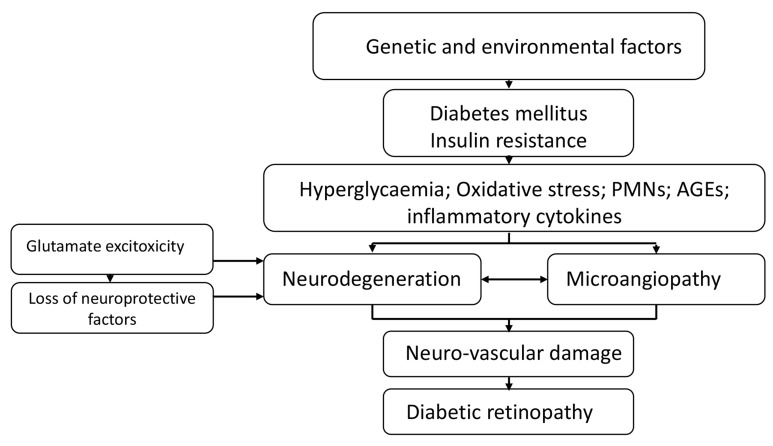
Diabetic retinopathy is generally considered as a microvascular disease which develops as a result of chronic hyperglycaemia. However, the neuronal apoptosis and reactive gliosis are recently postulated as early changes in diabetic retinopathy. This phenomenon is described as a neurodegeneration and suggests that diabetic retinopathy should be recognized as a neurovascular complication. In this review, we discuss the mechanisms leading to the neurodegeneration of the retina in diabetic patients including: low-grade inflammatory process, oxidative stress, activation of polymorphonuclear neutrophils, glutamate excitotoxicity and imbalance in the neuroprotective factors. Secondly, we point out the clinical significance of measuring the retinal neurodegeneration.
糖尿病视网膜病变通常被认为是一种由于慢性高血糖而发展的微血管疾病。然而,最近有研究推测神经元凋亡和反应性胶质细胞增生是糖尿病视网膜病变的早期变化。这种现象被描述为神经退行性变,提示糖尿病视网膜病变应被视为一种神经血管并发症。在本综述中,我们讨论了导致糖尿病患者视网膜神经退行性变的机制,包括:低度炎症过程、氧化应激、多形核中性粒细胞的激活、谷氨酸兴奋性毒性以及神经保护因子的失衡。其次,我们指出了测量视网膜神经退行性变的临床意义。