Al-Khannaq Maryam Nabiel, Ng Kim Tien, Oong Xiang Yong, Pang Yong Kek, Takebe Yutaka, Chook Jack Bee, Hanafi Nik Sherina, Kamarulzaman Adeeba, Tee Kok Keng
Department of Medicine, Faculty of Medicine, University of Malaya, Kuala Lumpur, Malaysia.
AIDS Research Center, National Institute of Infectious Diseases, Toyama, Shinjuku-ku, Tokyo, Japan.
Virol J. 2016 Feb 25;13:33. doi: 10.1186/s12985-016-0488-4.
Despite the worldwide circulation of human coronavirus OC43 (HCoV-OC43) and HKU1 (HCoV-HKU1), data on their molecular epidemiology and evolutionary dynamics in the tropical Southeast Asia region is lacking.
The study aimed to investigate the genetic diversity, temporal distribution, population history and clinical symptoms of betacoronavirus infections in Kuala Lumpur, Malaysia between 2012 and 2013. A total of 2,060 adults presented with acute respiratory symptoms were screened for the presence of betacoronaviruses using multiplex PCR. The spike glycoprotein, nucleocapsid and 1a genes were sequenced for phylogenetic reconstruction and Bayesian coalescent inference.
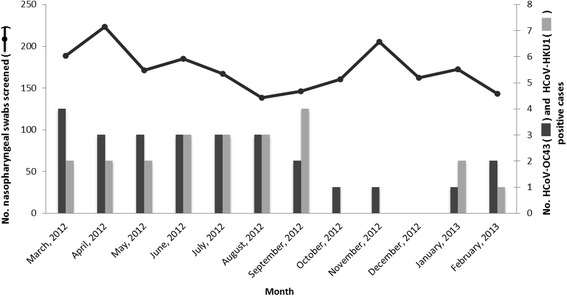
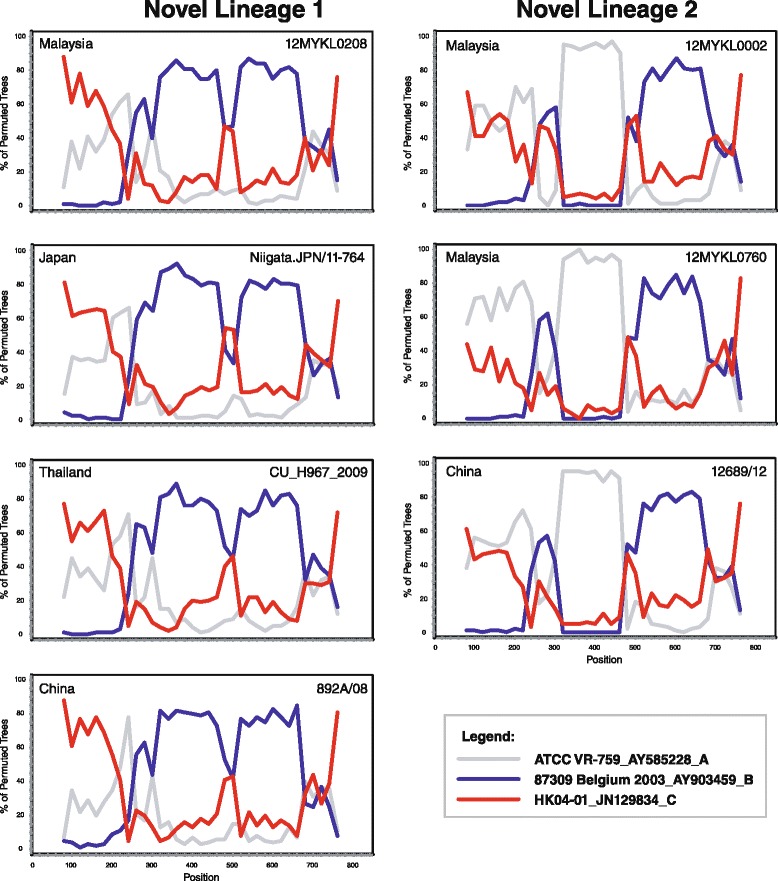
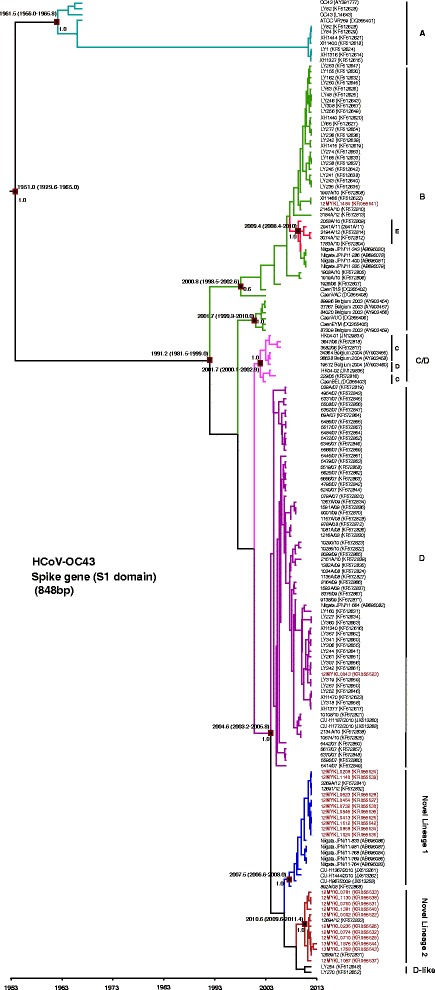
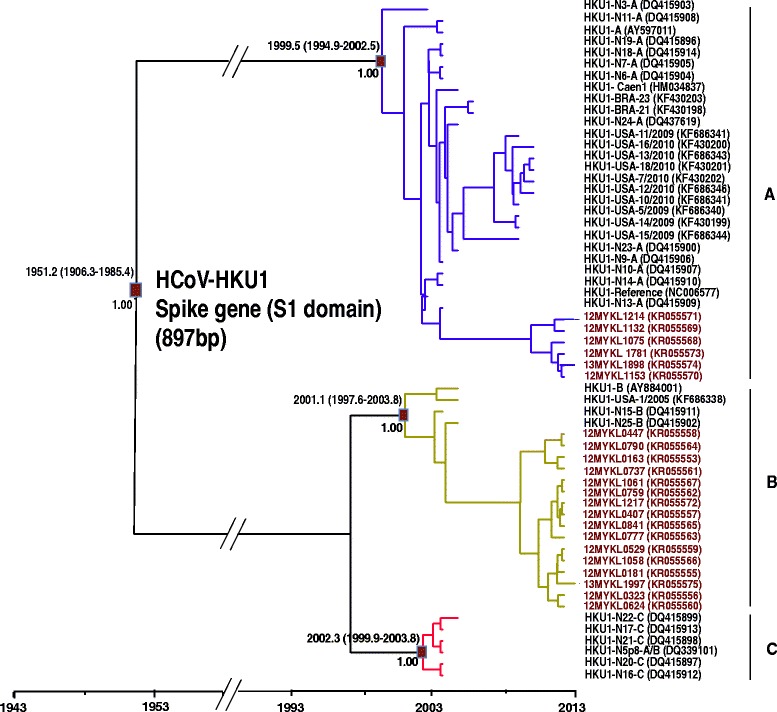
A total of 48/2060 (2.4 %) specimens were tested positive for HCoV-OC43 (1.3 %) and HCoV-HKU1 (1.1 %). Both HCoV-OC43 and HCoV-HKU1 were co-circulating throughout the year, with the lowest detection rates reported in the October-January period. Phylogenetic analysis of the spike gene showed that the majority of HCoV-OC43 isolates were grouped into two previously undefined genotypes, provisionally assigned as novel lineage 1 and novel lineage 2. Sign of natural recombination was observed in these potentially novel lineages. Location mapping showed that the novel lineage 1 is currently circulating in Malaysia, Thailand, Japan and China, while novel lineage 2 can be found in Malaysia and China. Molecular dating showed the origin of HCoV-OC43 around late 1950s, before it diverged into genotypes A (1960s), B (1990s), and other genotypes (2000s). Phylogenetic analysis revealed that 27.3 % of the HCoV-HKU1 strains belong to genotype A while 72.7 % belongs to genotype B. The tree root of HCoV-HKU1 was similar to that of HCoV-OC43, with the tMRCA of genotypes A and B estimated around the 1990s and 2000s, respectively. Correlation of HCoV-OC43 and HCoV-HKU1 with the severity of respiratory symptoms was not observed.
The present study reported the molecular complexity and evolutionary dynamics of human betacoronaviruses among adults with acute respiratory symptoms in a tropical country. Two novel HCoV-OC43 genetic lineages were identified, warranting further investigation on their genotypic and phenotypic characteristics.
尽管人冠状病毒OC43(HCoV-OC43)和HKU1(HCoV-HKU1)在全球范围内传播,但热带东南亚地区关于它们的分子流行病学和进化动力学的数据却很缺乏。
本研究旨在调查2012年至2013年期间马来西亚吉隆坡β冠状病毒感染的遗传多样性、时间分布、种群历史和临床症状。对总共2060名出现急性呼吸道症状的成年人使用多重PCR筛查β冠状病毒的存在情况。对刺突糖蛋白、核衣壳和1a基因进行测序,用于系统发育重建和贝叶斯合并推断。
总共48/2060(2.4%)份标本检测出HCoV-OC43(1.3%)和HCoV-HKU1(1.1%)呈阳性。HCoV-OC43和HCoV-HKU1全年都在共同传播,10月至1月期间检测率最低。刺突基因的系统发育分析表明,大多数HCoV-OC43分离株被归为两个先前未定义的基因型,暂定为新谱系1和新谱系2。在这些潜在的新谱系中观察到自然重组的迹象。地理位置映射显示,新谱系1目前在马来西亚、泰国、日本和中国传播,而新谱系2在马来西亚和中国发现。分子年代测定显示HCoV-OC43起源于20世纪50年代末,之后分化为基因型A(20世纪60年代)、B(20世纪90年代)和其他基因型(21世纪初)。系统发育分析显示,27.3%的HCoV-HKU1菌株属于基因型A,72.7%属于基因型B。HCoV-HKU1的树根与HCoV-OC43相似,基因型A和B的最近共同祖先时间分别估计在20世纪90年代和21世纪初。未观察到HCoV-OC43和HCoV-HKU1与呼吸道症状严重程度之间的相关性。
本研究报告了热带国家急性呼吸道症状成年人中人类β冠状病毒的分子复杂性和进化动力学。鉴定出两个新的HCoV-OC43遗传谱系,需要对其基因型和表型特征进行进一步研究。