Pitt Jonathan M, Blankley Simon, Potempa Krzysztof, Graham Christine M, Moreira-Teixeira Lucia, McNab Finlay W, Howes Ashleigh, Stavropoulos Evangelos, Pascual Virginia, Banchereau Jacques, Chaussabel Damien, O'Garra Anne
Laboratory of Immunoregulation and Infection, The Francis Crick Institute, Mill Hill Laboratory, London, United Kingdom.
Baylor Institute for Immunology Research/ANRS Center for Human Vaccines, INSERM, Dallas, Texas, United States of America.
PLoS One. 2016 Feb 26;11(2):e0150251. doi: 10.1371/journal.pone.0150251. eCollection 2016.
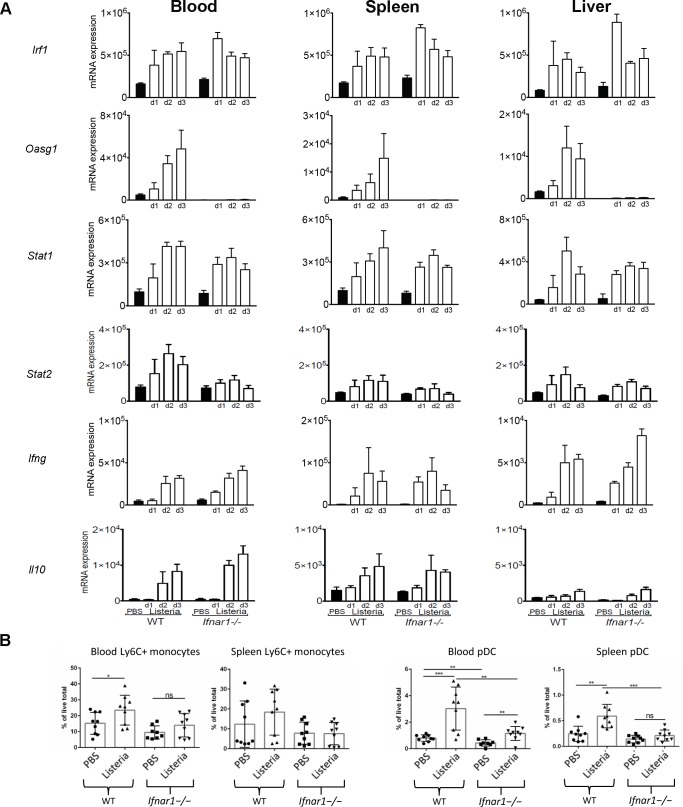
Analysis of the mouse transcriptional response to Listeria monocytogenes infection reveals that a large set of genes are perturbed in both blood and tissue and that these transcriptional responses are enriched for pathways of the immune response. Further we identified enrichment for both type I and type II interferon (IFN) signaling molecules in the blood and tissues upon infection. Since type I IFN signaling has been reported widely to impair bacterial clearance we examined gene expression from blood and tissues of wild type (WT) and type I IFNαβ receptor-deficient (Ifnar1-/-) mice at the basal level and upon infection with L. monocytogenes. Measurement of the fold change response upon infection in the absence of type I IFN signaling demonstrated an upregulation of specific genes at day 1 post infection. A less marked reduction of the global gene expression signature in blood or tissues from infected Ifnar1-/- as compared to WT mice was observed at days 2 and 3 after infection, with marked reduction in key genes such as Oasg1 and Stat2. Moreover, on in depth analysis, changes in gene expression in uninfected mice of key IFN regulatory genes including Irf9, Irf7, Stat1 and others were identified, and although induced by an equivalent degree upon infection this resulted in significantly lower final gene expression levels upon infection of Ifnar1-/- mice. These data highlight how dysregulation of this network in the steady state and temporally upon infection may determine the outcome of this bacterial infection and how basal levels of type I IFN-inducible genes may perturb an optimal host immune response to control intracellular bacterial infections such as L. monocytogenes.
对小鼠单核细胞增生李斯特菌感染转录反应的分析表明,大量基因在血液和组织中均受到干扰,且这些转录反应在免疫反应途径中富集。此外,我们发现感染后血液和组织中I型和II型干扰素(IFN)信号分子均有富集。由于广泛报道I型IFN信号会损害细菌清除,我们检测了野生型(WT)和I型IFNαβ受体缺陷型(Ifnar1-/-)小鼠在基础水平以及感染单核细胞增生李斯特菌后的血液和组织中的基因表达。在没有I型IFN信号的情况下,测量感染后的倍数变化反应表明,感染后第1天特定基因上调。在感染后第2天和第3天,与WT小鼠相比,感染的Ifnar1-/-小鼠血液或组织中的整体基因表达特征下降不太明显,关键基因如Oasg1和Stat2明显减少。此外,深入分析发现,未感染小鼠中关键IFN调节基因(包括Irf9、Irf7、Stat1等)的基因表达发生了变化,尽管感染时诱导程度相同,但这导致Ifnar1-/-小鼠感染后最终基因表达水平显著降低。这些数据突出了该网络在稳态和感染时的失调如何可能决定这种细菌感染的结果,以及I型IFN诱导基因的基础水平如何可能干扰宿主对控制细胞内细菌感染(如单核细胞增生李斯特菌)的最佳免疫反应。