Bian Minjuan, Du Xiaoye, Cui Jingang, Wang Peiwei, Wang Wenjian, Zhu Weiliang, Zhang Teng, Chen Yu
Clinical Research Institute of Integrative Medicine, Shanghai University of Traditional Chinese Medicine, Shanghai, 200437, China.
Yueyang Hospital, Shanghai University of Traditional Chinese Medicine, 110 Ganhe Rd, Shanghai, 200437, China.
J Neuroinflammation. 2016 Feb 27;13:50. doi: 10.1186/s12974-016-0516-8.
Photoreceptor death leads to vision impairment in several retinal degenerative disorders. Therapies protecting photoreceptor from degeneration remain to be developed. Anti-inflammation, anti-oxidative stress, and neuroprotective effects of celastrol have been demonstrated in a variety of disease models. The current study aimed to investigate the photoreceptor protective effect of celastrol.
Bright light-induced retinal degeneration in BALB/c mice was used, and morphological, functional, and molecular changes of retina were evaluated in the absence and presence of celastrol treatment.
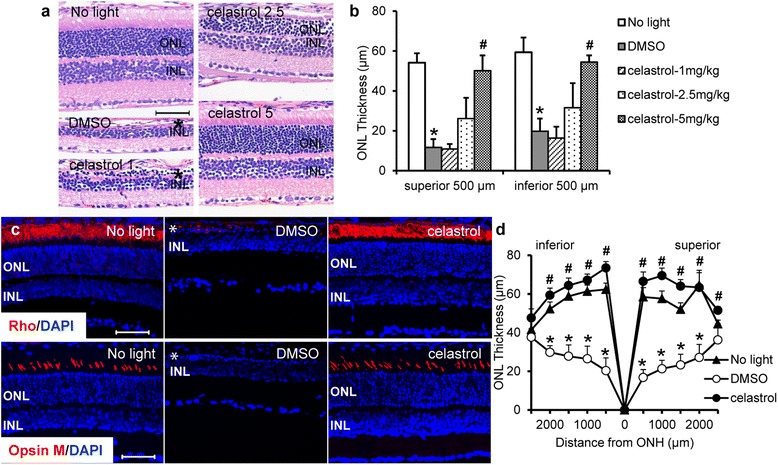
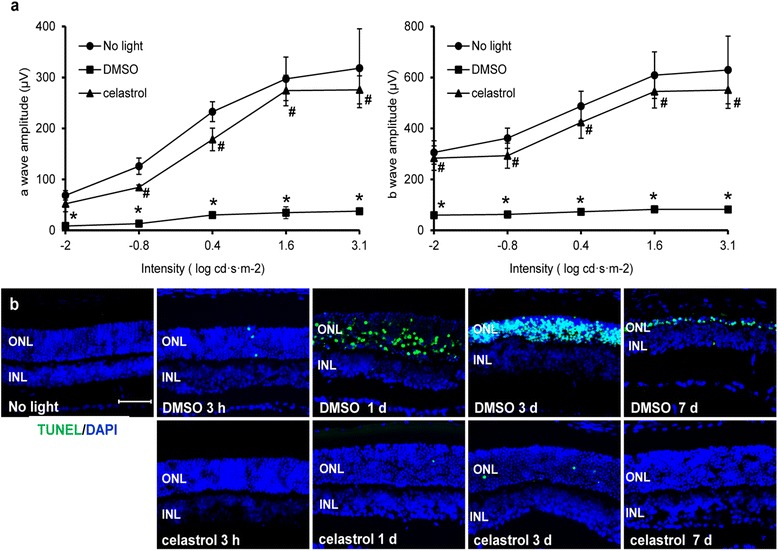
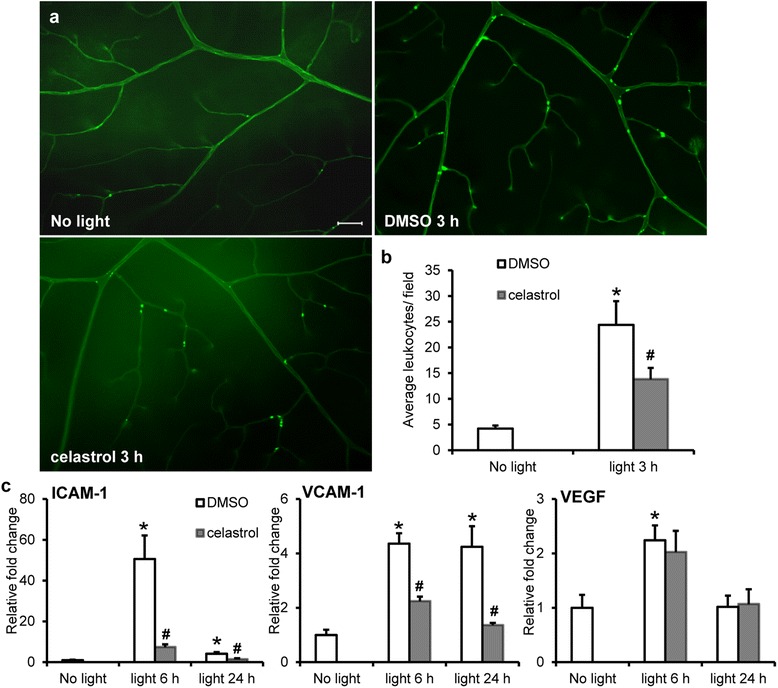
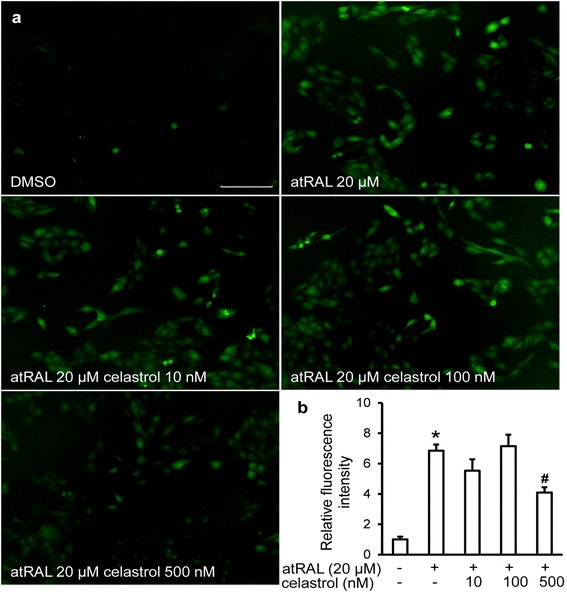
Significant morphological and functional protection was observed as a result of celastrol treatment in bright light-exposed BALB/c mice. Celastrol treatment resulted in suppression of cell death in photoreceptor cells, alleviation of oxidative stress in the retinal pigment epithelium and photoreceptors, downregulation of retinal expression of proinflammatory genes, and suppression of microglia activation and gliosis in the retina. Additionally, leukostasis was found to be induced in the retinal vasculature in light-exposed BALB/c mice, which was significantly attenuated by celastrol treatment. In vitro, celastrol attenuated all-trans-retinal-induced oxidative stress in cultured APRE19 cells. Moreover, celastrol treatment significantly suppressed lipopolysaccharides-stimulated expression of proinflammatory genes in both APRE19 and RAW264.7 cells.
The results demonstrated for the first time that celastrol prevents against light-induced retinal degeneration through inhibition of retinal oxidative stress and inflammation.
在几种视网膜退行性疾病中,光感受器死亡会导致视力损害。保护光感受器免于退变的疗法仍有待开发。在多种疾病模型中已证实雷公藤红素具有抗炎、抗氧化应激和神经保护作用。本研究旨在探讨雷公藤红素对光感受器的保护作用。
利用BALB/c小鼠的强光诱导视网膜退变模型,在有或无雷公藤红素治疗的情况下,评估视网膜的形态、功能和分子变化。
在暴露于强光的BALB/c小鼠中,雷公藤红素治疗可观察到显著的形态和功能保护作用。雷公藤红素治疗导致光感受器细胞死亡受到抑制,视网膜色素上皮和光感受器中的氧化应激减轻,视网膜促炎基因表达下调,视网膜中小胶质细胞活化和胶质增生受到抑制。此外,发现暴露于强光的BALB/c小鼠视网膜血管中诱导了白细胞停滞,而雷公藤红素治疗可显著减轻这种停滞。在体外,雷公藤红素减轻了全反式视黄醛诱导的培养APRE19细胞中的氧化应激。此外,雷公藤红素治疗显著抑制了脂多糖刺激的APRE19细胞和RAW264.7细胞中促炎基因的表达。
结果首次证明雷公藤红素通过抑制视网膜氧化应激和炎症来预防光诱导的视网膜退变。