Davison Angus, McDowell Gary S, Holden Jennifer M, Johnson Harriet F, Koutsovoulos Georgios D, Liu M Maureen, Hulpiau Paco, Van Roy Frans, Wade Christopher M, Banerjee Ruby, Yang Fengtang, Chiba Satoshi, Davey John W, Jackson Daniel J, Levin Michael, Blaxter Mark L
School of Life Sciences, University of Nottingham, Nottingham NG7 2RD, UK.
Center for Regenerative and Developmental Biology, and Department of Biology, Tufts University, Medford, MA 02155, USA.
Curr Biol. 2016 Mar 7;26(5):654-60. doi: 10.1016/j.cub.2015.12.071. Epub 2016 Feb 25.
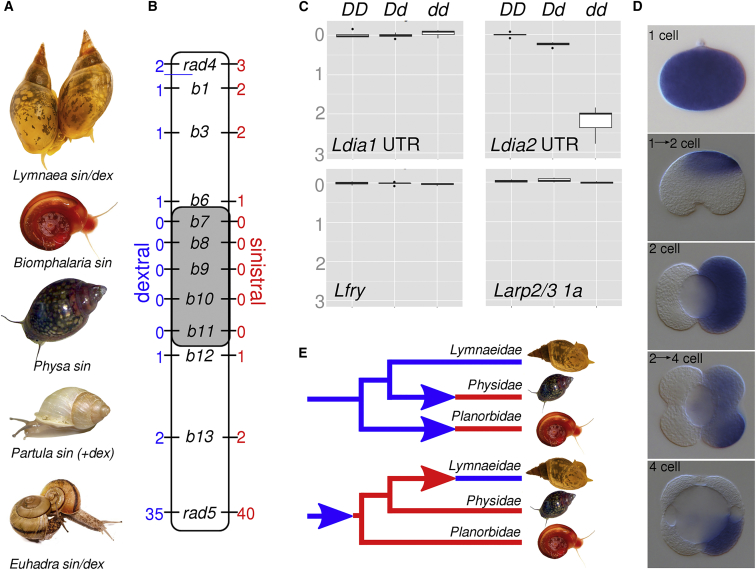
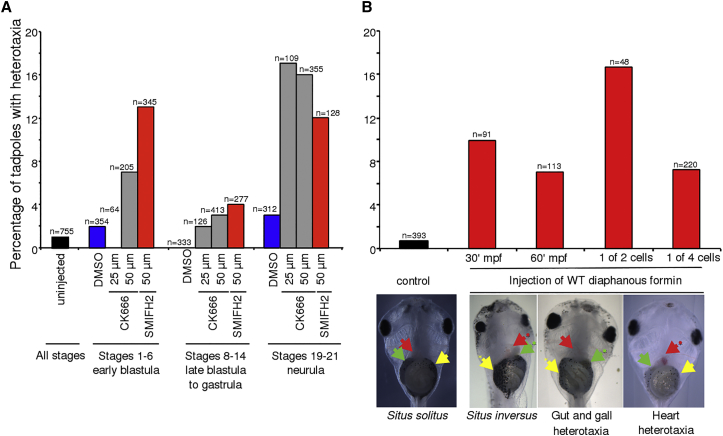
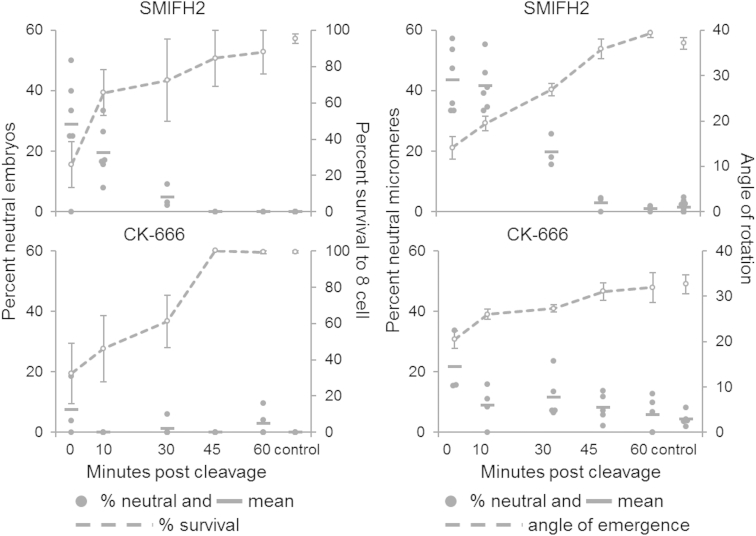
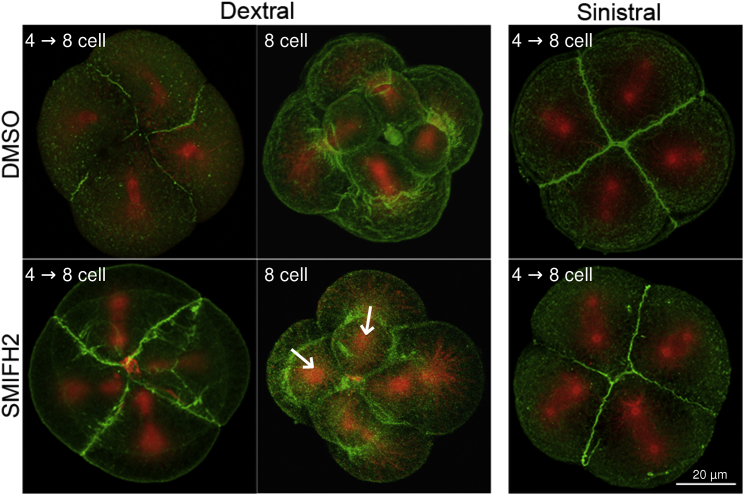
While components of the pathway that establishes left-right asymmetry have been identified in diverse animals, from vertebrates to flies, it is striking that the genes involved in the first symmetry-breaking step remain wholly unknown in the most obviously chiral animals, the gastropod snails. Previously, research on snails was used to show that left-right signaling of Nodal, downstream of symmetry breaking, may be an ancestral feature of the Bilateria [1 and 2]. Here, we report that a disabling mutation in one copy of a tandemly duplicated, diaphanous-related formin is perfectly associated with symmetry breaking in the pond snail. This is supported by the observation that an anti-formin drug treatment converts dextral snail embryos to a sinistral phenocopy, and in frogs, drug inhibition or overexpression by microinjection of formin has a chirality-randomizing effect in early (pre-cilia) embryos. Contrary to expectations based on existing models [3, 4 and 5], we discovered asymmetric gene expression in 2- and 4-cell snail embryos, preceding morphological asymmetry. As the formin-actin filament has been shown to be part of an asymmetry-breaking switch in vitro [6 and 7], together these results are consistent with the view that animals with diverse body plans may derive their asymmetries from the same intracellular chiral elements [8].
虽然从脊椎动物到果蝇等多种动物中都已鉴定出建立左右不对称性的信号通路的组成部分,但令人惊讶的是,在最明显具有手性的动物——腹足纲蜗牛中,参与第一步对称性打破的基因仍然完全未知。此前,对蜗牛的研究表明,在对称性打破之后,Nodal的左右信号传导可能是两侧对称动物的一个祖先特征[1和2]。在此,我们报告,串联重复的、与透明质酸相关的formin的一个拷贝中的失活突变与池塘蜗牛的对称性打破完全相关。这一发现得到了以下观察结果的支持:抗formin药物处理可将右旋蜗牛胚胎转化为左旋拟表型,并且在青蛙中,通过显微注射formin进行药物抑制或过表达,在早期(纤毛前)胚胎中具有随机化手性的作用。与基于现有模型的预期[3、4和5]相反,我们在2细胞和4细胞蜗牛胚胎中发现了不对称基因表达,早于形态学上的不对称。由于formin-肌动蛋白丝在体外已被证明是对称性打破开关的一部分[6和7],综合这些结果与以下观点一致:具有不同身体结构的动物可能从相同的细胞内手性元件获得其不对称性[8]。