Storzer Lena, Butz Markus, Hirschmann Jan, Abbasi Omid, Gratkowski Maciej, Saupe Dietmar, Schnitzler Alfons, Dalal Sarang S
Institute of Clinical Neuroscience and Medical Psychology, Medical Faculty, Heinrich Heine University Düsseldorf Düsseldorf, Germany.
Institute of Clinical Neuroscience and Medical Psychology, Medical Faculty, Heinrich Heine University DüsseldorfDüsseldorf, Germany; Department of Medical Engineering, Ruhr-University BochumBochum, Germany.
Front Hum Neurosci. 2016 Feb 19;10:61. doi: 10.3389/fnhum.2016.00061. eCollection 2016.
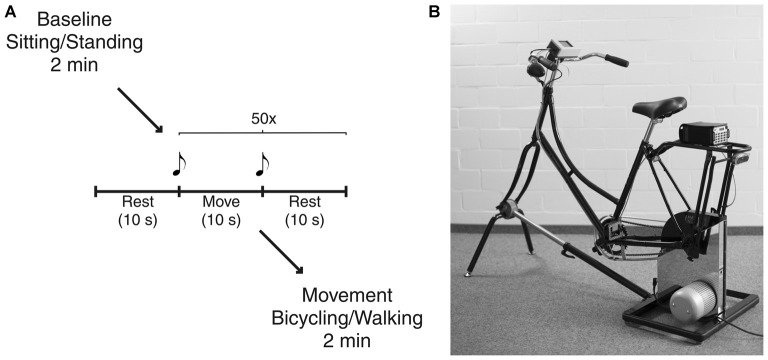
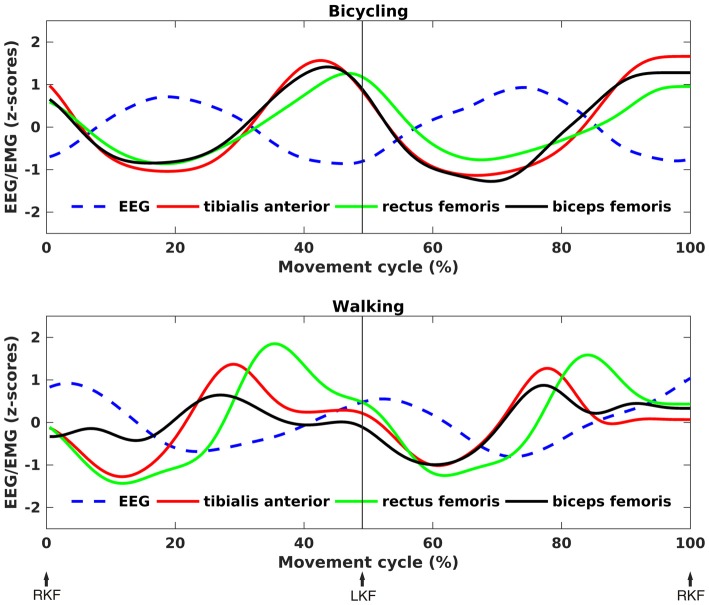
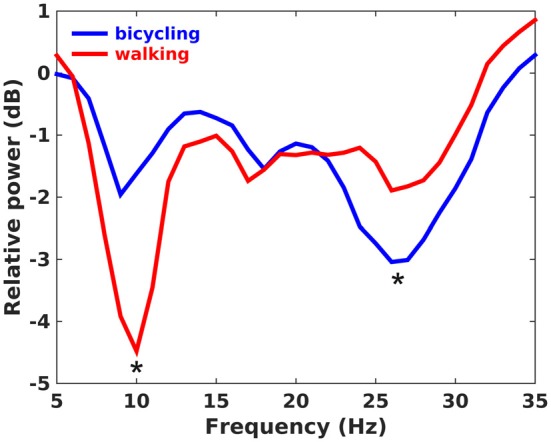
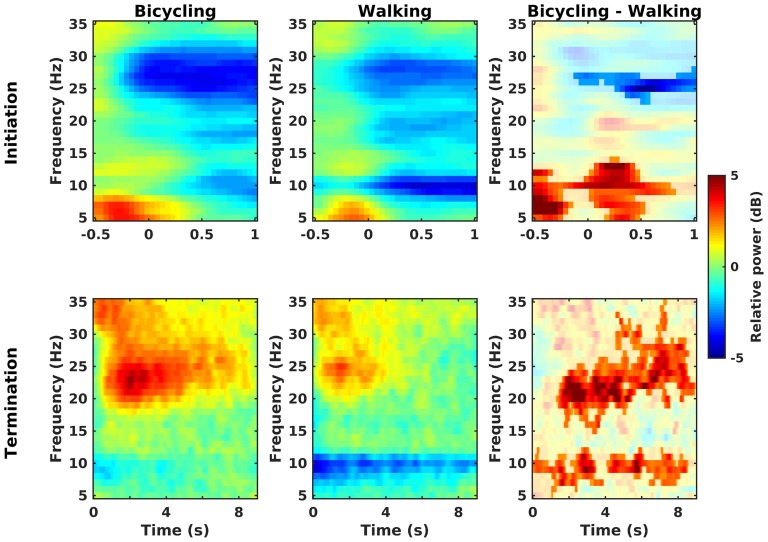
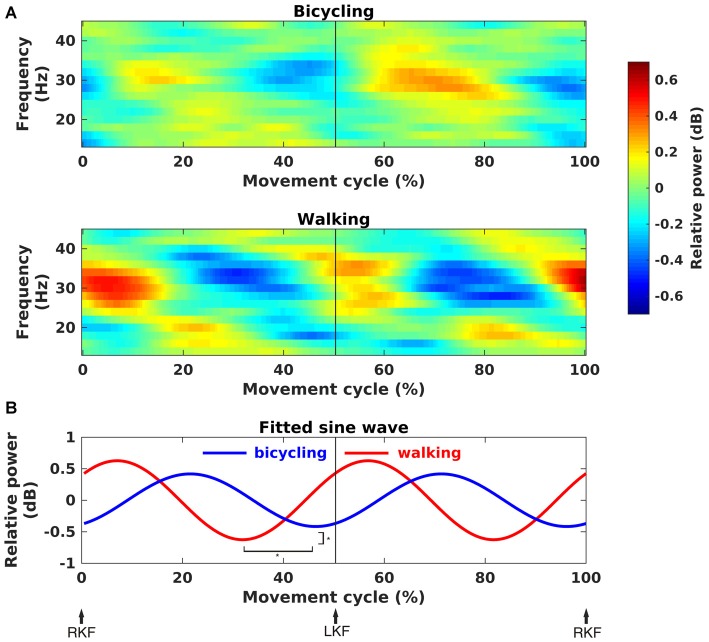
Although bicycling and walking involve similar complex coordinated movements, surprisingly Parkinson's patients with freezing of gait typically remain able to bicycle despite severe difficulties in walking. This observation suggests functional differences in the motor networks subserving bicycling and walking. However, a direct comparison of brain activity related to bicycling and walking has never been performed, neither in healthy participants nor in patients. Such a comparison could potentially help elucidating the cortical involvement in motor control and the mechanisms through which bicycling ability may be preserved in patients with freezing of gait. The aim of this study was to contrast the cortical oscillatory dynamics involved in bicycling and walking in healthy participants. To this end, EEG and EMG data of 14 healthy participants were analyzed, who cycled on a stationary bicycle at a slow cadence of 40 revolutions per minute (rpm) and walked at 40 strides per minute (spm), respectively. Relative to walking, bicycling was associated with a stronger power decrease in the high beta band (23-35 Hz) during movement initiation and execution, followed by a stronger beta power increase after movement termination. Walking, on the other hand, was characterized by a stronger and persisting alpha power (8-12 Hz) decrease. Both bicycling and walking exhibited movement cycle-dependent power modulation in the 24-40 Hz range that was correlated with EMG activity. This modulation was significantly stronger in walking. The present findings reveal differential cortical oscillatory dynamics in motor control for two types of complex coordinated motor behavior, i.e., bicycling and walking. Bicycling was associated with a stronger sustained cortical activation as indicated by the stronger high beta power decrease during movement execution and less cortical motor control within the movement cycle. We speculate this to be due to the more continuous nature of bicycling demanding less phase-dependent sensory processing and motor planning, as opposed to walking.
尽管骑自行车和步行都涉及类似的复杂协调运动,但令人惊讶的是,患有步态冻结的帕金森病患者通常在行走严重困难的情况下仍能骑自行车。这一观察结果表明,支持骑自行车和步行的运动网络存在功能差异。然而,从未在健康参与者或患者中对与骑自行车和步行相关的大脑活动进行过直接比较。这样的比较可能有助于阐明皮层在运动控制中的作用以及在步态冻结患者中骑自行车能力得以保留的机制。本研究的目的是对比健康参与者在骑自行车和步行时的皮层振荡动力学。为此,分析了14名健康参与者的脑电图(EEG)和肌电图(EMG)数据,他们分别以每分钟40转(rpm)的慢节奏在固定自行车上骑行以及以每分钟40步(spm)的速度行走。相对于步行,骑自行车在运动启动和执行过程中与高β频段(23 - 35Hz)更强的功率下降相关,随后在运动终止后β功率有更强的增加。另一方面,步行的特征是α功率(8 - 12Hz)有更强且持续的下降。骑自行车和步行在24 - 40Hz范围内均表现出与运动周期相关的功率调制,且与肌电图活动相关。这种调制在步行中明显更强。本研究结果揭示了两种复杂协调运动行为,即骑自行车和步行,在运动控制方面存在不同的皮层振荡动力学。骑自行车与更强的持续皮层激活相关,表现为运动执行过程中高β功率下降更强以及运动周期内皮层运动控制较少。我们推测这是由于骑自行车具有更连续的性质,与步行相比,对相位依赖的感觉处理和运动规划的需求较少。