Xu Tao, Zong Yuanyuan, Peng Lipan, Kong Shuai, Zhou Mingliang, Zou Jianqiang, Liu Jinglei, Miao Ruizheng, Sun Xichao, Li Leping
Department of Gastrointestinal Surgery, Shandong Provincial Hospital Affiliated to Shandong University, Jinan, Shandong, People's Republic of China.
Department of Pathology, Shandong Provincial Hospital Affiliated to Shandong University, Jinan, Shandong, People's Republic of China.
Onco Targets Ther. 2016 Feb 19;9:815-22. doi: 10.2147/OTT.S98330. eCollection 2016.
Liver metastasis is one of the leading causes of death in colorectal cancer (CRC) patients. The present study aimed to evaluate the value of eIF4E as a prognostic marker of colorectal liver metastasis (CLM) and identify the functional role of eIF4E in CRC metastasis.
The expression level of eIF4E in CRC tissues was analyzed by immunohistochemical staining and Western blot. Expression of eIF4E in CRC cell lines was evaluated by reverse transcription quantitative polymerase chain reaction (RT-qPCR) and Western blot. Cell Counting Kit-8 (CCK-8) and Transwell assays were performed to assess the effects of eIF4E on cell proliferation, migration, and invasion. Western blot was further used to investigate the mechanism of eIF4E in tumor metastasis.
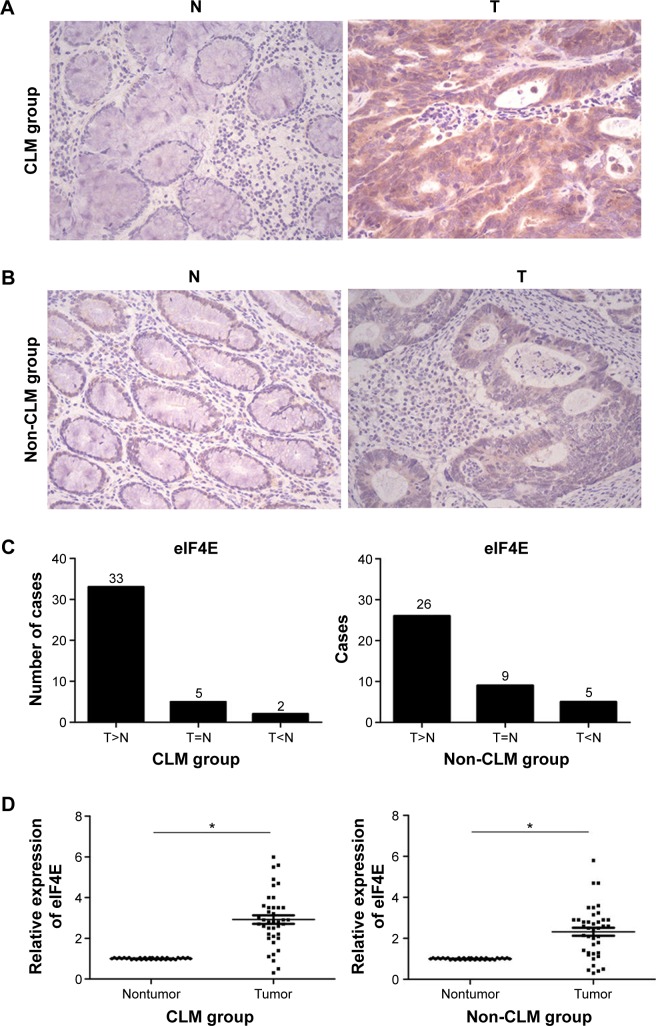
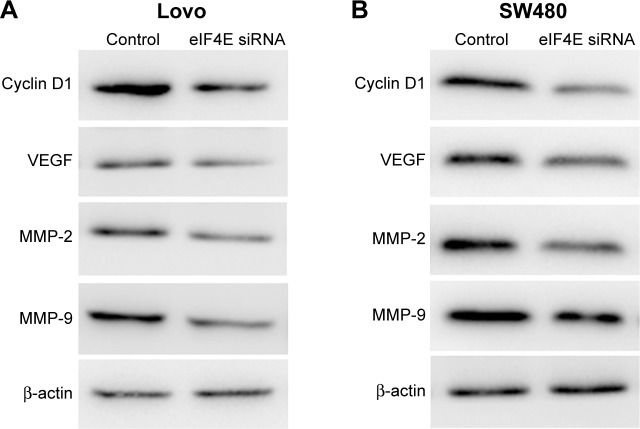
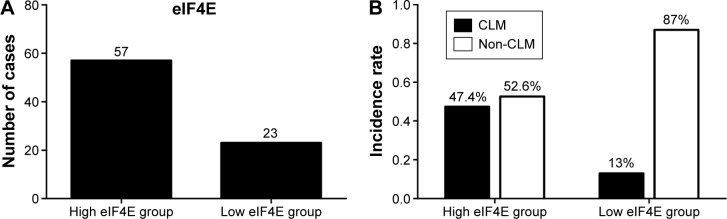
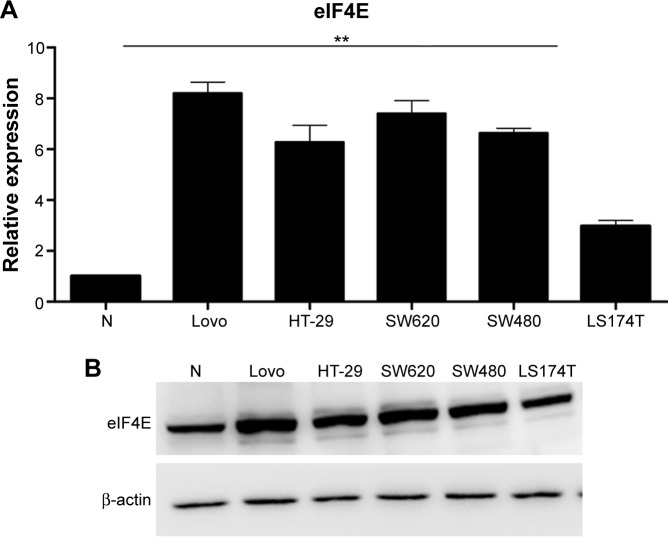
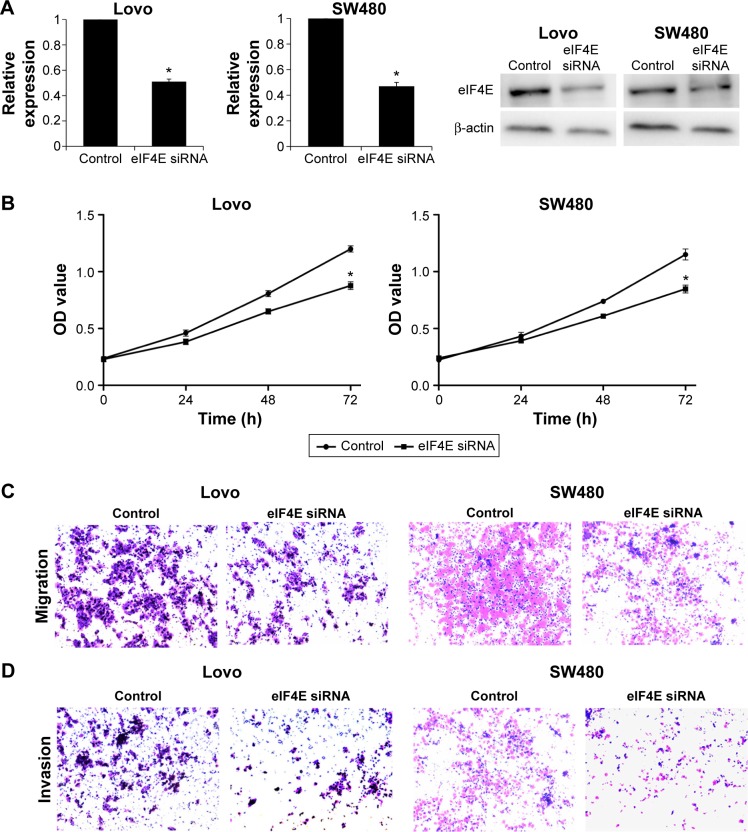
The upregulation frequency of eIF4E in the CLM group (82.5%) was higher than that in the non-CLM group (65.0%). Of the 80 patients recruited for the follow-up study, 23 were in the low eIF4E group (ratio of tumor to nontumor tissue <twofold), and 57 were in the high eIF4E group (ratio of tumor to nontumor tissue ≥twofold). In addition, the group exhibiting high eIF4E expression had a higher rate of liver metastasis (47.4%) than the group exhibiting low eIF4E expression (13.0%). In CRC cell lines, the expression of eIF4E was higher than in the normal cells. In vitro functional studies indicated that eIF4E knockdown inhibited the proliferation, migration, and invasion of Lovo and SW480 cells, and suppressed the expression of cyclin D1, VEGF, MMP-2, and MMP-9.
The results of the present study indicated that high eIF4E levels in CRC patients predicted a high risk of liver metastasis. Knockdown of eIF4E inhibited CRC cell metastasis in part through regulating the expression of cyclin D1, VEGF, MMP-2, and MMP-9.
肝转移是结直肠癌(CRC)患者的主要死亡原因之一。本研究旨在评估真核生物翻译起始因子4E(eIF4E)作为结直肠癌肝转移(CLM)预后标志物的价值,并确定eIF4E在CRC转移中的功能作用。
采用免疫组织化学染色和蛋白质印迹法分析CRC组织中eIF4E的表达水平。通过逆转录定量聚合酶链反应(RT-qPCR)和蛋白质印迹法评估CRC细胞系中eIF4E的表达。进行细胞计数试剂盒-8(CCK-8)和Transwell实验,以评估eIF4E对细胞增殖、迁移和侵袭的影响。进一步采用蛋白质印迹法研究eIF4E在肿瘤转移中的机制。
CLM组中eIF4E的上调频率(82.5%)高于非CLM组(65.0%)。在纳入随访研究的80例患者中,23例为eIF4E低表达组(肿瘤组织与非肿瘤组织的比值<2倍),57例为eIF4E高表达组(肿瘤组织与非肿瘤组织的比值≥2倍)。此外,eIF4E表达高的组肝转移率(47.4%)高于eIF4E表达低的组(13.0%)。在CRC细胞系中,eIF4E的表达高于正常细胞。体外功能研究表明,敲低eIF4E可抑制Lovo和SW480细胞的增殖、迁移和侵袭,并抑制细胞周期蛋白D1、血管内皮生长因子(VEGF)、基质金属蛋白酶-2(MMP-2)和基质金属蛋白酶-9(MMP-9)的表达。
本研究结果表明,CRC患者中eIF4E水平高预示着肝转移风险高。敲低eIF4E部分通过调节细胞周期蛋白D1、VEGF、MMP-2和MMP-9的表达来抑制CRC细胞转移。