Kruk Margaret E, Yamey Gavin, Angell Sonia Y, Beith Alix, Cotlear Daniel, Guanais Frederico, Jacobs Lisa, Saxenian Helen, Victora Cesar, Goosby Eric
Department of Global Health and Population, Harvard T.H. Chan School of Public Health, Boston, Massachusetts, United States of America.
Evidence to Policy Initiative, Global Health Group, University of California San Francisco, San Francisco, California, United States of America.
PLoS Biol. 2016 Mar 2;14(3):e1002360. doi: 10.1371/journal.pbio.1002360. eCollection 2016 Mar.
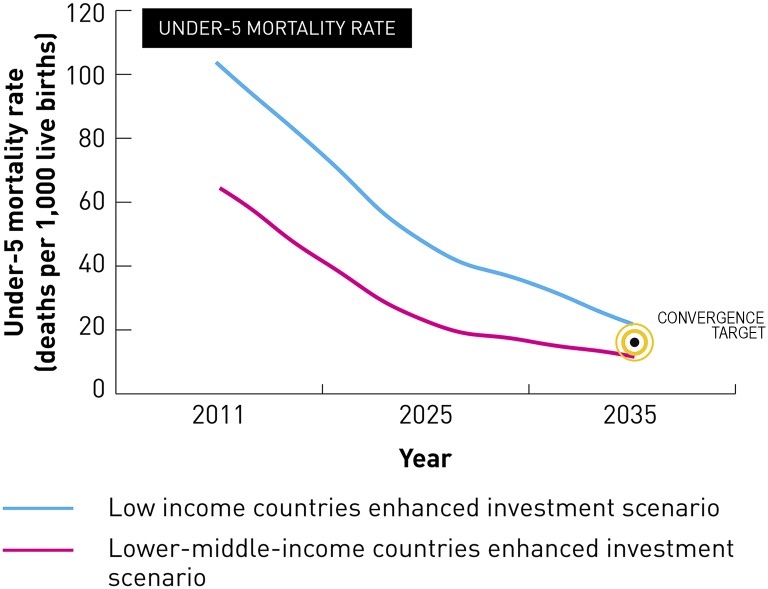
In its report Global Health 2035, the Commission on Investing in Health proposed that health investments can reduce mortality in nearly all low- and middle-income countries to very low levels, thereby averting 10 million deaths per year from 2035 onward. Many of these gains could be achieved through scale-up of existing technologies and health services. A key instrument to close this gap is policy and implementation research (PIR) that aims to produce generalizable evidence on what works to implement successful interventions at scale. Rigorously designed PIR promotes global learning and local accountability. Much greater national and global investments in PIR capacity will be required to enable the scaling of effective approaches and to prevent the recycling of failed ideas. Sample questions for the PIR research agenda include how to close the gap in the delivery of essential services to the poor, which population interventions for non-communicable diseases are most applicable in different contexts, and how to engage non-state actors in equitable provision of health services in the context of universal health coverage.
在其《2035年全球健康》报告中,健康投资委员会提出,健康投资能够将几乎所有低收入和中等收入国家的死亡率降至极低水平,从而从2035年起每年避免1000万人死亡。其中许多成果可通过扩大现有技术和健康服务来实现。缩小这一差距的关键手段是政策与实施研究(PIR),其旨在就如何大规模实施成功干预措施产生可推广的证据。精心设计的PIR促进全球学习和地方问责。为了能够扩大有效方法的应用范围并防止失败理念的反复出现,需要在国家和全球层面大幅增加对PIR能力的投资。PIR研究议程的示例问题包括如何缩小向贫困人口提供基本服务方面的差距、哪些针对非传染性疾病的人群干预措施在不同背景下最为适用,以及如何让非国家行为体在全民健康覆盖的背景下公平地提供健康服务。