Gleim Elizabeth R, Garrison Laurel E, Vello Marianne S, Savage Mason Y, Lopez Gaylord, Berghaus Roy D, Yabsley Michael J
Southeastern Cooperative Wildlife Disease Study, College of Veterinary Medicine, The University of Georgia, 589 D.W. Brooks Dr., Wildlife Health Bldg, Athens, GA, 30602, USA.
Warnell School of Forestry and Natural Resources, The University of Georgia, 180 E. Green St., Athens, GA, 30602, USA.
Parasit Vectors. 2016 Mar 2;9:125. doi: 10.1186/s13071-016-1408-6.
The incidence and emergence of tick-borne diseases has increased dramatically in the United States during the past 30 years, yet few large-scale epidemiological studies have been performed on individuals bitten by ticks. Epidemiological information, including disease development, may provide valuable information regarding effectiveness of tick bite prevention education, pathogen transmission, human-disease dynamics, and potential implications for under reporting of tick-borne diseases.
Ticks found attached to Georgia residents were submitted for identification and polymerase chain reaction (PCR) testing for Francisella tularensis, Ehrlichia, Anaplasma, Borrelia, and Rickettsia spp. Tick bite victims were interviewed three weeks after the tick bite to identify various epidemiologic factors associated with infestation and if signs suggestive of a tick-borne disease had developed. Fisher's exact test of independence was used to evaluate associations between various factors evaluated in the study. A multivariable logistic regression model was used for the prediction of non-specific illness post-tick bite.
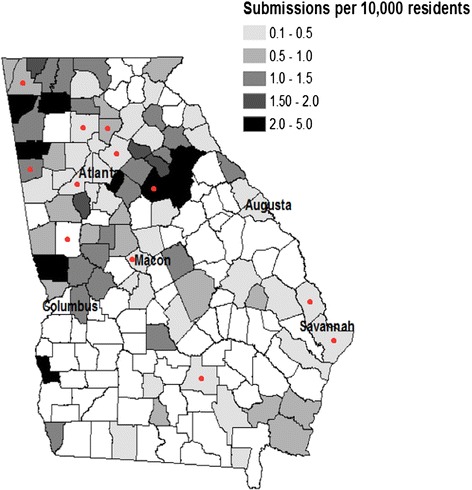
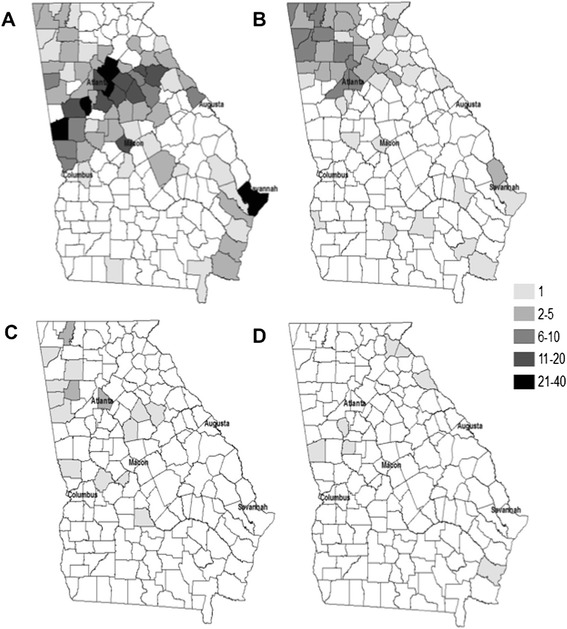
From April 2005-December 2006, 444 participants submitted 597 ticks (426 Amblyomma americanum, 142 Dermacentor variabilis, 19 A. maculatum, 7 Ixodes scapularis, 3 Amblyomma sp.) which originated from 95 counties. Only 25 (34 %) of 74 interviewed individuals purposely took tick bite prevention measures. Ticks that were PCR positive for bacterial organisms were attached to 136 participants. Of the 77 participants who developed non-specific illness, 50 did not have PCR positive ticks, whereas 27 did have PCR positive tick (s). Of those 27 individuals, 12 fit the criteria for a possible tick-borne illness (i.e., tick attached >6 h [if known], ≥4 day incubation period, and the individual exhibited clinical symptoms typical of a tick-borne illness without exhibiting cough, sore throat, or sinus congestion). Ticks from these individuals were positive for R. amblyommii (n = 8), E. ewingii (n = 1), R. montana (n = 1), R. rhiphicephali (n = 1), and Rickettsia sp. TR-39 (n = 1).
Although illnesses reported in this study cannot definitively be connected with tick bites, it does provide insight into development, diagnosis, and treatment of possible tick-borne diseases post-tick bite. The study also provided data on pathogen prevalence, and epidemiologic factors associated with tick bites, as well as tick presence by county in Georgia.
在过去30年里,美国蜱传疾病的发病率和出现频率急剧上升,但针对被蜱虫叮咬个体的大规模流行病学研究却很少。包括疾病发展情况在内的流行病学信息,可能会为蜱虫叮咬预防教育的有效性、病原体传播、人类疾病动态以及蜱传疾病报告不足的潜在影响提供有价值的信息。
提交给佐治亚州居民身上发现的蜱虫,用于鉴定以及针对土拉弗朗西斯菌、埃立克体属、无形体属、疏螺旋体属和立克次体属进行聚合酶链反应(PCR)检测。蜱虫叮咬受害者在被蜱虫叮咬三周后接受访谈,以确定与感染相关的各种流行病学因素,以及是否出现了提示蜱传疾病的体征。采用费舍尔精确独立性检验来评估研究中所评估的各种因素之间的关联。使用多变量逻辑回归模型来预测蜱虫叮咬后的非特异性疾病。
2005年4月至2006年12月期间,444名参与者提交了597只蜱虫(426只美洲钝眼蜱、142只变异革蜱、19只斑点钝眼蜱、7只肩突硬蜱、3只钝眼蜱属),这些蜱虫来自95个县。在接受访谈的74个人中,只有25人(34%)特意采取了蜱虫叮咬预防措施。PCR检测细菌呈阳性的蜱虫附着在136名参与者身上。在出现非特异性疾病的77名参与者中,50人的蜱虫PCR检测为阴性,而27人的蜱虫PCR检测为阳性。在这27个人中,有12人符合可能的蜱传疾病标准(即蜱虫附着时间>6小时[如果已知]、潜伏期≥4天,且个体表现出蜱传疾病的典型临床症状,但未出现咳嗽、喉咙痛或鼻窦充血)。来自这些个体的蜱虫对安氏立克次体(n = 8)、尤因埃立克体(n = 1)、蒙大拿立克次体(n = 1)、头状立克次体(n = 1)和立克次体属TR - 39(n = 1)呈阳性。
尽管本研究中报告的疾病不能明确与蜱虫叮咬相关,但它确实为蜱虫叮咬后可能的蜱传疾病的发展、诊断和治疗提供了见解。该研究还提供了病原体流行率、与蜱虫叮咬相关的流行病学因素以及佐治亚州各县蜱虫存在情况的数据。