Pressacco Federico, Uhlίř Vojtěch, Gatti Matteo, Bendounan Azzedine, Fullerton Eric E, Sirotti Fausto
Synchrotron-SOLEIL, Saint-Aubin, BP 48, F-91192 Gif sur Yvette Cedex, France.
Center for Memory and Recording Research, University of California, San Diego, 9500 Gilman Drive, La Jolla, California 92093-0401, USA.
Sci Rep. 2016 Mar 3;6:22383. doi: 10.1038/srep22383.
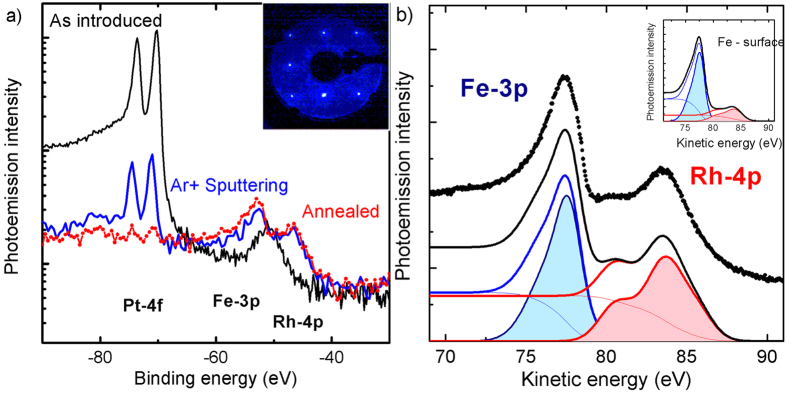
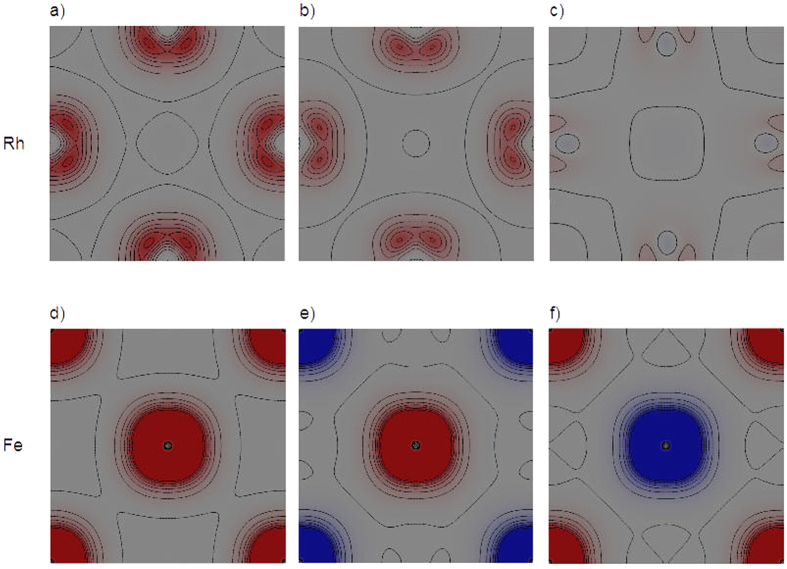
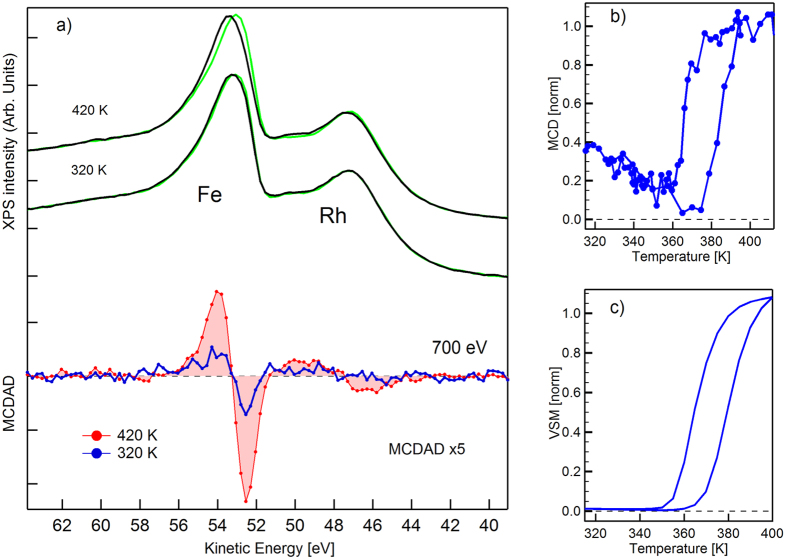
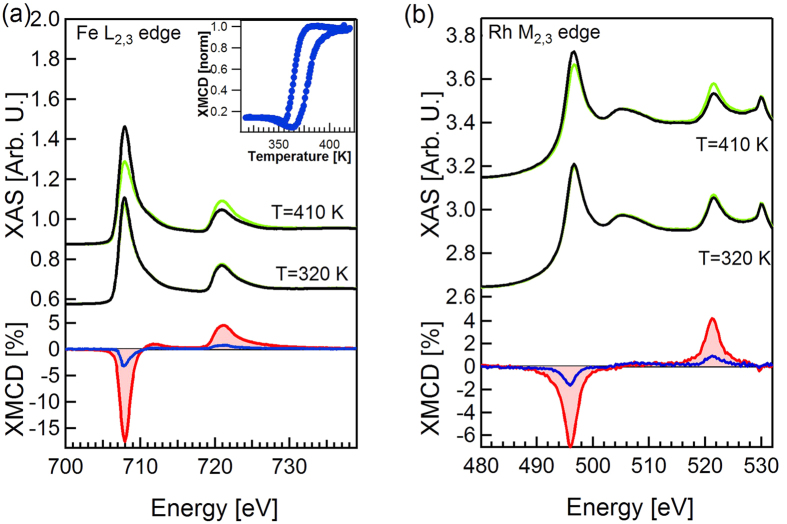
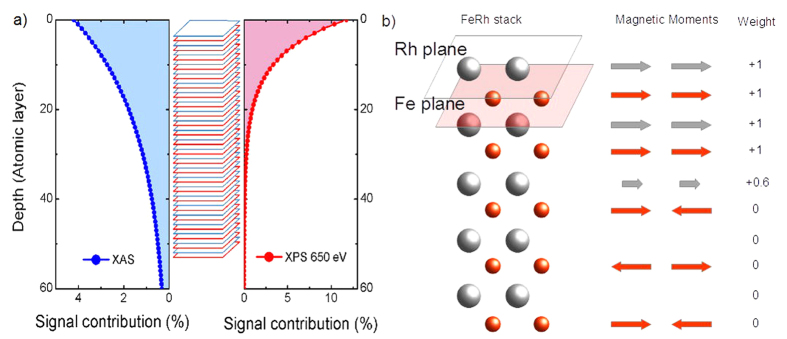
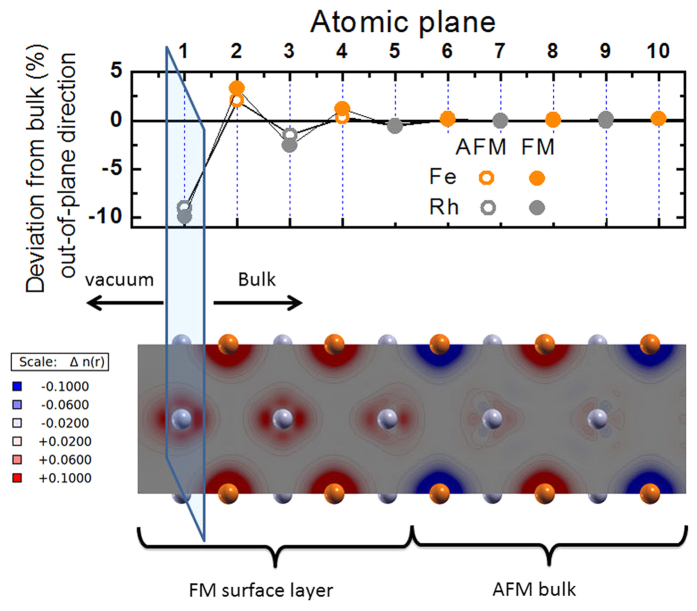
Interfaces and low dimensionality are sources of strong modifications of electronic, structural, and magnetic properties of materials. FeRh alloys are an excellent example because of the first-order phase transition taking place at ~400 K from an antiferromagnetic phase at room temperature to a high temperature ferromagnetic one. It is accompanied by a resistance change and volume expansion of about 1%. We have investigated the electronic and magnetic properties of FeRh(100) epitaxially grown on MgO by combining spectroscopies characterized by different probing depths, namely X-ray magnetic circular dichroism and photoelectron spectroscopy. We find that the symmetry breaking induced at the Rh-terminated surface stabilizes a surface ferromagnetic layer involving five planes of Fe and Rh atoms in the nominally antiferromagnetic phase at room temperature. First-principles calculations provide a microscopic description of the structural relaxation and the electron spin-density distribution that support the experimental findings.
界面和低维特性是导致材料电子、结构和磁性发生显著变化的根源。FeRh合金就是一个很好的例子,因为它在约400K时会发生一级相变,从室温下的反铁磁相转变为高温铁磁相。这伴随着电阻变化和约1%的体积膨胀。我们通过结合具有不同探测深度的光谱学方法,即X射线磁圆二色性和光电子能谱,研究了在MgO上外延生长的FeRh(100)的电子和磁性特性。我们发现,在Rh端表面诱导的对称性破缺稳定了一个表面铁磁层,该层在室温下的名义反铁磁相中包含五个Fe和Rh原子平面。第一性原理计算提供了结构弛豫和电子自旋密度分布的微观描述,支持了实验结果。