Morawiec Seweryn, Holovský Jakub, Mendes Manuel J, Müller Martin, Ganzerová Kristina, Vetushka Aliaksei, Ledinský Martin, Priolo Francesco, Fejfar Antonin, Crupi Isodiana
MATIS IMM-CNR, via S. Sofia 64, I-95123 Catania, Italy.
Dipartimento di Fisica e Astronomia, Università di Catania, via S. Sofia 64, I-95123 Catania, Italy.
Sci Rep. 2016 Mar 3;6:22481. doi: 10.1038/srep22481.
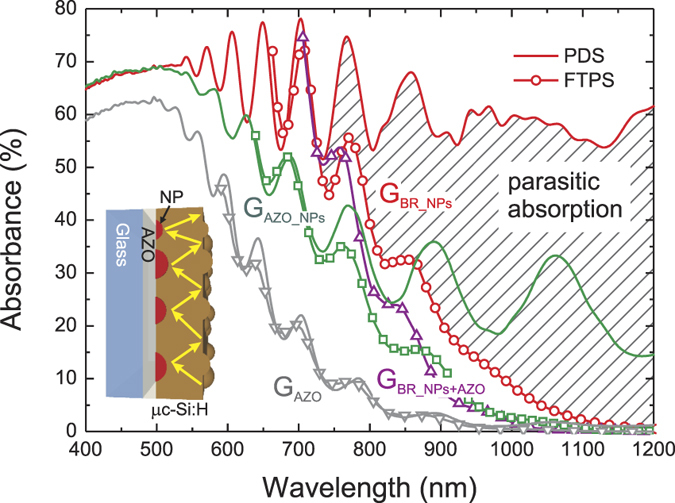
A combination of photocurrent and photothermal spectroscopic techniques is applied to experimentally quantify the useful and parasitic absorption of light in thin hydrogenated microcrystalline silicon (μc-Si:H) films incorporating optimized metal nanoparticle arrays, located at the rear surface, for improved light trapping via resonant plasmonic scattering. The photothermal technique accounts for the total absorptance and the photocurrent signal accounts only for the photons absorbed in the μc-Si:H layer (useful absorptance); therefore, the method allows for independent quantification of the useful and parasitic absorptance of the plasmonic (or any other) light trapping structure. We demonstrate that with a 0.9 μm thick absorber layer the optical losses related to the plasmonic light trapping in the whole structure are insignificant below 730 nm, above which they increase rapidly with increasing illumination wavelength. An average useful absorption of 43% and an average parasitic absorption of 19% over 400-1100 nm wavelength range is measured for μc-Si:H films deposited on optimized self-assembled Ag nanoparticles coupled with a flat mirror (plasmonic back reflector). For this sample, we demonstrate a significant broadband enhancement of the useful absorption resulting in the achievement of 91% of the maximum theoretical Lambertian limit of absorption.
将光电流和光热光谱技术相结合,用于实验量化包含优化金属纳米颗粒阵列的氢化微晶硅(μc-Si:H)薄膜中光的有用吸收和寄生吸收。这些金属纳米颗粒阵列位于背面,通过共振等离子体散射改善光捕获。光热技术计算的是总吸收率,而光电流信号仅计算在μc-Si:H层中吸收的光子(有用吸收率);因此,该方法能够独立量化等离子体(或任何其他)光捕获结构的有用吸收率和寄生吸收率。我们证明,对于厚度为0.9μm的吸收层,在整个结构中与等离子体光捕获相关的光学损耗在730nm以下微不足道,在此波长以上,它们随着照明波长的增加而迅速增加。对于沉积在优化的自组装银纳米颗粒与平面镜(等离子体背反射器)耦合上的μc-Si:H薄膜,在400 - 1100nm波长范围内测量到平均有用吸收率为43%,平均寄生吸收率为19%。对于该样品,我们展示了有用吸收的显著宽带增强,实现了最大理论朗伯吸收极限的91%。