Ochnik Aleksandra M, Peterson Mark S, Avdulov Svetlana V, Oh Annabell S, Bitterman Peter B, Yee Douglas
Masonic Cancer Center, Departments of Medicine and Pharmacology, University of Minnesota, Minneapolis, MN, USA.
Department of Medicine, Division of Pulmonary, Allergy, Critical Care and Sleep Medicine, Minneapolis, MN, USA.
Neoplasia. 2016 Feb;18(2):100-10. doi: 10.1016/j.neo.2016.01.001.
Control of mRNA translation is fundamentally altered in cancer. Insulin-like growth factor-I (IGF-I) signaling regulates key translation mediators to modulate protein synthesis (e.g. eIF4E, 4E-BP1, mTOR, and S6K1). Importantly the Amplified in Breast Cancer (AIB1) oncogene regulates transcription and is also a downstream mediator of IGF-I signaling.
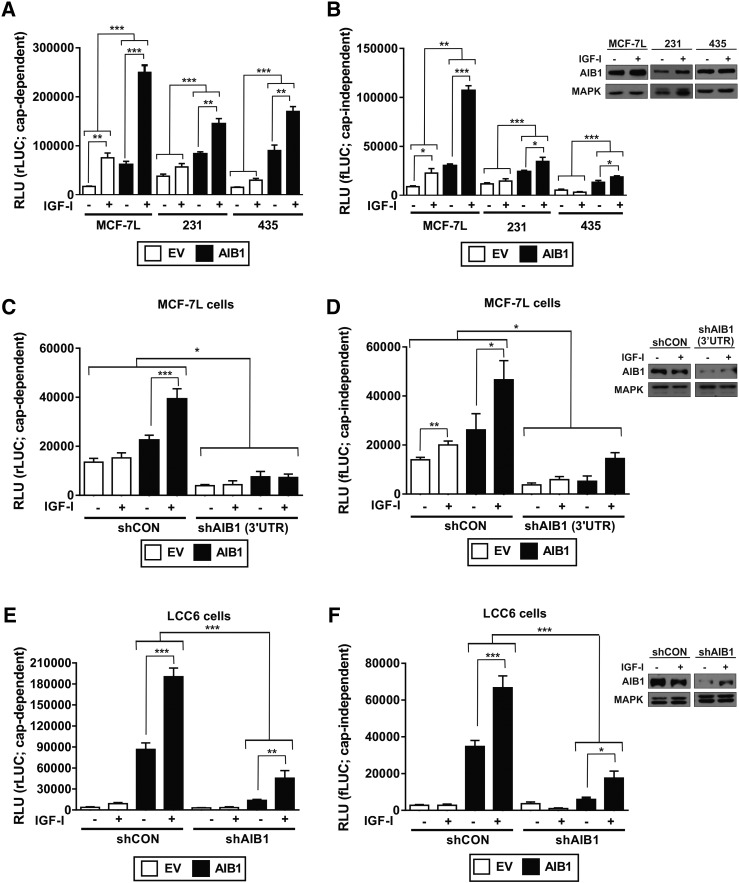
To determine if AIB1 also affects mRNA translation, we conducted gain and loss of AIB1 function experiments in estrogen receptor alpha (ERα)(+) (MCF-7L) and ERα(-) (MDA-MB-231, MDA-MB-435 and LCC6) breast cancer cells.
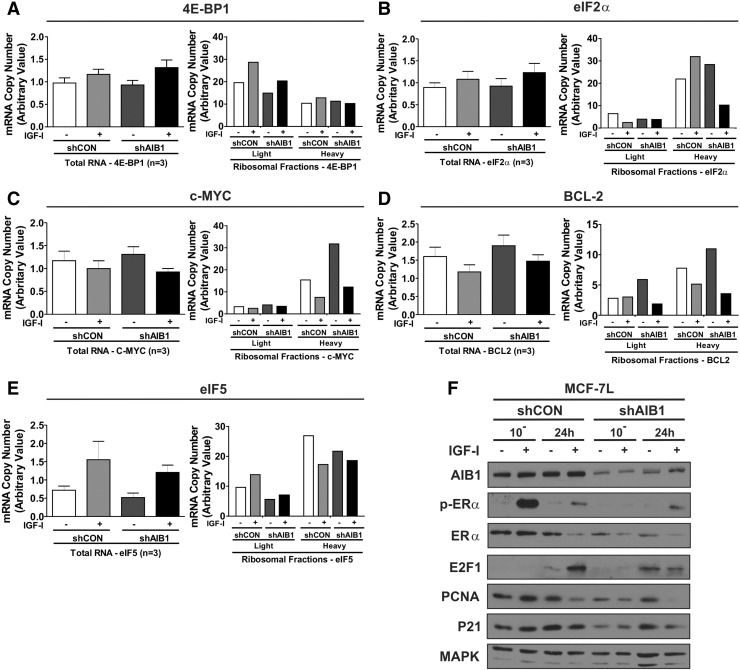
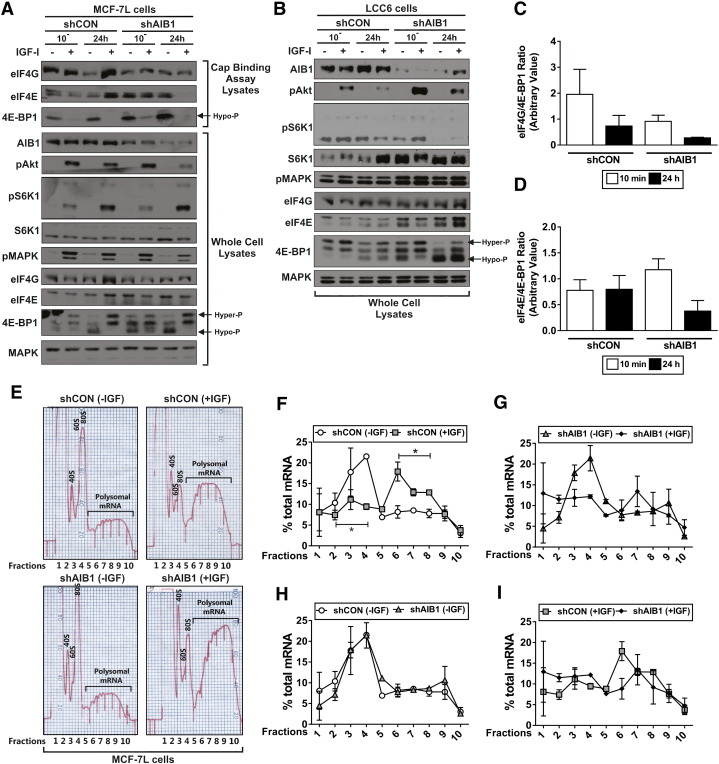
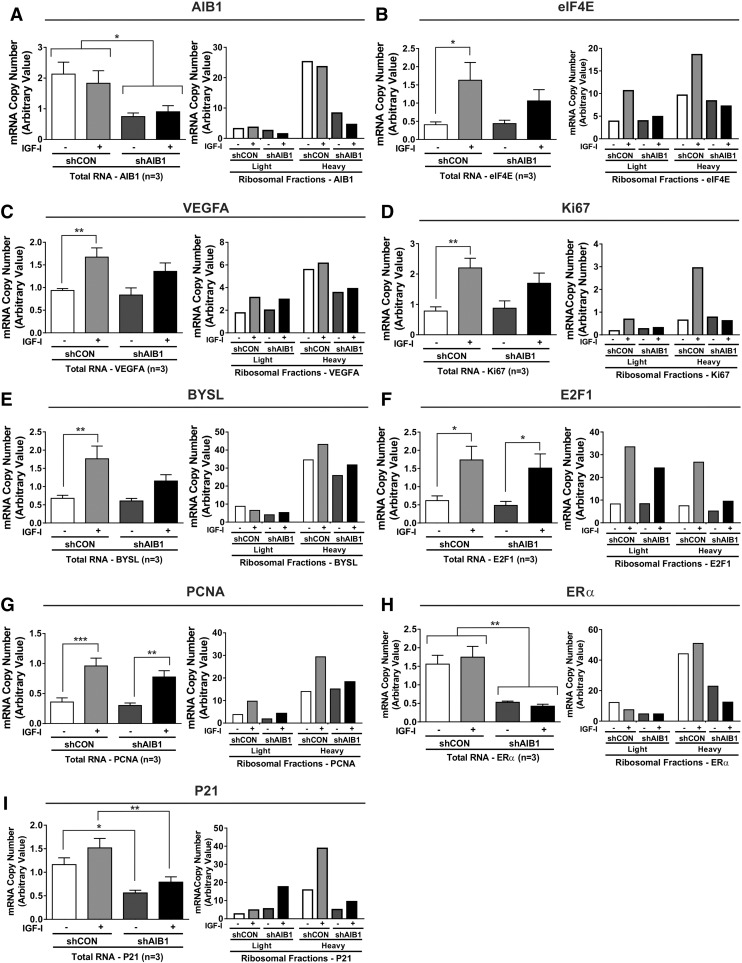
AIB1 positively regulated IGF-I-induced mRNA translation in both ERα(+) and ERα(-) cells. Formation of the eIF4E-4E-BP1 translational complex was altered in the AIB1 ERα(+) and ERα(-) knockdown cells, leading to a reduction in the eIF4E/4E-BP1 and eIF4G/4E-BP1 ratios. In basal and IGF-I stimulated MCF-7 and LCC6 cells, knockdown of AIB1 decreased the integrity of the cap-binding complex, reduced global IGF-I stimulated polyribosomal mRNA recruitment with a concomitant decrease in ten of the thirteen genes tested in polysome-bound mRNAs mapping to proliferation, cell cycle, survival, transcription, translation and ribosome biogenesis ontologies. Specifically, knockdown of AIB1 decreased ribosome-bound mRNA and steady-state protein levels of the transcription factors ERα and E2F1 in addition to reduced ribosome-bound mRNA of the ribosome biogenesis factor BYSL in a cell-line specific manner to regulate mRNA translation.
The oncogenic transcription factor AIB1 has a novel role in the regulation of polyribosome recruitment and formation of the translational complex. Combinatorial therapies targeting IGF signaling and mRNA translation in AIB1 expressing breast cancers may have clinical benefit and warrants further investigation.
癌症中mRNA翻译的调控发生了根本性改变。胰岛素样生长因子-I(IGF-I)信号通路调节关键的翻译介质以调节蛋白质合成(例如eIF4E、4E-BP1、mTOR和S6K1)。重要的是,乳腺癌中扩增基因1(AIB1)癌基因调节转录,并且还是IGF-I信号通路的下游介质。
为了确定AIB1是否也影响mRNA翻译,我们在雌激素受体α(ERα)阳性(MCF-7L)和ERα阴性(MDA-MB-231、MDA-MB-435和LCC6)乳腺癌细胞中进行了AIB1功能获得和缺失实验。
AIB1在ERα阳性和ERα阴性细胞中均正向调节IGF-I诱导的mRNA翻译。在AIB1 ERα阳性和ERα阴性敲低细胞中,eIF4E-4E-BP1翻译复合物的形成发生改变,导致eIF4E/4E-BP1和eIF4G/4E-BP1比率降低。在基础状态和IGF-I刺激的MCF-7和LCC6细胞中,敲低AIB1降低了帽结合复合物的完整性,减少了整体IGF-I刺激的多核糖体mRNA募集,同时在与增殖、细胞周期、存活、转录、翻译和核糖体生物发生本体相关的多核糖体结合mRNA中测试的13个基因中的10个基因也随之减少。具体而言,敲低AIB1以细胞系特异性方式降低了核糖体结合的mRNA以及转录因子ERα和E2F1的稳态蛋白水平,此外还降低了核糖体生物发生因子BYSL的核糖体结合mRNA,从而调节mRNA翻译。
致癌转录因子AIB1在多核糖体募集和翻译复合物形成的调控中具有新作用。针对表达AIB1的乳腺癌中IGF信号通路和mRNA翻译的联合疗法可能具有临床益处,值得进一步研究。