Palmucci Stefano, Cappello Giuseppina, Attinà Giancarlo, Foti Pietro Valerio, Siverino Rita Olivia Anna, Roccasalva Federica, Piccoli Marina, Sinagra Nunziata, Milone Pietro, Veroux Massimiliano, Ettorre Giovanni Carlo
Radiodiagnostic and Radiotherapy Unit, University Hospital "Policlinico-Vittorio Emanuele", Via Santa Sofia 78, 95123 Catania, Italy.
Vascular Surgery and Organ Transplant Unit, Department of Surgery, Transplantation and Advanced Technologies, University Hospital "Policlinico-Vittorio Emanuele", Via Santa Sofia 78, 95123 Catania, Italy.
Eur J Radiol Open. 2015 May 16;2:71-80. doi: 10.1016/j.ejro.2015.05.001. eCollection 2015.
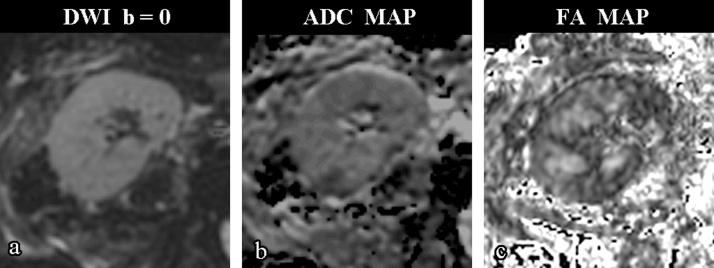
The aim of this study is to investigate the relation between renal indexes and functional MRI in a population of kidney transplant recipients who underwent MR with diffusion-weighted imaging (DWI) and diffusion tensor imaging (DTI) of the transplanted graft.
Study population included 40 patients with single kidney transplant. The patients were divided into 3 groups, on the basis of creatinine clearance (CrCl) values calculated using Cockcroft-Gault formula: group A, including patients with normal renal function (CrCl ≥ 60 mL/min); group B, which refers to patients with moderate renal impairment (CrCl > 30 but <60 mL/min); and, finally, group C, which means severe renal deterioration (CrCl ≤ 30 mL/min). All patients were investigated with a 1.5 Tesla MRI scanner, acquiring DWI and DTI sequences. A Mann-Whitney U test was adopted to compare apparent diffusion coefficients (ADCs) and fractional anisotropy (FA) measurements between groups. Receiver operating characteristic (ROC) curves were created for prediction of normal renal function (group A) and renal failure (group C). Pearson correlation was performed between renal clearance and functional imaging parameter (ADC and FA), obtained for cortical and medullar regions.
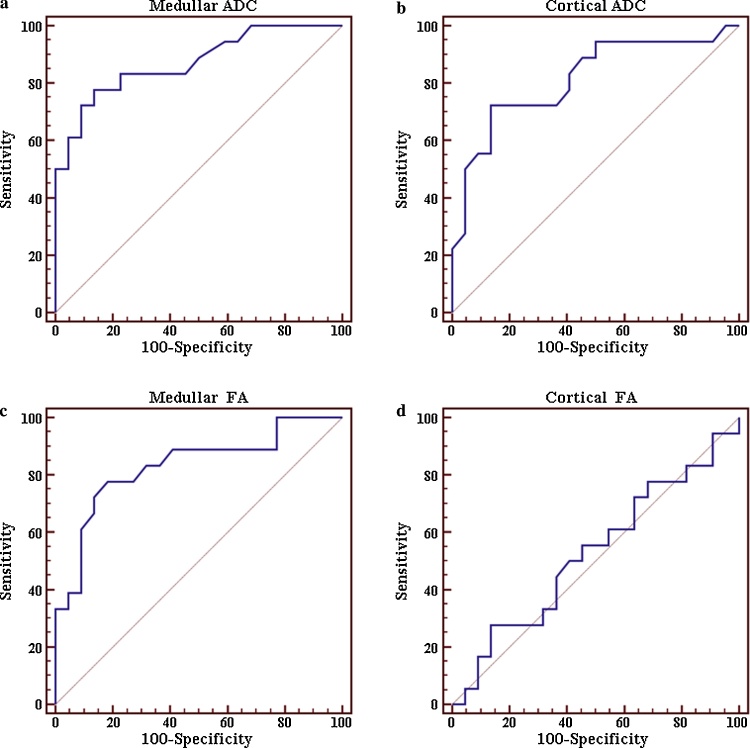
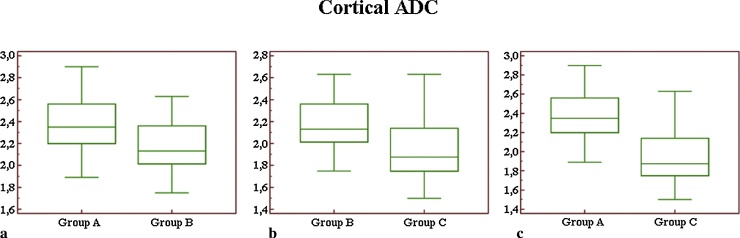
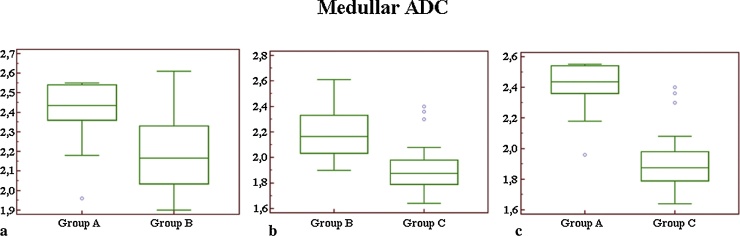
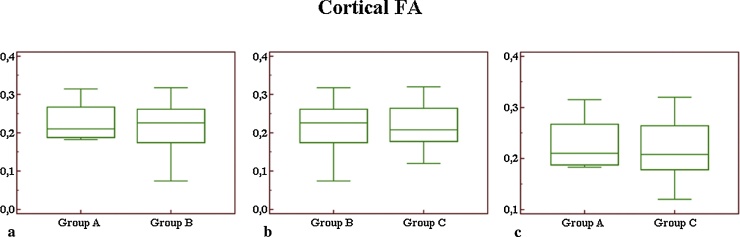
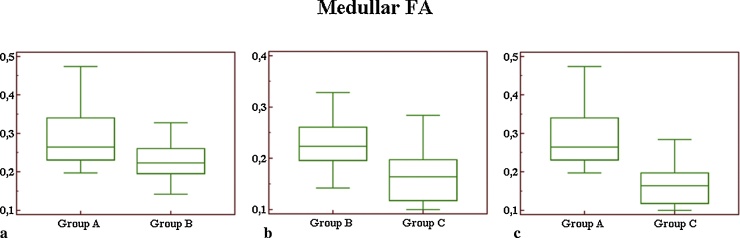
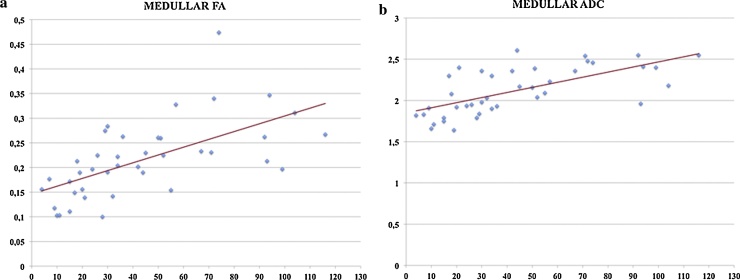
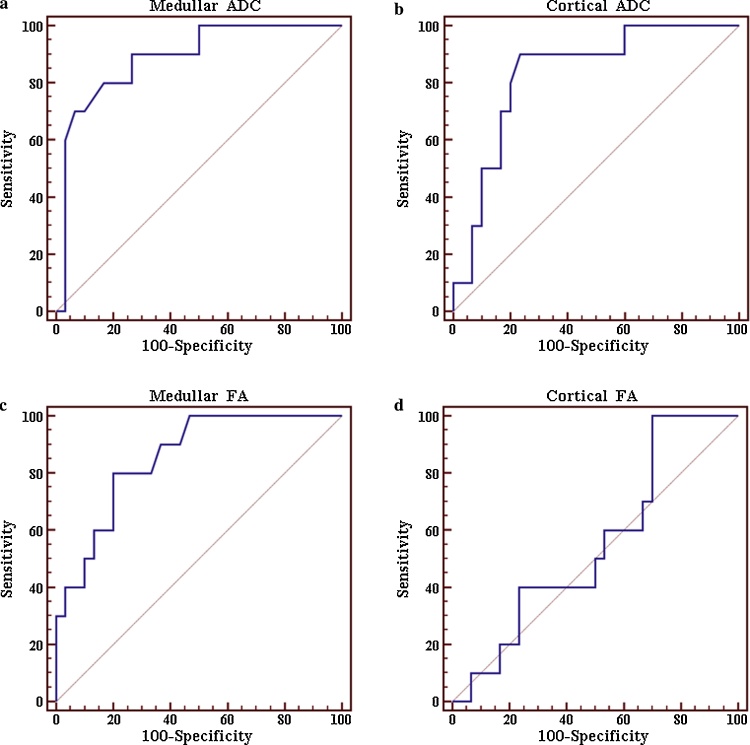
Mann-Whitney U test revealed a highly significant difference (p < 0.01) between patients with low CrCl (group C) and normal CrCl (group A) considering both medullar ADC and FA and cortical ADC. Regarding contiguous groups, the difference between group B and C was highly significant (p < 0.01) for medullar ADC and significant (p < 0.05) for cortical ADC and medullar FA. No difference between these groups was found considering cortical FA. Analyzing groups A and B, we found a significant difference (p < 0.05) for medullar both ADC and FA, while no difference was found for cortical ADC and FA. Strongest Pearson correlation was found between CrCl and medullar ADC (r = 0.65). For predicting normal renal function or severe renal impairment, highest values of AUC were observed using medullar ADC cut-off values (respectively 0.885 and 0.871); medullar FA showed also high accuracy (respectively 0.831 and 0.853).
DWI and DTI are promising tools for non-invasive monitoring of renal function; medullar ADC proved to be the best parameter for renal function assessment.
本研究旨在调查接受移植肾磁共振成像(MRI)检查(包括扩散加权成像(DWI)和扩散张量成像(DTI))的肾移植受者群体中,肾脏指标与功能MRI之间的关系。
研究人群包括40名单肾移植患者。根据使用Cockcroft - Gault公式计算的肌酐清除率(CrCl)值,将患者分为3组:A组,包括肾功能正常(CrCl≥60 mL/min)的患者;B组,指中度肾功能损害(CrCl>30但<60 mL/min)的患者;最后是C组,即严重肾功能恶化(CrCl≤30 mL/min)的患者。所有患者均使用1.5特斯拉MRI扫描仪进行检查,采集DWI和DTI序列。采用Mann - Whitney U检验比较各组之间的表观扩散系数(ADC)和分数各向异性(FA)测量值。绘制受试者操作特征(ROC)曲线以预测正常肾功能(A组)和肾衰竭(C组)。对皮质和髓质区域获得的肾脏清除率与功能成像参数(ADC和FA)进行Pearson相关性分析。
Mann - Whitney U检验显示,考虑髓质ADC、FA以及皮质ADC时,低CrCl(C组)患者与正常CrCl(A组)患者之间存在高度显著差异(p<0.01)。对于相邻组,B组和C组之间在髓质ADC方面差异高度显著(p<0.01),在皮质ADC和髓质FA方面差异显著(p<0.05)。考虑皮质FA时,这些组之间未发现差异。分析A组和B组,我们发现髓质ADC和FA均存在显著差异(p<0.05),而皮质ADC和FA未发现差异。CrCl与髓质ADC之间发现最强的Pearson相关性(r = 0.65)。对于预测正常肾功能或严重肾功能损害,使用髓质ADC临界值时观察到最高的曲线下面积(AUC)值(分别为0.885和0.871);髓质FA也显示出较高的准确性(分别为0.831和0.853)。
DWI和DTI是用于肾功能无创监测的有前景的工具;髓质ADC被证明是评估肾功能的最佳参数。