• 文献检索
  • 文档翻译
  • 深度研究
  • 学术资讯
  • Suppr Zotero 插件Zotero 插件
  • 邀请有礼
  • 套餐&价格
  • 历史记录
应用&插件
Suppr Zotero 插件Zotero 插件浏览器插件Mac 客户端Windows 客户端微信小程序
定价
高级版会员购买积分包购买API积分包
服务
文献检索文档翻译深度研究API 文档MCP 服务
关于我们
关于 Suppr公司介绍联系我们用户协议隐私条款
关注我们

Suppr 超能文献

核心技术专利:CN118964589B侵权必究
粤ICP备2023148730 号-1Suppr @ 2026

文献检索

告别复杂PubMed语法,用中文像聊天一样搜索,搜遍4000万医学文献。AI智能推荐,让科研检索更轻松。

立即免费搜索

文件翻译

保留排版,准确专业,支持PDF/Word/PPT等文件格式,支持 12+语言互译。

免费翻译文档

深度研究

AI帮你快速写综述,25分钟生成高质量综述,智能提取关键信息,辅助科研写作。

立即免费体验

美洲埃及伊蚊和白纹伊蚊对寨卡病毒的易感性差异

Differential Susceptibilities of Aedes aegypti and Aedes albopictus from the Americas to Zika Virus.

作者信息

Chouin-Carneiro Thais, Vega-Rua Anubis, Vazeille Marie, Yebakima André, Girod Romain, Goindin Daniella, Dupont-Rouzeyrol Myrielle, Lourenço-de-Oliveira Ricardo, Failloux Anna-Bella

机构信息

Instituto Oswaldo Cruz, Rio de Janeiro, Brazil.

Institut Pasteur, Arboviruses and Insect Vectors, Paris, France.

出版信息

PLoS Negl Trop Dis. 2016 Mar 3;10(3):e0004543. doi: 10.1371/journal.pntd.0004543. eCollection 2016 Mar.

DOI:10.1371/journal.pntd.0004543
PMID:26938868
原文链接:https://pmc.ncbi.nlm.nih.gov/articles/PMC4777396/
Abstract

BACKGROUND

Since the major outbreak in 2007 in the Yap Island, Zika virus (ZIKV) causing dengue-like syndromes has affected multiple islands of the South Pacific region. In May 2015, the virus was detected in Brazil and then spread through South and Central America. In December 2015, ZIKV was detected in French Guiana and Martinique. The aim of the study was to evaluate the vector competence of the mosquito spp. Aedes aegypti and Aedes albopictus from the Caribbean (Martinique, Guadeloupe), North America (southern United States), South America (Brazil, French Guiana) for the currently circulating Asian genotype of ZIKV isolated from a patient in April 2014 in New Caledonia.

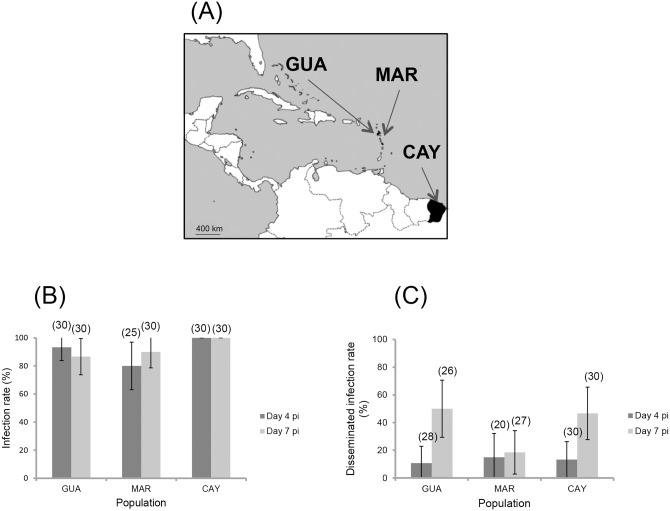
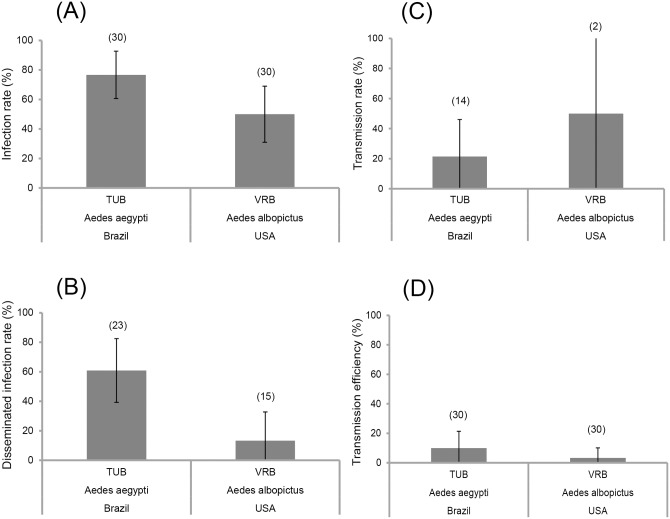
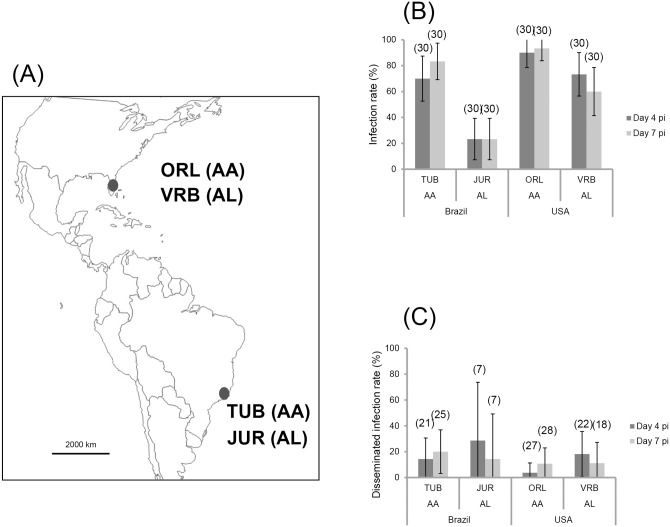
METHODOLOGY/PRINCIPAL FINDINGS: Mosquitoes were orally exposed to an Asian genotype of ZIKV (NC-2014-5132). Upon exposure, engorged mosquitoes were maintained at 28° ± 1 °C, a 16h:8h light:dark cycle and 80% humidity. 25-30 mosquitoes were processed at 4, 7 and 14 days post-infection (dpi). Mosquito bodies (thorax and abdomen), heads and saliva were analyzed to measure infection, dissemination and transmission, respectively. High infection but lower disseminated infection and transmission rates were observed for both Ae. aegypti and Ae. albopictus. Ae. aegypti populations from Guadeloupe and French Guiana exhibited a higher dissemination of ZIKV than the other Ae. aegypti populations examined. Transmission of ZIKV was observed in both mosquito species at 14 dpi but at a low level.

CONCLUSIONS/SIGNIFICANCE: This study suggests that although susceptible to infection, Ae. aegypti and Ae. albopictus were unexpectedly low competent vectors for ZIKV. This may suggest that other factors such as the large naïve population for ZIKV and the high densities of human-biting mosquitoes contribute to the rapid spread of ZIKV during the current outbreak.

摘要

背景

自2007年在雅浦岛发生重大疫情以来,导致登革热样综合征的寨卡病毒(ZIKV)已影响南太平洋地区的多个岛屿。2015年5月,该病毒在巴西被检测到,随后传播至南美洲和中美洲。2015年12月,在法属圭亚那和马提尼克岛检测到寨卡病毒。本研究的目的是评估来自加勒比地区(马提尼克岛、瓜德罗普岛)、北美洲(美国南部)、南美洲(巴西、法属圭亚那)的埃及伊蚊和白纹伊蚊这两种蚊子对2014年4月在新喀里多尼亚从一名患者身上分离出的目前正在传播的亚洲基因型寨卡病毒的媒介能力。

方法/主要发现:让蚊子经口接触亚洲基因型的寨卡病毒(NC - 2014 - 5132)。接触后,饱血的蚊子饲养在28°±1°C、16小时光照:8小时黑暗周期和80%湿度的环境中。在感染后4天、7天和14天对25 - 30只蚊子进行处理。分别对蚊子的身体(胸部和腹部)、头部和唾液进行分析,以测量感染、传播和传播率。埃及伊蚊和白纹伊蚊均观察到高感染率,但传播感染率和传播率较低。来自瓜德罗普岛和法属圭亚那的埃及伊蚊种群对寨卡病毒的传播率高于所检测的其他埃及伊蚊种群。在14天感染期时,在两种蚊子中均观察到寨卡病毒的传播,但水平较低。

结论/意义:本研究表明,尽管埃及伊蚊和白纹伊蚊易受感染,但它们对寨卡病毒而言却是出人意料的低效媒介。这可能表明,其他因素,如对寨卡病毒缺乏免疫力的大量人群以及高密度的嗜人蚊子,促成了当前疫情期间寨卡病毒的快速传播。
https://cdn.ncbi.nlm.nih.gov/pmc/blobs/793d/4777396/d0d935a9b86b/pntd.0004543.g003.jpg
https://cdn.ncbi.nlm.nih.gov/pmc/blobs/793d/4777396/76a23ba437f0/pntd.0004543.g001.jpg
https://cdn.ncbi.nlm.nih.gov/pmc/blobs/793d/4777396/f3431d9fcef2/pntd.0004543.g002.jpg
https://cdn.ncbi.nlm.nih.gov/pmc/blobs/793d/4777396/d0d935a9b86b/pntd.0004543.g003.jpg
https://cdn.ncbi.nlm.nih.gov/pmc/blobs/793d/4777396/76a23ba437f0/pntd.0004543.g001.jpg
https://cdn.ncbi.nlm.nih.gov/pmc/blobs/793d/4777396/f3431d9fcef2/pntd.0004543.g002.jpg
https://cdn.ncbi.nlm.nih.gov/pmc/blobs/793d/4777396/d0d935a9b86b/pntd.0004543.g003.jpg

相似文献

1
Differential Susceptibilities of Aedes aegypti and Aedes albopictus from the Americas to Zika Virus.美洲埃及伊蚊和白纹伊蚊对寨卡病毒的易感性差异
PLoS Negl Trop Dis. 2016 Mar 3;10(3):e0004543. doi: 10.1371/journal.pntd.0004543. eCollection 2016 Mar.
2
Zika Virus, a New Threat for Europe?寨卡病毒,欧洲面临的新威胁?
PLoS Negl Trop Dis. 2016 Aug 9;10(8):e0004901. doi: 10.1371/journal.pntd.0004901. eCollection 2016 Aug.
3
Vector competence of Australian Aedes aegypti and Aedes albopictus for an epidemic strain of Zika virus.澳大利亚致倦库蚊和白纹伊蚊对 Zika 病毒流行株的媒介效能。
PLoS Negl Trop Dis. 2019 Apr 4;13(4):e0007281. doi: 10.1371/journal.pntd.0007281. eCollection 2019 Apr.
4
Zika virus outbreak in the Pacific: Vector competence of regional vectors.太平洋地区的 Zika 病毒爆发:区域传播媒介的媒介效能。
PLoS Negl Trop Dis. 2018 Jul 17;12(7):e0006637. doi: 10.1371/journal.pntd.0006637. eCollection 2018 Jul.
5
Evidence for infection but not transmission of Zika virus by Aedes albopictus (Diptera: Culicidae) from Spain.证据表明,西班牙白纹伊蚊(双翅目:蚊科)可感染寨卡病毒但不会传播该病毒。
Parasit Vectors. 2019 May 3;12(1):204. doi: 10.1186/s13071-019-3467-y.
6
Zika virus transmission by Brazilian Aedes aegypti and Aedes albopictus is virus dose and temperature-dependent.巴西伊蚊和白纹伊蚊传播寨卡病毒与病毒剂量和温度有关。
PLoS Negl Trop Dis. 2020 Sep 8;14(9):e0008527. doi: 10.1371/journal.pntd.0008527. eCollection 2020 Sep.
7
Mosquito co-infection with Zika and chikungunya virus allows simultaneous transmission without affecting vector competence of Aedes aegypti.寨卡病毒与基孔肯雅病毒的蚊媒共感染可实现同时传播,且不影响埃及伊蚊的媒介能力。
PLoS Negl Trop Dis. 2017 Jun 1;11(6):e0005654. doi: 10.1371/journal.pntd.0005654. eCollection 2017 Jun.
8
Vector competence of Virginia mosquitoes for Zika and Cache Valley viruses.弗吉尼亚州蚊虫对寨卡病毒和卡什谷病毒的媒介效能。
Parasit Vectors. 2020 Apr 10;13(1):188. doi: 10.1186/s13071-020-04042-0.
9
Aedes (Stegomyia) albopictus (Skuse): a potential vector of Zika virus in Singapore.白纹伊蚊(Stegomyia albopictus)(Skuse):新加坡寨卡病毒的潜在传播媒介。
PLoS Negl Trop Dis. 2013 Aug 1;7(8):e2348. doi: 10.1371/journal.pntd.0002348. Print 2013.
10
Culex quinquefasciatus from Rio de Janeiro Is Not Competent to Transmit the Local Zika Virus.里约热内卢致倦库蚊不适宜传播当地的 Zika 病毒。
PLoS Negl Trop Dis. 2016 Sep 6;10(9):e0004993. doi: 10.1371/journal.pntd.0004993. eCollection 2016 Sep.

引用本文的文献

1
Comprehensive intra-host infection kinetics reveals high arbo-orthoflavivirus transmission potential by neglected vector species, Aedes scutellaris.全面的宿主内感染动力学揭示了被忽视的媒介物种斯氏伊蚊具有高虫媒正黄病毒传播潜力。
PLoS Negl Trop Dis. 2025 May 6;19(5):e0012530. doi: 10.1371/journal.pntd.0012530. eCollection 2025 May.
2
Comparison of Three Chimeric Zika Vaccine Prototypes Developed on the Genetic Background of the Clinically Proven Live-Attenuated Japanese Encephalitis Vaccine SA-14-2.在临床验证的减毒活疫苗日本脑炎疫苗SA - 14 - 2的基因背景上开发的三种嵌合寨卡疫苗原型的比较。
Int J Mol Sci. 2024 Dec 29;26(1):195. doi: 10.3390/ijms26010195.
3

本文引用的文献

1
A report on the outbreak of Zika virus on Easter Island, South Pacific, 2014.2014年南太平洋复活节岛寨卡病毒疫情报告。
Arch Virol. 2016 Mar;161(3):665-8. doi: 10.1007/s00705-015-2695-5. Epub 2015 Nov 26.
2
Chikungunya Virus Replication in Salivary Glands of the Mosquito Aedes albopictus.基孔肯雅病毒在白纹伊蚊唾液腺中的复制
Viruses. 2015 Nov 17;7(11):5902-7. doi: 10.3390/v7112917.
3
Potential of selected Senegalese Aedes spp. mosquitoes (Diptera: Culicidae) to transmit Zika virus.塞内加尔部分伊蚊属蚊子(双翅目:蚊科)传播寨卡病毒的可能性。
The role of vector population variation and climate in Zika virus transmission patterns in Africa: a modelling study.
媒介种群变异和气候在非洲寨卡病毒传播模式中的作用:一项建模研究
Lancet Planet Health. 2024 Dec;8(12):e1020-e1029. doi: 10.1016/S2542-5196(24)00276-6.
4
Temperature Interference on ZIKV and CHIKV Cycles in Mosquitoes and Mammalian Cells.温度对蚊子和哺乳动物细胞中寨卡病毒和基孔肯雅病毒循环的干扰。
Pathogens. 2024 Sep 21;13(9):814. doi: 10.3390/pathogens13090814.
5
Study on the cross-resistance of Aedes albopictus (Skuse) (Diptera: Culicidae) to deltamethrin and pyriproxyfen.白纹伊蚊(Skuse)(双翅目:蚊科)对溴氰菊酯和吡丙醚的交互抗性研究。
Parasit Vectors. 2024 Sep 27;17(1):403. doi: 10.1186/s13071-024-06485-1.
6
Dengue Virus Serotype 1 Effects on Mosquito Survival Differ among Geographically Distinct Populations.登革热病毒1型对蚊子生存的影响在地理上不同的种群中存在差异。
Insects. 2024 May 28;15(6):393. doi: 10.3390/insects15060393.
7
Exposure to Zika and chikungunya viruses impacts aspects of the vectorial capacity of Aedes aegypti and Culex quinquefasciatus.寨卡病毒和基孔肯雅热病毒的暴露会影响埃及伊蚊和致倦库蚊的媒介传播能力。
PLoS One. 2024 May 15;19(5):e0281851. doi: 10.1371/journal.pone.0281851. eCollection 2024.
8
Assessing and managing the risk of Aedes mosquito introductions via the global maritime trade network.评估和管理通过全球海上贸易网络引入伊蚊的风险。
PLoS Negl Trop Dis. 2024 Apr 10;18(4):e0012110. doi: 10.1371/journal.pntd.0012110. eCollection 2024 Apr.
9
Increased threat of urban arboviral diseases from mosquitoes in Colombia.哥伦比亚城市中蚊子传播的虫媒病毒疾病威胁增加。
IJID Reg. 2024 Mar 22;11:100360. doi: 10.1016/j.ijregi.2024.100360. eCollection 2024 Jun.
10
Intersecting vulnerabilities: climatic and demographic contributions to future population exposure to -borne viruses in the United States.交叉脆弱性:气候和人口结构对美国未来人口接触虫媒病毒的影响
Environ Res Lett. 2020 Aug;15(8). doi: 10.1088/1748-9326/ab9141. Epub 2020 Aug 12.
BMC Infect Dis. 2015 Nov 2;15:492. doi: 10.1186/s12879-015-1231-2.
4
Zika Virus Outbreak, Bahia, Brazil.巴西巴伊亚州寨卡病毒疫情
Emerg Infect Dis. 2015 Oct;21(10):1885-6. doi: 10.3201/eid2110.150847.
5
Zika virus: following the path of dengue and chikungunya?寨卡病毒:会步登革热和基孔肯雅热的后尘吗?
Lancet. 2015 Jul 18;386(9990):243-4. doi: 10.1016/S0140-6736(15)61273-9.
6
First report of autochthonous transmission of Zika virus in Brazil.寨卡病毒在巴西本土传播的首次报告。
Mem Inst Oswaldo Cruz. 2015 Jun;110(4):569-72. doi: 10.1590/0074-02760150192. Epub 2015 Jun 9.
7
Co-infection with Zika and dengue viruses in 2 patients, New Caledonia, 2014.2014年,新喀里多尼亚2名患者同时感染寨卡病毒和登革热病毒。
Emerg Infect Dis. 2015 Feb;21(2):381-2. doi: 10.3201/eid2102.141553.
8
Chikungunya virus-vector interactions.基孔肯雅病毒与媒介的相互作用。
Viruses. 2014 Nov 24;6(11):4628-63. doi: 10.3390/v6114628.
9
Zika virus emergence in mosquitoes in southeastern Senegal, 2011.2011年,寨卡病毒在塞内加尔东南部的蚊子中出现。
PLoS One. 2014 Oct 13;9(10):e109442. doi: 10.1371/journal.pone.0109442. eCollection 2014.
10
The effect of temperature on the extrinsic incubation period and infection rate of dengue virus serotype 2 infection in Aedes albopictus.温度对白纹伊蚊感染登革病毒2型的外在潜伏期和感染率的影响。
Arch Virol. 2014 Nov;159(11):3053-7. doi: 10.1007/s00705-014-2051-1. Epub 2014 Jul 3.