Sjöblom Liisa, Saramäki Outi, Annala Matti, Leinonen Katri, Nättinen Janika, Tolonen Teemu, Wahlfors Tiina, Nykter Matti, Bova G Steven, Schleutker Johanna, Tammela Teuvo L J, Lilja Hans, Visakorpi Tapio
Prostate Cancer Research Center, Institute of Biosciences and Medical Technology (BioMediTech), University of Tampere, Tampere, Finland.
Fimlab Laboratories, Tampere University Hospital, Tampere, Finland.
PLoS One. 2016 Mar 3;11(3):e0150241. doi: 10.1371/journal.pone.0150241. eCollection 2016.
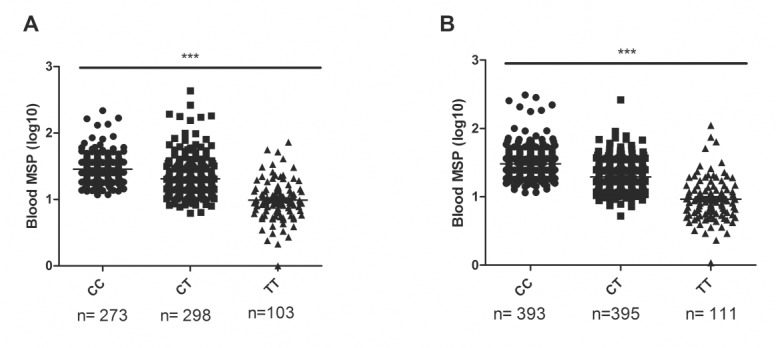
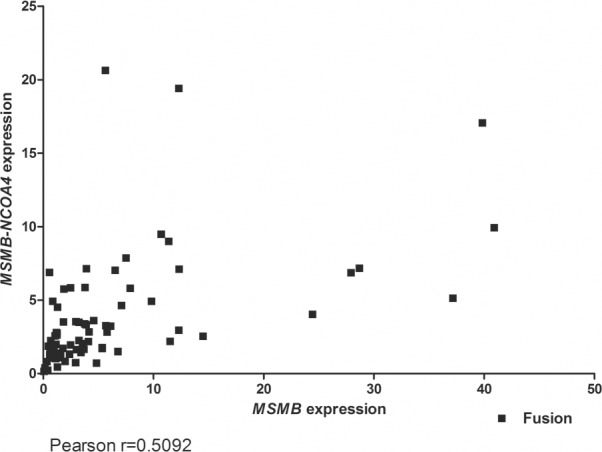
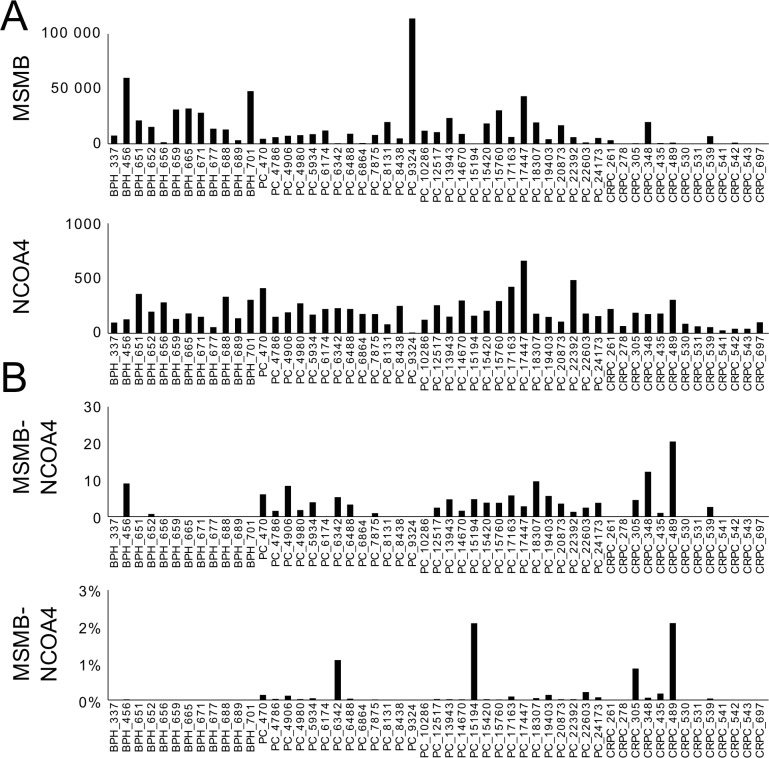
Microseminoprotein-beta (MSMB, MSMB) is an abundant secretory protein contributed by the prostate, and is implicated as a prostate cancer (PC) biomarker based on observations of its lower expression in cancerous cells compared with benign prostate epithelium. However, as the current literature on MSMB is inconsistent, we assessed the expression of MSMB at the protein and mRNA levels in a comprehensive set of different clinical stages of PC. Immunohistochemistry using monoclonal and polyclonal antibodies against MSMB was used to study protein expression in tissue specimens representing prostatectomies (n = 261) and in diagnostic needle biopsies from patients treated with androgen deprivation therapy (ADT) (n = 100), and in locally recurrent castration-resistant PC (CRPC) (n = 105) and CRPC metastases (n = 113). The transcript levels of MSMB, nuclear receptor co-activator 4 (NCOA4) and MSMB-NCOA4 fusion were examined by qRT-PCR in prostatectomy samples and by RNA-sequencing in benign prostatic hyperplasia, PC, and CRPC samples. We also measured serum MSMB levels and genotyped the single nucleotide polymorphism rs10993994 using DNA from the blood of 369 PC patients and 903 controls. MSMB expression in PC (29% of prostatectomies and 21% of needle biopsies) was more frequent than in CRPC (9% of locally recurrent CRPCs and 9% of CRPC metastases) (p<0.0001). Detection of MSMB protein was inversely correlated with the Gleason score in prostatectomy specimens (p = 0.024). The read-through MSMB-NCOA4 transcript was detected at very low levels in PC. MSMB levels in serum were similar in cases of PC and controls but were significantly associated with PC risk when adjusted for age at diagnosis and levels of free or total PSA (p<0.001). Serum levels of MSMB in both PC patients and controls were significantly associated with the rs10993994 genotype (p<0.0001). In conclusion, decreased expression of MSMB parallels the clinical progression of PC and adjusted serum MSMB levels are associated with PC risk.
微小精液蛋白-β(MSMB)是前列腺分泌的一种丰富的分泌蛋白,基于其在癌细胞中表达低于良性前列腺上皮细胞的观察结果,它被认为是一种前列腺癌(PC)生物标志物。然而,由于目前关于MSMB的文献并不一致,我们在一组全面的不同临床阶段的PC中评估了MSMB在蛋白质和mRNA水平的表达。使用针对MSMB的单克隆和多克隆抗体进行免疫组织化学,以研究代表前列腺切除术(n = 261)的组织标本、接受雄激素剥夺治疗(ADT)的患者的诊断性穿刺活检(n = 100)、局部复发性去势抵抗性PC(CRPC)(n = 105)和CRPC转移灶(n = 113)中的蛋白质表达。通过qRT-PCR检测前列腺切除标本中MSMB、核受体共激活因子4(NCOA4)和MSMB-NCOA4融合体的转录水平,并通过RNA测序检测良性前列腺增生、PC和CRPC样本中的转录水平。我们还测量了369例PC患者和903例对照者血液中的血清MSMB水平,并对单核苷酸多态性rs10993994进行基因分型。MSMB在PC中的表达(前列腺切除术的29%和穿刺活检的21%)比在CRPC中更常见(局部复发性CRPC的9%和CRPC转移灶的9%)(p<0.0001)。在前列腺切除标本中,MSMB蛋白的检测与Gleason评分呈负相关(p = 0.024)。在PC中以极低水平检测到通读的MSMB-NCOA4转录本。PC患者和对照者血清中的MSMB水平相似,但在调整诊断年龄和游离或总PSA水平后,与PC风险显著相关(p<0.001)。PC患者和对照者的血清MSMB水平均与rs10993994基因型显著相关(p<0.0001)。总之,MSMB表达降低与PC的临床进展平行,调整后的血清MSMB水平与PC风险相关。