Weisman Paul S, Ng Charlotte K Y, Brogi Edi, Eisenberg Rachel E, Won Helen H, Piscuoglio Salvatore, De Filippo Maria R, Ioris Rafael, Akram Muzaffar, Norton Larry, Weigelt Britta, Berger Michael F, Reis-Filho Jorge S, Wen Hannah Y
Department of Pathology, Memorial Sloan Kettering Cancer Center, New York, NY, USA.
Department of Medicine, Memorial Sloan Kettering Cancer Center, New York, NY, USA.
Mod Pathol. 2016 May;29(5):476-88. doi: 10.1038/modpathol.2016.39. Epub 2016 Mar 4.
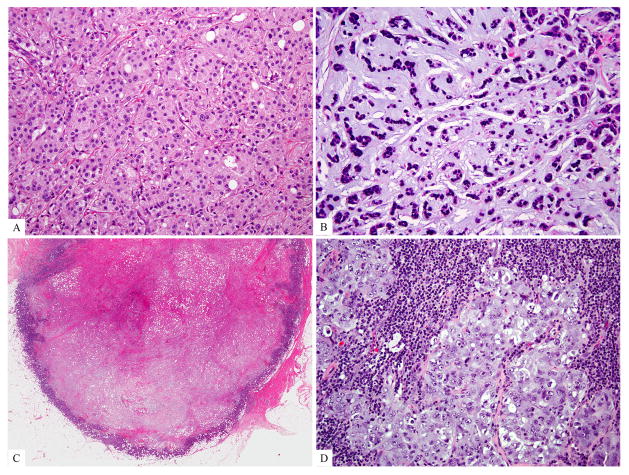
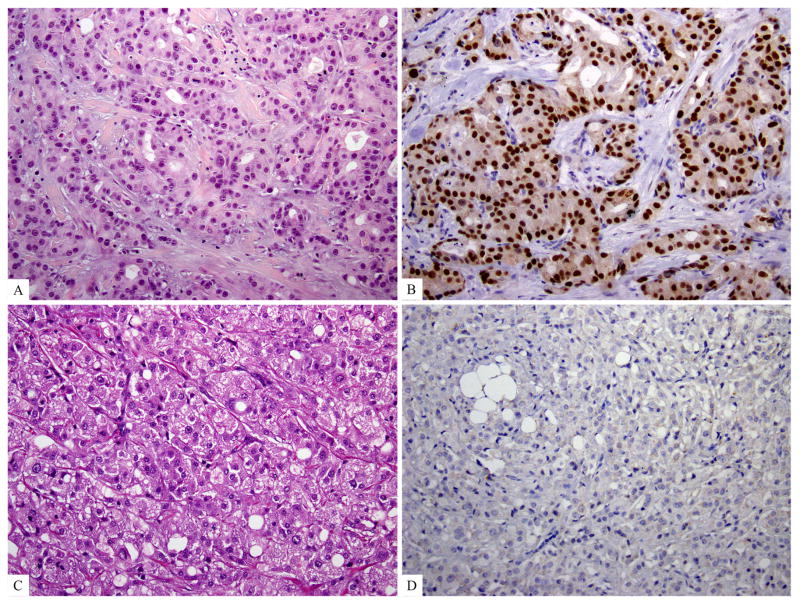
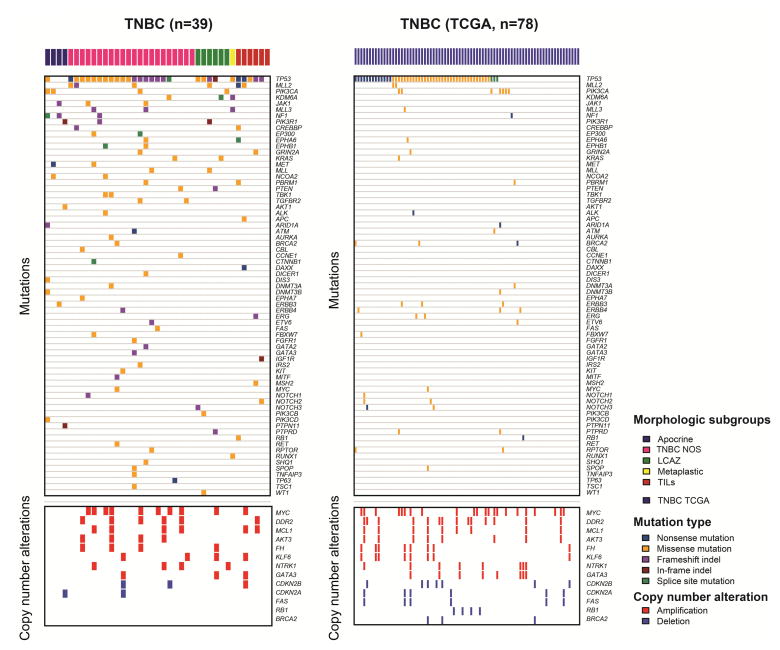
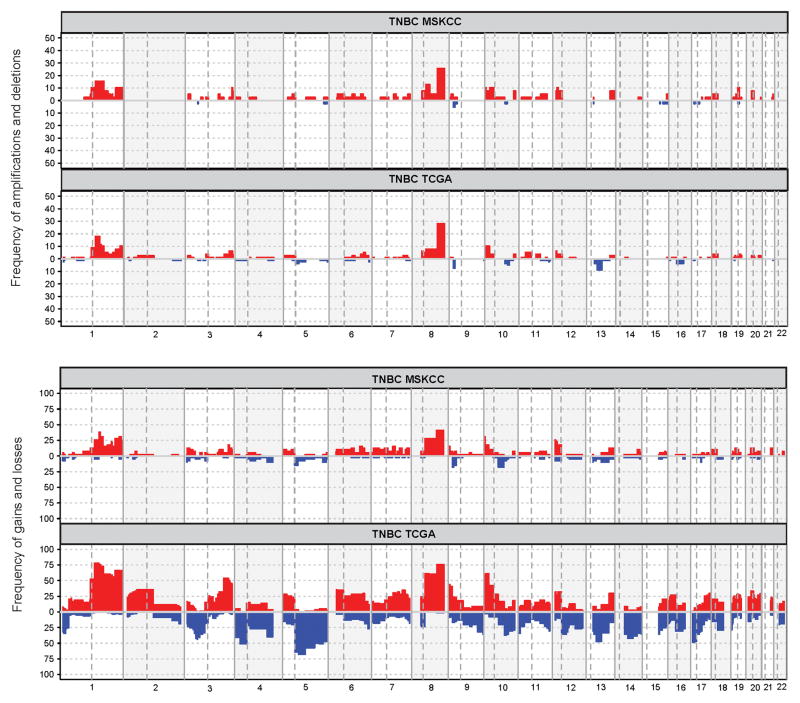
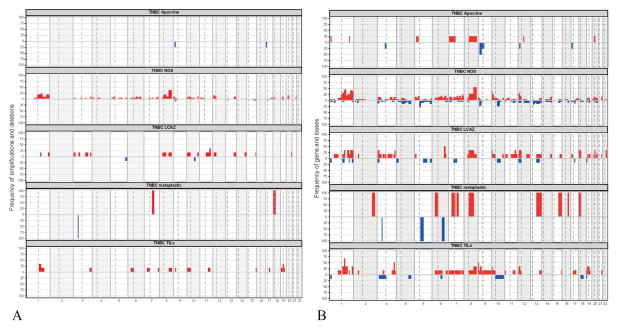
Triple negative breast cancer represents a heterogeneous group of breast carcinomas, both at the histologic and genetic level. Although recent molecular studies have comprehensively characterized the genetic landscape of these tumors, few have integrated a detailed histologic examination into the analysis. In this study, we defined the genetic alterations in 39 triple negative breast cancers using a high-depth targeted massively parallel sequencing assay and correlated the findings with a detailed morphologic analysis. We obtained representative frozen tissue of primary triple negative breast cancers from patients treated at our institution between 2002 and 2010. We characterized tumors according to their histologic subtype and morphologic features. DNA was extracted from paired frozen primary tumor and normal tissue samples and was subjected to a targeted massively parallel sequencing platform comprising 229 cancer-associated genes common across all experiments. The average number of non-synonymous mutations was 3 (range 0-10) per case. The most frequent somatic alterations were mutations in TP53 (74%) and PIK3CA (10%) and MYC amplifications (26%). Triple negative breast cancers with apocrine differentiation less frequently harbored TP53 mutations (25%) and MYC gains (0%), and displayed a high mutation frequency in PIK3CA and other PI3K signaling pathway-related genes (75%). Using a targeted massively parallel sequencing platform, we identified the key somatic genetic alterations previously reported in triple negative breast cancers. Furthermore, our findings show that triple negative breast cancers with apocrine differentiation constitute a distinct subset, characterized by a high frequency of PI3K pathway alterations similar to luminal subtypes of breast cancer.
三阴性乳腺癌在组织学和基因水平上均代表一组异质性的乳腺癌。尽管最近的分子研究已全面描述了这些肿瘤的基因图谱,但很少有研究将详细的组织学检查纳入分析中。在本研究中,我们使用高深度靶向大规模平行测序分析确定了39例三阴性乳腺癌中的基因改变,并将结果与详细的形态学分析相关联。我们从2002年至2010年在我们机构接受治疗的患者中获取了原发性三阴性乳腺癌的代表性冷冻组织。我们根据肿瘤的组织学亚型和形态学特征对其进行了分类。从配对的冷冻原发性肿瘤和正常组织样本中提取DNA,并将其应用于一个靶向大规模平行测序平台,该平台包含所有实验中通用的229个癌症相关基因。每例患者非同义突变的平均数量为3个(范围为0至10个)。最常见的体细胞改变是TP53突变(74%)、PIK3CA突变(10%)和MYC扩增(26%)。具有大汗腺分化的三阴性乳腺癌较少出现TP53突变(25%)和MYC扩增(0%),并且在PI3KCA和其他PI3K信号通路相关基因中显示出高突变频率(75%)。通过靶向大规模平行测序平台,我们确定了先前在三阴性乳腺癌中报道的关键体细胞基因改变。此外,我们的研究结果表明,具有大汗腺分化的三阴性乳腺癌构成一个独特的亚组,其特征是PI3K通路改变的频率较高,类似于乳腺癌的管腔亚型。