Mandrekar Pranoti, Bataller Ramon, Tsukamoto Hidekazu, Gao Bin
Department of Medicine, University of Massachusetts Medical School, Worcester, MA.
Division of Gastroenterology and Hepatology, Departments of Medicine and Nutrition, University of North Carolina at Chapel Hill, Chapel Hill, NC.
Hepatology. 2016 Oct;64(4):1343-55. doi: 10.1002/hep.28530. Epub 2016 Apr 15.
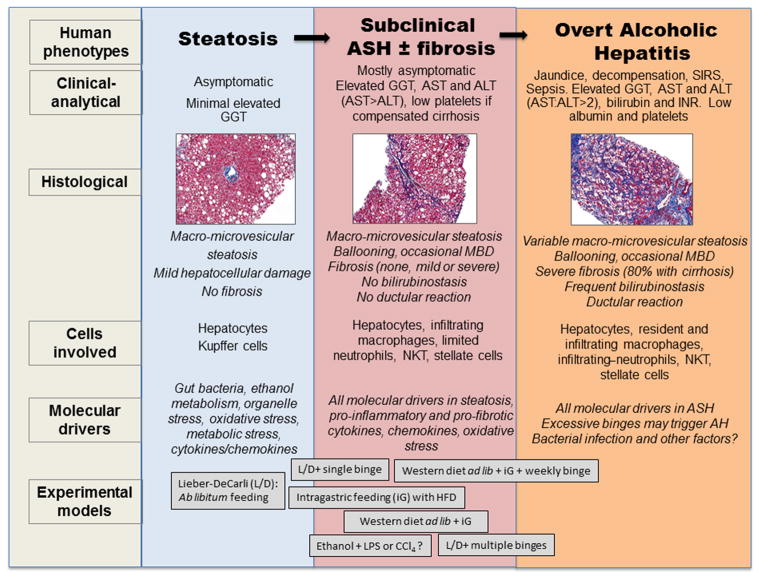
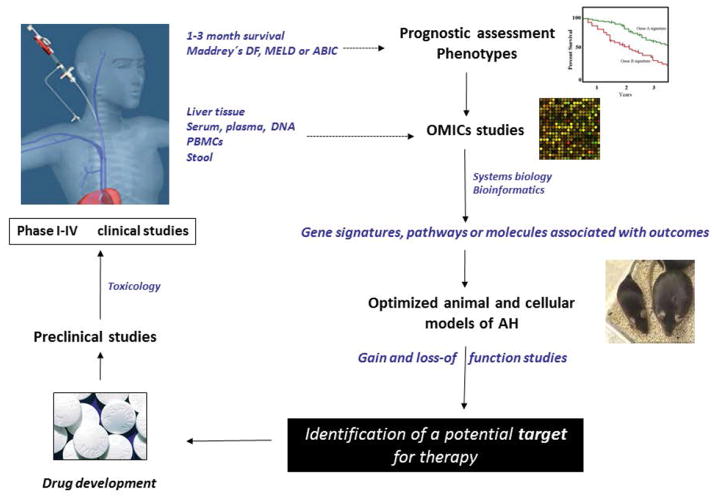
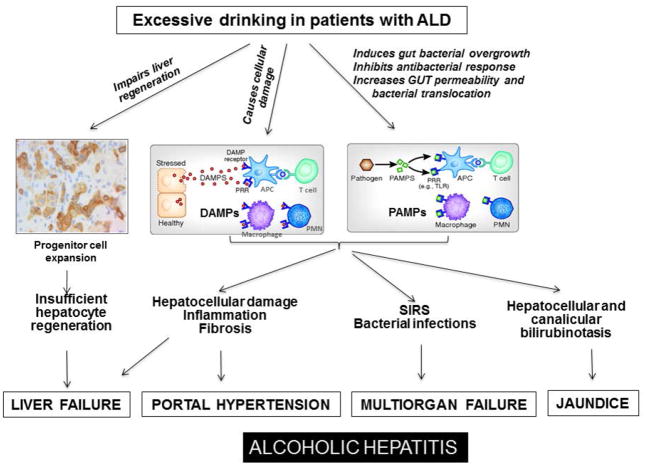
Alcoholic liver disease is a leading cause of liver-related mortality worldwide. In contrast to recent advances in therapeutic strategies for patients with viral hepatitis, there is a significant lack of novel therapeutic options for patients with alcoholic liver disease. In particular, there is an urgent need to focus our efforts on effective therapeutic interventions for alcoholic hepatitis (AH), the most severe form of alcoholic liver disease. AH is characterized by an abrupt development of jaundice and complications related to liver insufficiency and portal hypertension in patients with heavy alcohol intake. The mortality of patients with AH is very high (20%-50% at 3 months). Available therapies are not effective in many patients, and targeted approaches are imminently needed. The development of such therapies requires translational studies in human samples and suitable animal models that reproduce the clinical and histological features of AH. In recent years, new animal models that simulate some of the features of human AH have been developed, and translational studies using human samples have identified potential pathogenic factors and histological parameters that predict survival.
This review summarizes the unmet needs for translational studies on the pathogenesis of AH, preclinical translational tools, and emerging drug targets to benefit the AH patient. (Hepatology 2016;64:1343-1355).
酒精性肝病是全球肝脏相关死亡的主要原因。与病毒性肝炎患者治疗策略的最新进展形成对比的是,酒精性肝病患者严重缺乏新的治疗选择。特别是,我们迫切需要将精力集中在针对酒精性肝炎(AH)的有效治疗干预上,AH是酒精性肝病最严重的形式。AH的特征是大量饮酒的患者突然出现黄疸以及与肝功能不全和门静脉高压相关的并发症。AH患者的死亡率非常高(3个月时为20% - 50%)。现有疗法对许多患者无效,因此迫切需要有针对性的方法。此类疗法的开发需要在人类样本和能够重现AH临床和组织学特征的合适动物模型上进行转化研究。近年来,已经开发出了一些模拟人类AH某些特征的新动物模型,并且使用人类样本的转化研究已经确定了预测生存的潜在致病因素和组织学参数。
本综述总结了在AH发病机制的转化研究、临床前转化工具以及新出现的药物靶点方面尚未满足的需求,以造福AH患者。(《肝脏病学》2016年;64卷:1343 - 1355页)