Cheung W-H, Li C-Y, Zhu T Y, Leung K-S
Department of Orthopaedics and Traumatology, 5/F, Clinical Sciences Building, The Chinese University of Hong Kong, Shatin, New Territories, Hong Kong SAR, China.
J Musculoskelet Neuronal Interact. 2016 Mar;16(1):4-11.
To investigate the effects on muscle performance after one-year cessation of 18-month low-magnitude high-frequency vibration (LMHFV) intervention in the untrained community elderly.
This is a case-control study with 59 community elderly women (25 control without any treatment; 34 received 18-month LMHFV but discontinued for 1 year from our previous clinical study). Muscle strength, balancing ability, occurrence of fall/fracture, quality of life (QoL) were assessed 1-year after cessation of intervention. The 30-month results were compared with baseline and 18-month treatment endpoint data between groups.
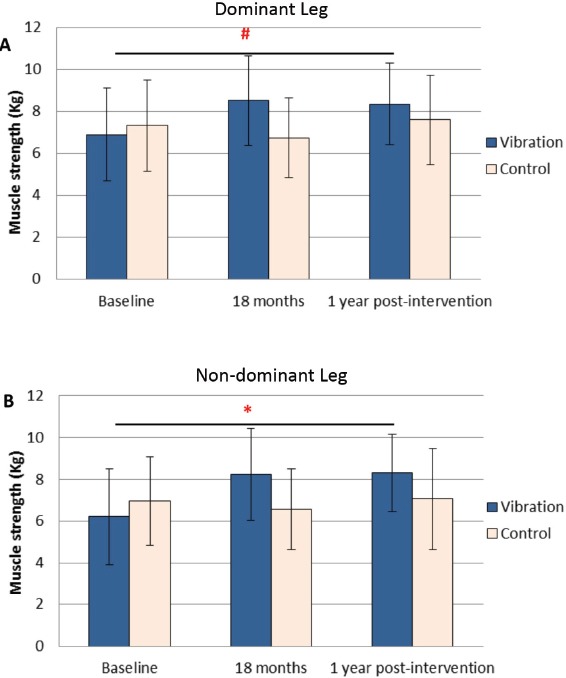
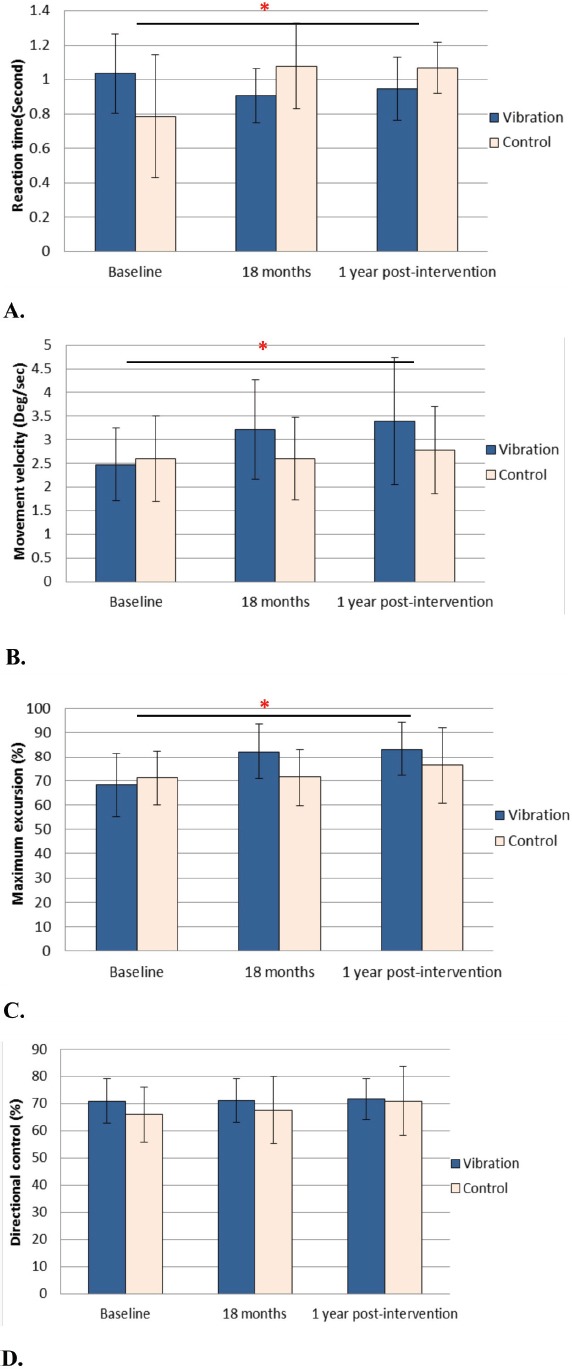
At 30 months (i.e. one year post-intervention), the muscle strengths of dominant and non-dominant legs relative to baseline in treatment group were significantly better than those of control. In balancing ability test, reaction time, movement velocity and maximum excursion of treatment group (relative to baseline) remained significantly better than the control group. The muscle strength, balancing ability and quality of life at 30 months relative to 18 months did not show significant differences between the two groups.
The benefits of LMHFV for balancing ability, muscle strength and risk of falling in elderly were retained 1 year after cessation of LMHFV.
研究在未受过训练的社区老年人中,18个月的低强度高频振动(LMHFV)干预停止一年后对肌肉性能的影响。
这是一项病例对照研究,纳入了59名社区老年女性(25名未接受任何治疗作为对照组;34名接受了18个月的LMHFV干预,但从我们之前的临床研究开始已停止干预1年)。在干预停止1年后评估肌肉力量、平衡能力、跌倒/骨折发生率、生活质量(QoL)。将30个月的结果与两组之间的基线和18个月治疗终点数据进行比较。
在30个月时(即干预后1年),治疗组优势腿和非优势腿相对于基线的肌肉力量显著优于对照组。在平衡能力测试中,治疗组的反应时间、运动速度和最大偏移(相对于基线)仍显著优于对照组。两组在30个月时相对于18个月时的肌肉力量、平衡能力和生活质量均未显示出显著差异。
在停止LMHFV干预1年后,其对老年人平衡能力、肌肉力量和跌倒风险的益处依然存在。