Gorney A M, Blau S R, Dohse C S, Griffith E H, Williams K D, Lim J-H, Knazovicky D, Lascelles B D X, Olby N J
Department of Clinical Sciences, College of Veterinary Medicine, North Carolina State University, Raleigh, NC.
Department of Statistics, North Carolina State University, Raleigh, NC.
J Vet Intern Med. 2016 Mar-Apr;30(2):627-35. doi: 10.1111/jvim.13913. Epub 2016 Mar 5.
Intervertebral disc herniation is a common cause of spinal cord injury (SCI) causing paralysis and sensory loss. Little quantitative information is available on the loss and recovery of sensation in dogs with SCI.
To determine whether quantitative sensory testing (QST) can be used to establish thermal and mechanical sensory thresholds in chrondrodystrophoid dogs and compare thresholds among normal dogs and dogs with different grades of SCI.
Thirty-three client-owned chondrodystrophoid dogs: 15 normal and 18 SCI dogs.
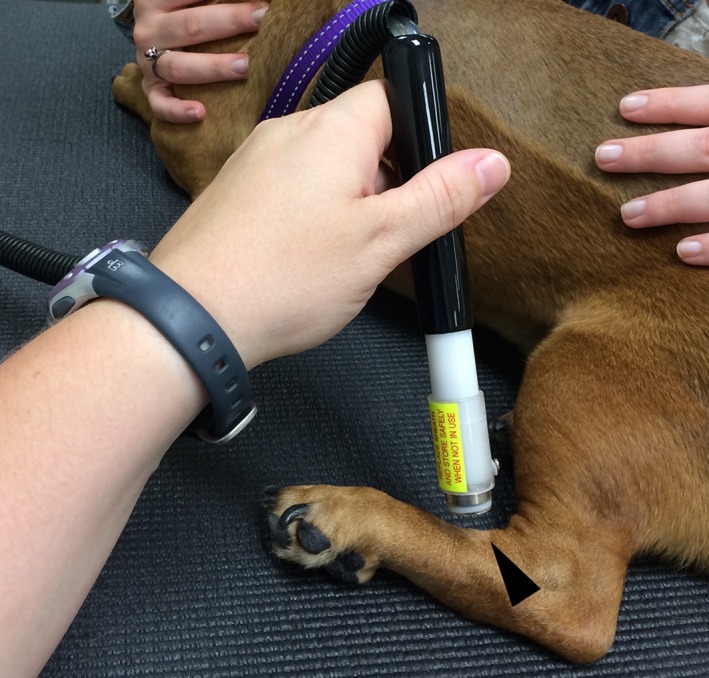
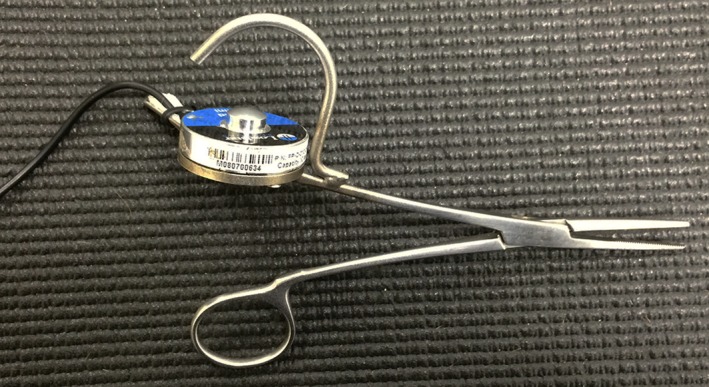
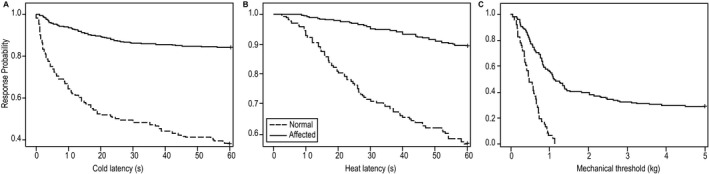
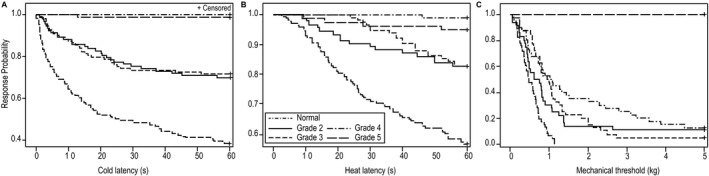
Thermal testing was performed by placing a hot (49°C) and cold (5°C) probe on the dorsal metatarsus and mechanical thresholds were tested using calibrated forceps to apply force to the lateral digit. Stimuli were applied until acknowledged, and response rate, latency, and force applied to response were recorded. Test-retest repeatability was determined by calculating intraclass correlation coefficients. Response rates were compared using logistic regression and thresholds were compared using Kaplan-Meier Survival curves.
Testing was feasible with moderate repeatability. Thresholds and response rates were significantly different between normal and SCI dogs for all modalities (P < .001). When dogs were grouped by their clinical grade, each grade was significantly different from normal dogs, and cold stimuli differentiated among all grades.
Sensory thresholds can be measured reliably in chondrodystrophoid dogs and are altered by SCI. The differences in sensation among neurologic grades indicate that these techniques can be used to further characterize recovery of SCI dogs.
椎间盘突出是脊髓损伤(SCI)导致瘫痪和感觉丧失的常见原因。关于脊髓损伤犬感觉丧失和恢复的定量信息很少。
确定定量感觉测试(QST)是否可用于确定软骨发育不良犬的热感觉和机械感觉阈值,并比较正常犬和不同等级脊髓损伤犬的阈值。
33只客户拥有的软骨发育不良犬:15只正常犬和18只脊髓损伤犬。
通过将热(49°C)和冷(5°C)探头置于跖背进行热测试,使用校准镊子对外侧趾施加力来测试机械阈值。施加刺激直至得到确认,并记录反应率、潜伏期和引起反应所需的力。通过计算组内相关系数来确定重测重复性。使用逻辑回归比较反应率,使用Kaplan-Meier生存曲线比较阈值。
测试具有中等重复性,是可行的。正常犬和脊髓损伤犬在所有模式下的阈值和反应率均有显著差异(P < .001)。当根据临床等级对犬进行分组时,每个等级与正常犬均有显著差异,并且冷刺激在所有等级之间存在差异。
在软骨发育不良犬中可以可靠地测量感觉阈值,并且脊髓损伤会改变这些阈值。神经学等级之间感觉的差异表明,这些技术可用于进一步描述脊髓损伤犬的恢复情况。