Li Zhongjie, Zhang Qian, Zheng Canjun, Zhou Sheng, Sun Junling, Zhang Zike, Geng Qibin, Zhang Honglong, Wang Liping, Lai Shengjie, Hu Wenbiao, Clements Archie C A, Zhou Xiao-Nong, Yang Weizhong
Division of Infectious Diseases, Key Laboratory of Surveillance and Early-warning on Infectious Disease, Chinese Center for Disease Control and Prevention, 155 Changbai Road, Changping, 102206, Beijing, China.
Center of Clinical Laboratory, the First Affiliated Hospital, College of Medicine, Zhejiang University, Hangzhou, China.
Malar J. 2016 Mar 5;15:141. doi: 10.1186/s12936-016-1188-7.
With the dramatic increase in international travel among Chinese people, the risk of malaria importation from malaria-endemic regions threatens the achievement of the malaria elimination goal of China.
Epidemiological investigations of all imported malaria cases were conducted in nine provinces of China from 1 Nov, 2013 to 30 Oct, 2014. Plasmodium species, spatiotemporal distribution, clinical severity, preventive measures and infection history of the imported malaria cases were analysed using descriptive statistics.
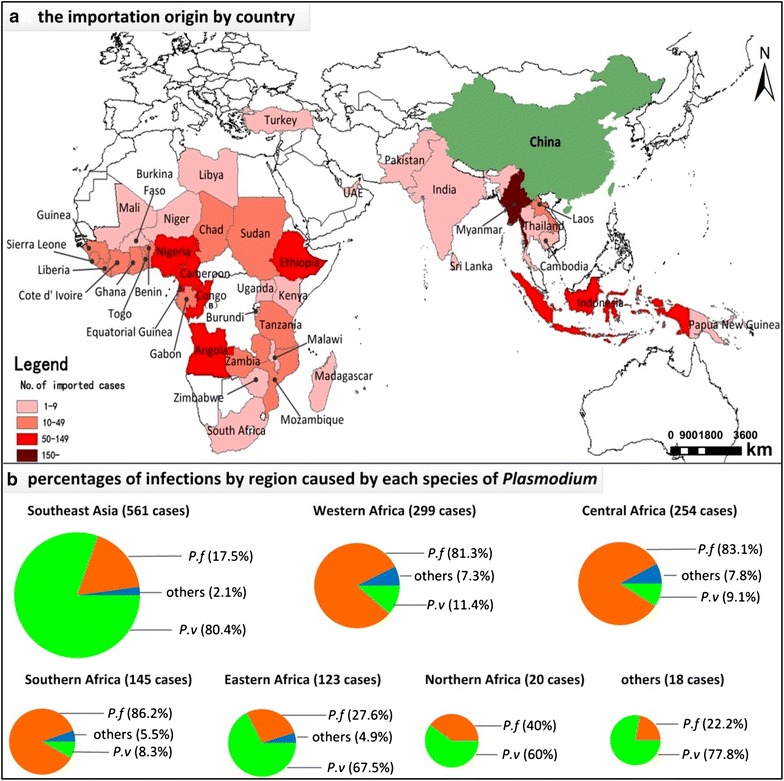
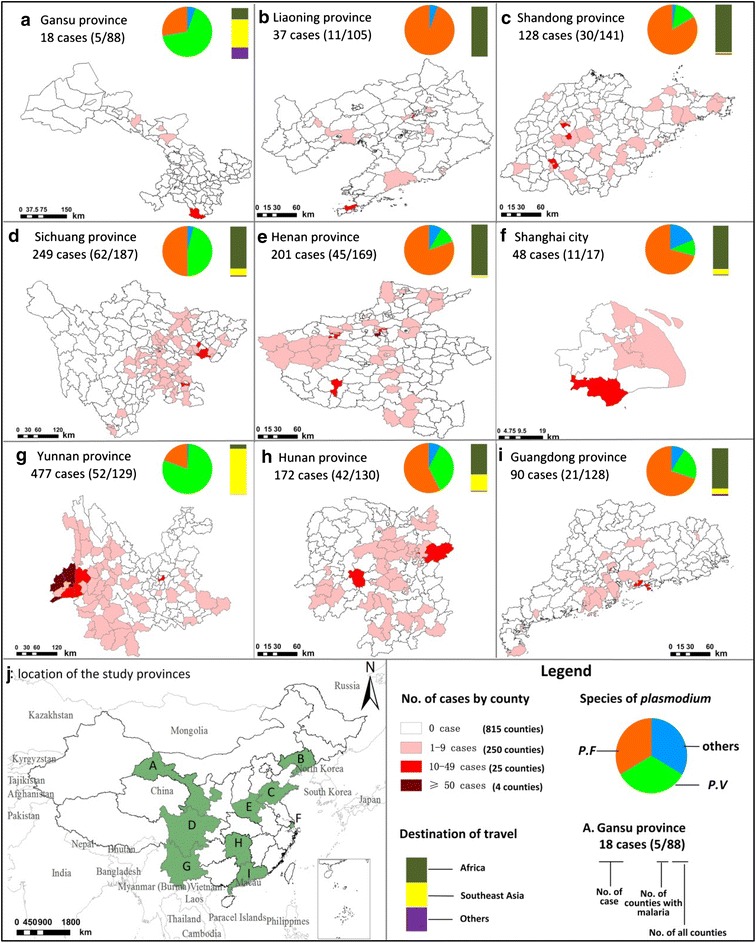
A total of 1420 imported malaria cases were recorded during the study period, with P. falciparum (723 cases, 50.9 %) and P. vivax (629 cases, 44.3 %) being the two predominant species. Among them, 81.8 % of cases were in Chinese overseas labourers. The imported cases returned from 41 countries, mainly located in Africa (58.9 %) and Southeast Asia (39.4 %). About a quarter (25.5 %, 279/1094) of counties in the nine study provinces were affected by imported malaria cases. There were 112 cases (7.9 %) developing complicated malaria, including 12 deaths (case fatality rate: 0.8 %). Only 27.8 % of the imported cases had taken prophylactic anti-malarial drugs. While staying abroad, 27.7 % of the cases had experienced two or more episodes of malaria infection. The awareness of clinical manifestations and the capacity for malaria diagnosis were weak in private clinics and primary healthcare facilities.
Imported malaria infections among Chinese labourers, returned from various countries, poses an increasing challenge to the malaria elimination programme in China. The risk of potential re-introduction of malaria into inland malaria-free areas of China should be urgently addressed.
随着中国人国际旅行的急剧增加,来自疟疾流行地区的疟疾输入风险威胁着中国消除疟疾目标的实现。
2013年11月1日至2014年10月30日,在中国9个省份对所有输入性疟疾病例进行了流行病学调查。采用描述性统计方法分析输入性疟疾病例的疟原虫种类、时空分布、临床严重程度、预防措施及感染史。
研究期间共记录1420例输入性疟疾病例,其中恶性疟原虫(723例,50.9%)和间日疟原虫(629例,44.3%)为两个主要种类。其中,81.8%的病例为中国海外务工人员。输入病例来自41个国家,主要位于非洲(58.9%)和东南亚(39.4%)。9个研究省份中约四分之一(25.5%,279/1094)的县受到输入性疟疾病例的影响。有112例(7.9%)发生重症疟疾,其中12例死亡(病死率:0.8%)。仅27.8%的输入病例服用过预防性抗疟药物。在国外期间,27.7%的病例曾经历过两次或更多次疟疾感染。私立诊所和基层医疗机构对临床表现的认识及疟疾诊断能力较弱。
来自不同国家的中国务工人员中的输入性疟疾感染,对中国的疟疾消除计划构成了日益严峻的挑战。应紧急应对疟疾重新传入中国内陆无疟疾地区的潜在风险。