Department of Urology, New York University, New York, New York; Population Health, New York University, New York, New York; Laura and Isaac Perlmutter Cancer Center, New York University, New York, New York.
Population Health, New York University, New York, New York.
J Urol. 2016 Sep;196(3):721-6. doi: 10.1016/j.juro.2016.02.2963. Epub 2016 Mar 2.
While major prostate cancer active surveillance programs recommend repeat testing such as prostate specific antigen and prostate biopsy, to our knowledge compliance with such testing is unknown. We determined whether men in the community receive the same intensity of active surveillance testing as in prospective active surveillance protocols.
We performed a retrospective cohort study of men 66 years old or older in the SEER (Surveillance, Epidemiology and End Results)-Medicare database. These men were diagnosed with prostate cancer from 2001 to 2009, did not receive curative therapy in the year after diagnosis and underwent 1 or more post-diagnosis prostate biopsies. We used multivariable adjusted Poisson regression to determine the association of the frequency of active surveillance testing with patient demographics and clinical features. In 1,349 men with 5 years of followup we determined the proportion who underwent testing as intense as that recommended by the Sunnybrook Health Sciences Centre and PRIAS (Prostate Cancer Research International Active Surveillance) programs, including 14 or more PSA tests and 2 or more biopsies, and The Johns Hopkins program, including 10 or more prostate specific antigen tests and 4 or more biopsies.
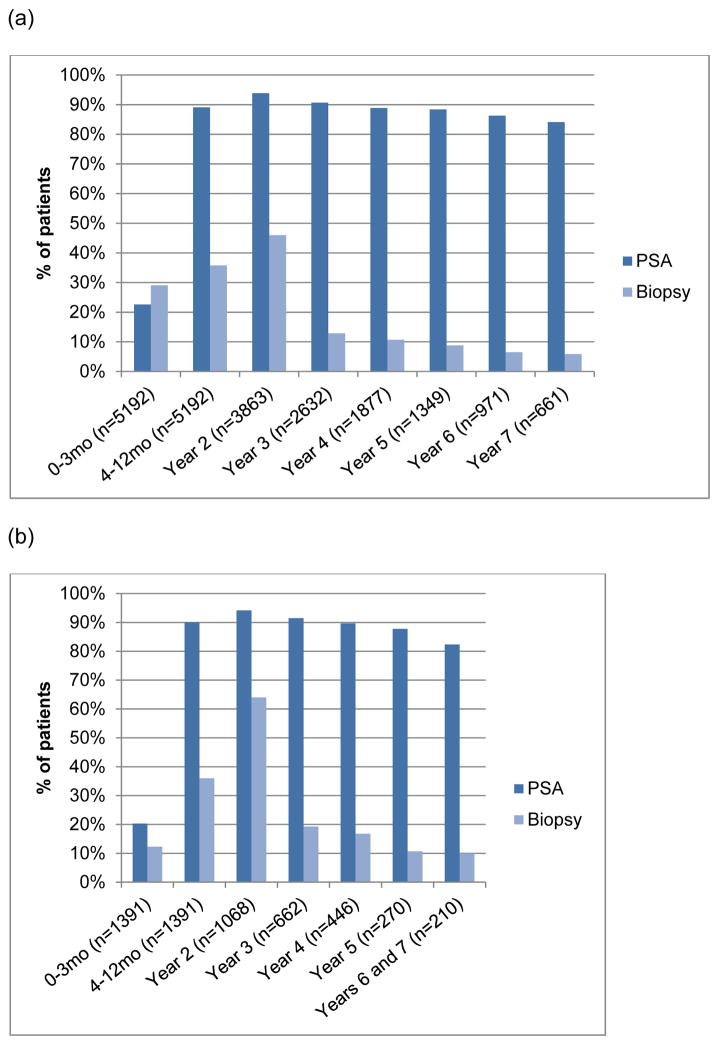
Among 5,192 patients undergoing active surveillance greater than 80% had 1 or more prostate specific antigen tests per year but fewer than 13% underwent biopsy beyond the first 2 years. Magnetic resonance imaging was rarely done during the study period. On multivariable analysis recent diagnosis and higher income were associated with a higher frequency of surveillance biopsy while older age and greater comorbidity were associated with fewer biopsies. African American men underwent fewer prostate specific antigen tests but a similar number of biopsies. During 5 years of active surveillance only 11.1% and 5.0% of patients met the testing standards of the Sunnybrook/PRIAS and The Johns Hopkins programs, respectively.
In the community few elderly men receive the intensity of active surveillance testing recommended in major prospective active surveillance programs.
虽然主要的前列腺癌主动监测项目建议重复检测前列腺特异性抗原和前列腺活检等,但据我们所知,这种检测的依从性尚不清楚。我们确定社区中的男性是否接受与前瞻性主动监测方案相同强度的主动监测检测。
我们对 SEER(监测、流行病学和最终结果)-医疗保险数据库中 66 岁或以上的男性进行了回顾性队列研究。这些男性在 2001 年至 2009 年间被诊断患有前列腺癌,在诊断后的第一年未接受治愈性治疗,并进行了 1 次或多次诊断后前列腺活检。我们使用多变量调整泊松回归来确定主动监测检测频率与患者人口统计学和临床特征的关联。在 1349 名随访 5 年的男性中,我们确定了符合 Sunnybrook 健康科学中心和 PRIAS(前列腺癌研究国际主动监测)计划建议的检测强度的比例,包括 14 次或更多前列腺特异性抗原检测和 2 次或更多活检,以及约翰霍普金斯计划,包括 10 次或更多前列腺特异性抗原检测和 4 次或更多活检。
在 5192 名接受主动监测的患者中,超过 80%的患者每年接受 1 次或多次前列腺特异性抗原检测,但不到 13%的患者在第 2 年之后接受了活检。在研究期间很少进行磁共振成像检查。多变量分析显示,最近诊断和较高收入与较高的监测活检频率相关,而年龄较大和合并症较多与较少的活检相关。非裔美国男性接受的前列腺特异性抗原检测较少,但活检数量相似。在 5 年的主动监测期间,只有 11.1%和 5.0%的患者分别符合 Sunnybrook/PRIAS 和约翰霍普金斯计划的检测标准。
在社区中,很少有老年男性接受主要前瞻性主动监测方案中建议的主动监测检测强度。