Frare J-C, Sawazaki-Calone I, Ayroza-Rangel A-L-C, Bueno A-G, de Morais C-F, Nagai H-M, Kunz R, Lopes M-A
Faculdade de Odontologia de Piracicaba -UNICAMP, Departamento de Diagnóstico Oral - Semiologia, Av. Limeira, 901. Piracicaba, São Paulo - Brazil, CEP: 13414-903,
Med Oral Patol Oral Cir Bucal. 2016 May 1;21(3):e285-98. doi: 10.4317/medoral.20953.
To analyze the clinicopathological profile of young patients (≤ 40 years) with oral SCC and correlate with a control group (≥ 50 years) by means of histopathological grading systems.
14 young patients and 14 control patients were selected with similar clinical stage and tumor location. Demographic and clinical data were obtained from patient records and histological sections were evaluated according to four histopathological grading systems. Associations between categories of demographic and clinical data were performed through Chi-square test and Exact Fisher test. The survival analyzes were performed according to the Kaplan-Meier method.
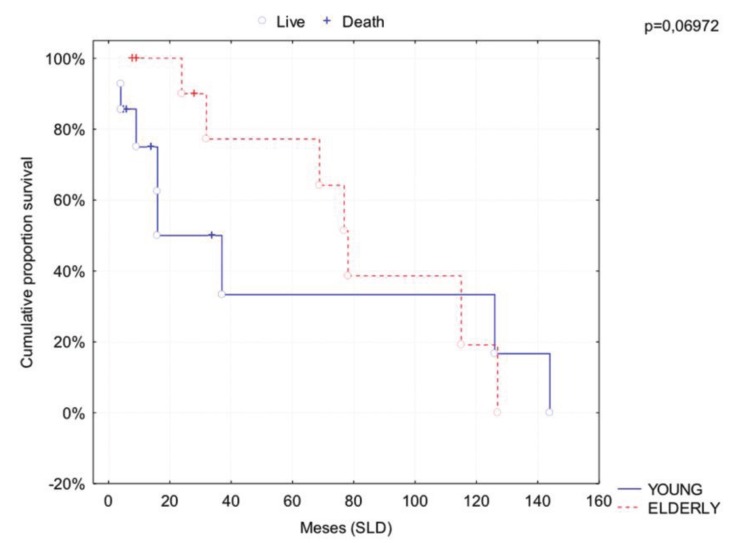
The comparison between groups showed a greater association of treatment modalities in younger patients (p=0.022), they had a higher incidence of local recurrence and regional metastasis (p=0.018) and lower disease-free survival in 5 years (p=0.069). There was no difference in 5-year overall survival among the studied groups. There was no difference in histological grading between studied groups according to the four used systems.
This study showed that, despite tumors had similar histological grade and more therapeutic modalities were used in the young group, tumors in young patients had a higher incidence of recurrence/metastasis, showing tendency to a more aggressive behavior.
分析年轻(≤40岁)口腔鳞状细胞癌患者的临床病理特征,并通过组织病理学分级系统与对照组(≥50岁)进行对比。
选取14例年轻患者和14例对照患者,其临床分期和肿瘤部位相似。从患者记录中获取人口统计学和临床数据,并根据四种组织病理学分级系统对组织学切片进行评估。通过卡方检验和精确费舍尔检验对人口统计学和临床数据类别之间的关联进行分析。采用Kaplan-Meier方法进行生存分析。
组间比较显示年轻患者的治疗方式关联更大(p=0.022),局部复发和区域转移发生率更高(p=0.018),5年无病生存率更低(p=0.069)。研究组间5年总生存率无差异。根据所使用的四种系统,研究组间组织学分级无差异。
本研究表明,尽管肿瘤组织学分级相似且年轻组采用了更多治疗方式,但年轻患者的肿瘤复发/转移发生率更高,表现出更具侵袭性的行为倾向。