Oral Oncology Center, Araçatuba Dental School São Paulo State University - UNESP José Bonifácio Street, 1193, Araçatuba São Paulo, 16015-050, Brazil
Med Oral Patol Oral Cir Bucal. 2020 May 1;25(3):e416-e424. doi: 10.4317/medoral.23461.
To describe the clinicopathologic profile of young patients with head and neck squamous cell carcinoma (HNSCC) and compare to middle-aged and elderly adults.
Patients' individual records were reviewed for clinicopathologic data. Eighty-nine patients with age 18-45 years old met the inclusion criteria of the study. Two additional groups of middle-aged (n=89) and old (n=89) adults were set to comparative analysis.
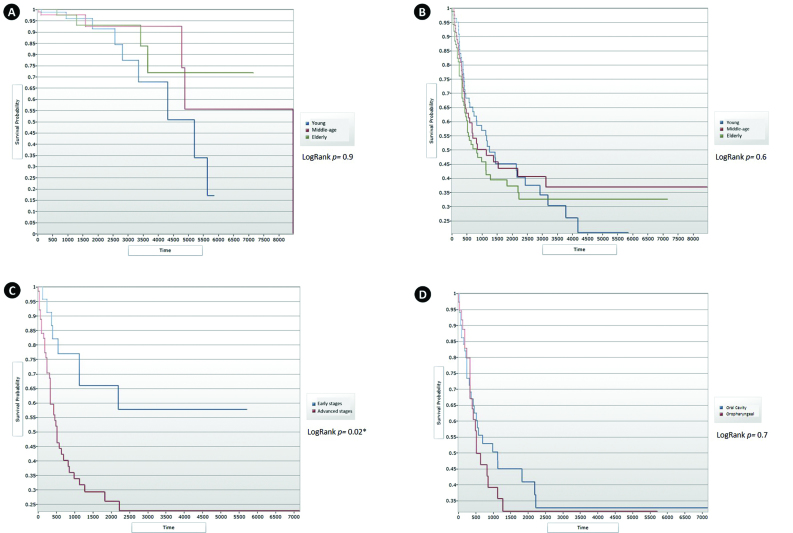
Young patients represented 11.9% of all patients diagnosed with HNSCC. Women were more affected by HNSCC in the young and elder groups (p= 0.04), and young patients were more prone to be non-smokers (p= 0.01) and have lymph node metastasis at the time of diagnosis (p=0.04). In the young group, patients diagnosed with the disease in advanced stages were more prone to have a positive familial history of cancer (p= 0.04), a positive status of alcohol consumption (p= 0.03), and to be heavy drinkers (p= 0.01). Survival was not different for the young group in comparison to the other groups.
HNSCC in young patients had a different profile when compared to older patients, especially regarding sex and exposure to the classic risk factors for this disease. The survival of the young group is similar to the older groups and advanced clinical stage is predictor of worse survival.
描述年轻头颈鳞状细胞癌(HNSCC)患者的临床病理特征,并与中老年患者进行比较。
回顾性分析患者的个体病历,以获取临床病理数据。符合研究纳入标准的 18-45 岁患者共 89 例。另外设置了年龄在中年(n=89)和老年(n=89)的两组成年人作为对照分析。
年轻患者占所有 HNSCC 患者的 11.9%。在年轻和老年组中,女性更容易受到 HNSCC 的影响(p=0.04),而年轻患者更倾向于不吸烟(p=0.01),且在诊断时更容易发生淋巴结转移(p=0.04)。在年轻组中,诊断为晚期疾病的患者更倾向于有癌症家族史(p=0.04)、有酒精摄入阳性史(p=0.03)和酗酒史(p=0.01)。与其他组相比,年轻组的生存率没有差异。
与老年患者相比,年轻患者的 HNSCC 具有不同的特征,尤其是在性别和接触该疾病的经典危险因素方面。年轻组的生存率与老年组相似,而晚期临床分期是生存率较差的预测因素。