Park Jaechan, Chang Won Hyuk, Cho Jin Whan, Youn Jinyoung, Kim Yun Kwan, Kim Sun Woong, Kim Yun-Hee
Department of Physical and Rehabilitation Medicine, Center for Prevention and Rehabilitation, Heart Vascular and Stroke Institute, Samsung Medical Center, Sungkyunkwan University School of Medicine, Seoul, Korea.
Department of Neurology, Samsung Medical Center, Sungkyunkwan University School of Medicine, Seoul, Korea.
Ann Rehabil Med. 2016 Feb;40(1):81-7. doi: 10.5535/arm.2016.40.1.81. Epub 2016 Feb 26.
To investigate the clinical significance of upper and lower extremity transcranial magnetic stimulation (TMS)-induced motor evoked potentials (MEPs) in patients with parkinsonism.
Twenty patients (14 men, 6 women; mean age 70.5±9.1 years) suffering from parkinsonism were included in this study. All participants underwent single-pulse TMS session to assess the corticospinal excitability of the upper and lower extremity motor cortex. The resting motor threshold (RMT) was defined as the lowest stimulus intensity able to evoke MEPs of an at least 50 µV peak-to-peak amplitude in 5 of 10 consecutive trials. Five sweeps of MEPs at 120% of the RMT were performed, and the mean amplitude and latency of the MEPs were calculated. Patients were also assessed using the Unified Parkinson's Disease Rating Scale part III (UPDRS-III) and the 5-meter Timed Up and Go (5m-TUG) test.
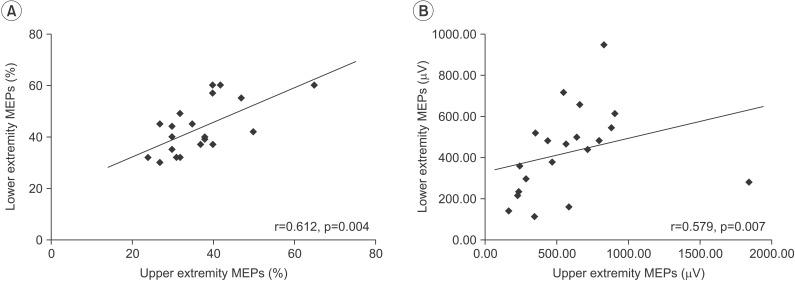
There was a significant positive correlation between the RMTs of MEPs in the upper and lower extremities (r=0.612, p=0.004) and between the amplitude of MEPs in the upper and lower extremities (r=0.579, p=0.007). The RMT of upper extremity MEPs showed a significant negative relationship with the UPDRS-III score (r=-0.516, p=0.020). In addition, RMTs of lower extremity MEPs exhibited a negative relationship with the UPDRS-III score, but the association was not statistically significant (r=-406, p=0.075).
These results indicated that the RMT of MEPs reflect the severity of motor dysfunction in patients with parkinsonism. MEP is a potential quantitative, electrodiagnostic method to assess motor function in patients with parkinsonism.
探讨帕金森综合征患者上下肢经颅磁刺激(TMS)诱发运动诱发电位(MEP)的临床意义。
本研究纳入20例帕金森综合征患者(14例男性,6例女性;平均年龄70.5±9.1岁)。所有参与者均接受单脉冲TMS检查,以评估上下肢运动皮层的皮质脊髓兴奋性。静息运动阈值(RMT)定义为在连续10次试验中的5次中,能够诱发至少50 μV峰峰值幅度MEP的最低刺激强度。在RMT的120%下进行5次MEP扫描,并计算MEP的平均幅度和潜伏期。患者还使用统一帕金森病评定量表第三部分(UPDRS-III)和5米计时起立行走(5m-TUG)测试进行评估。
上下肢MEP的RMT之间存在显著正相关(r=0.612,p=0.004),上下肢MEP的幅度之间也存在显著正相关(r=0.579,p=0.007)。上肢MEP的RMT与UPDRS-III评分呈显著负相关(r=-0.516,p=0.020)。此外,下肢MEP的RMT与UPDRS-III评分呈负相关,但这种关联无统计学意义(r=-0.406,p=0.075)。
这些结果表明,MEP的RMT反映了帕金森综合征患者运动功能障碍的严重程度。MEP是评估帕金森综合征患者运动功能的一种潜在的定量电诊断方法。