Abdelhamid A M, Mahmoud Aaa, Abdelhaq M M, Yasin H M, Bayoumi Asm
Department of Anesthesia, Faculty of Medicine, Benha University, Benha, Egypt.
Department of Anesthesia, Faculty of Medicine, Beni Suef University, Beni Suef, Egypt.
Saudi J Anaesth. 2016 Jan-Mar;10(1):50-4. doi: 10.4103/1658-354X.169475.
No studies compared parenteral dexmedetomidine with its use as an adjuvant to ophthalmic block. We compared between adding dexmedetomidine to bupivacaine in peribulbar block and intravenous (IV) dexmedetomidine during peribulbar block for cataract surgery.
A prospective, randomized, double-blind study on 90 patients for cataract surgery under peribulbar anesthesia. Study included three groups; all patients received 10 ml of peribulbar anesthesia and IV infusion of drugs as follows: Group I: Received a mixture of bupivacaine 0.5% (4.5 ml) + lidocaine 2% (4.5 ml) + normal saline (1 ml) + 150 IU hyaluronidase + IV infusion of normal saline, Group II: Received mixture of bupivacaine 0.5% (4.5 ml) + lidocaine 2% (4.5 ml) + dexmedetomidine 50 μg (1 ml) +150 IU hyaluronidase + IV infusion of normal saline and Group III: Received mixture of bupivacaine 0.5% (4.5 ml) + lidocaine 2% (4.5 ml) + normal saline (1 ml) +150 IU hyaluronidase + IV dexmedetomidine 1 μg/kg over 10 min; followed by 0.4 μg/kg/h IV infusion. We recorded onset, duration of block, Ramsay Sedation Score, intra-ocular pressure (IOP), hemodynamics, and adverse effects.
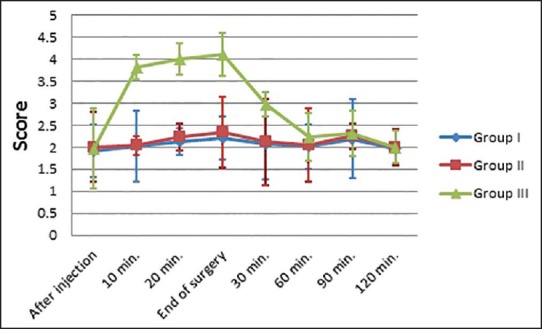
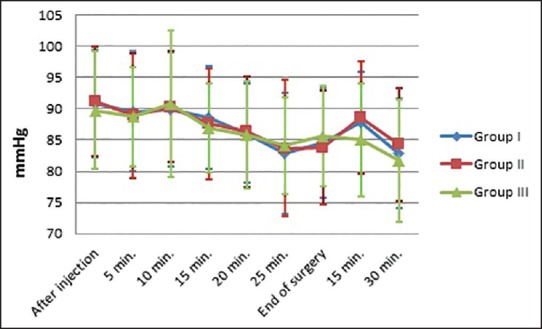
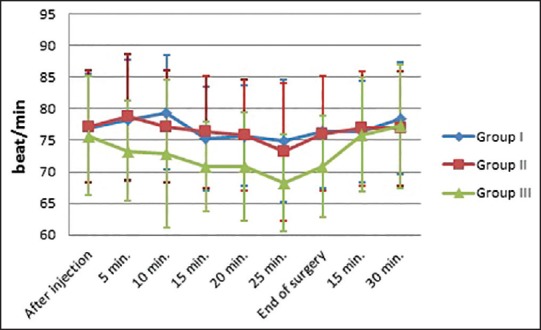
There was a significant decrease in the onset of action and increase in the duration of block in Group II as compared with the Group I and Group III. Mean Ramsay Sedation Score was higher in Group III. The IOP showed a significant decrease in Group II and Group III 10 min after injection (P < 0.01). Heart rate showed a significant decrease in Group III in comparison with the two other groups (P < 0.05). Only two patients in Group III developed bradycardia.
Dexmedetomidine as an additive shortens onset time, prolong block durations and significantly decreases the IOP with minimal side effects. IV dexmedetomidine, in addition, produces intra-operative sedation with hemodynamic stability.
尚无研究比较胃肠外给予右美托咪定及其作为眼科阻滞辅助药物的效果。我们比较了在球周阻滞中于布比卡因中添加右美托咪定与在白内障手术球周阻滞期间静脉注射(IV)右美托咪定的效果。
一项针对90例接受球周麻醉的白内障手术患者的前瞻性、随机、双盲研究。研究包括三组;所有患者均接受10 ml球周麻醉及如下静脉输注药物:第一组:接受0.5%布比卡因(4.5 ml)+2%利多卡因(4.5 ml)+生理盐水(1 ml)+150 IU透明质酸酶的混合物及静脉输注生理盐水;第二组:接受0.5%布比卡因(4.5 ml)+2%利多卡因(4.5 ml)+50 μg右美托咪定(1 ml)+150 IU透明质酸酶的混合物及静脉输注生理盐水;第三组:接受0.5%布比卡因(4.5 ml)+2%利多卡因(4.5 ml)+生理盐水(1 ml)+150 IU透明质酸酶,并在10分钟内静脉注射1 μg/kg右美托咪定;随后以0.4 μg/(kg·h)静脉输注。我们记录了起效时间、阻滞持续时间、Ramsay镇静评分、眼压(IOP)、血流动力学及不良反应。
与第一组和第三组相比,第二组的起效时间显著缩短,阻滞持续时间延长。第三组的平均Ramsay镇静评分更高。注射后10分钟,第二组和第三组的眼压显著降低(P < 0.01)。与其他两组相比,第三组的心率显著降低(P < 0.05)。第三组仅2例患者出现心动过缓。
右美托咪定作为添加剂可缩短起效时间、延长阻滞持续时间,并显著降低眼压,且副作用最小。此外,静脉注射右美托咪定可产生术中镇静并维持血流动力学稳定。