Pezeshki Ali, Safi Sara, Feizi Awat, Askari Gholamreza, Karami Fatemeh
Department of Community Nutrition, School of Nutrition and Food Sciences, Food Security Research Center, Isfahan University of Medical Sciences, Isfahan, Iran; Department of Nutrition and Food Sciences, Metabolic Liver Diseases Research Center, Isfahan University of Medical Sciences, Isfahan, Iran.
School of Medicine, Isfahan University of Medical Sciences, Isfahan, Iran.
Int J Prev Med. 2016 Feb 1;7:28. doi: 10.4103/2008-7802.173051. eCollection 2016.
Green tea is one of the most popular beverages in the world. It is believed to have beneficial effects in the prevention and treatment of many diseases, one of which is nonalcoholic fatty liver disease (NAFLD). The present study investigated the effects of consumption of green tea in NAFLD patients.
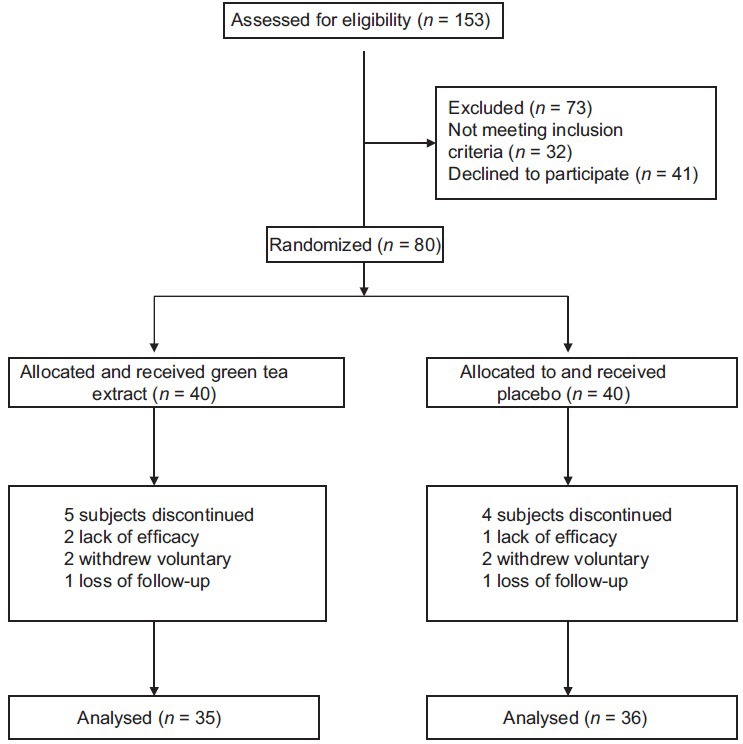
This study was a double-blind, placebo-controlled, randomized clinical trial. Ultrasonography was used to diagnose fatty liver in patients with alanine aminotransferase (ALT) >31 mg/dl and 41 mg/dl and aspartate aminotransferase (AST) >31 mg/dl and 47 g/dl in women and men, respectively and without other hepatic diseases. A total of 80 participants (20-50 years) with NAFLD were randomly allocated into two groups to receive either green tea extract (GTE) supplement (500 mg GTE tablet per day) or placebo for 90 days. At baseline and at the end of the intervention weight, serum ALT, AST, and alkaline phosphatase (ALP) were measured in fasting state, and dietary data were collected at baseline and end of the study.
Green tea group showed significant reductions in ALT and AST levels after 12 weeks period (P < 0.001). The placebo group showed a reduction in ALT and AST levels at the end of the study, but it was no significant. ALP levels showed significant reductions in both groups after 12 weeks period (P < 0.001).
According to the findings of this study, GTE supplementation decrease liver enzymes in patients with NAFLD. It can be claimed that GTE prescribed can be considered as a treatment to improve serum levels of liver enzymes in NAFLD patients.
绿茶是世界上最受欢迎的饮品之一。人们认为它对许多疾病的预防和治疗具有有益作用,非酒精性脂肪性肝病(NAFLD)就是其中之一。本研究调查了饮用绿茶对NAFLD患者的影响。
本研究为双盲、安慰剂对照、随机临床试验。对于丙氨酸氨基转移酶(ALT)>31 mg/dl(女性)和>41 mg/dl(男性)以及天冬氨酸氨基转移酶(AST)>31 mg/dl(女性)和>47 mg/dl(男性)且无其他肝脏疾病的患者,采用超声检查诊断脂肪肝。共有80名年龄在20至50岁之间的NAFLD参与者被随机分为两组,分别接受绿茶提取物(GTE)补充剂(每天500毫克GTE片剂)或安慰剂,为期90天。在基线和干预结束时测量空腹状态下的体重、血清ALT、AST和碱性磷酸酶(ALP),并在基线和研究结束时收集饮食数据。
12周后,绿茶组的ALT和AST水平显著降低(P < 0.001)。安慰剂组在研究结束时ALT和AST水平有所降低,但不显著。12周后,两组的ALP水平均显著降低(P < 0.001)。
根据本研究结果,补充GTE可降低NAFLD患者的肝酶水平。可以认为,所开的GTE可被视为改善NAFLD患者肝酶血清水平的一种治疗方法。