Søndberg Emilie, Jelsbak Lotte
Department of Biology, Copenhagen University, Ole Maaløes Vej 5, DK-2200, Copenhagen N, Denmark.
Department of Science, Systems and Models, Roskilde University, Universitetsvej 1, DK-4000, Roskilde, Denmark.
BMC Microbiol. 2016 Mar 8;16:30. doi: 10.1186/s12866-016-0646-2.
Typhoid fever caused by Salmonella enterica serovar Typhi (S. Typhi) is a severe systemic human disease and endemic in regions of the world with poor drinking water quality and sewage treatment facilities. A significant number of patients become asymptomatic life-long carriers of S. Typhi and serve as the reservoir for the disease. The specific mechanisms and adaptive strategies enabling S. Typhi to survive inside the host for extended periods are incompletely understood. Yet, elucidation of these processes is of major importance for improvement of therapeutic strategies. In the current study genetic adaptation during experimental chronic S. Typhimurium infections of mice, an established model of chronic typhoid fever, was probed as an approach for studying the molecular mechanisms of host-adaptation during long-term host-association.
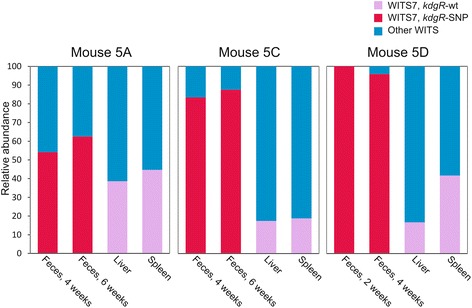
Individually sequence-tagged wild type strains of S. Typhimurium 4/74 were used to establish chronic infections of 129X1/SvJ mice. Over the course of infections, S. Typhimurium bacteria were isolated from feces and from livers and spleens upon termination of the experiment. In all samples dominant clones were identified and select clones were subjected to whole genome sequencing. Dominant clones isolated from either systemic organs or fecal samples exhibited distinct single nucleotide polymorphisms (SNPs). One mouse appeared to have distinct adapted clones in the spleen and liver, respectively. Three mice were colonized in the intestines by the same clone containing the same non-synonymous SNP in a transcriptional regulator, kdgR, of metabolic genes. This likely indicates transmission of this clone between mice. The mutation was tracked to have occurred prior to 2 weeks post infection in one of the three mice and had subsequently been transmitted to the other two mice. Re-infection with this clone confirmed that it is superior to the wild type for intestinal colonization.
During 4 to 6 weeks of chronic infections, S. Typhimurium acquired distinct SNPs in known regulators of metabolic and virulence genes. One SNP, the kdgR-SNP was confirmed to confer selective advantage during chronic infections and constitute a true patho-adaptive mutation. Together, the results provide evidence for rapid genetic adaptation to the host of S. Typhimurium and validate experimental evolution in the context of host infection as a strategy for elucidating pathogen host interactions at the molecular level.
由伤寒沙门氏菌(S. Typhi)引起的伤寒热是一种严重的全身性人类疾病,在世界上饮用水质量差和污水处理设施不完善的地区流行。相当数量的患者成为伤寒沙门氏菌的无症状终身携带者,并成为该疾病的储存宿主。伤寒沙门氏菌在宿主体内长期存活的具体机制和适应性策略尚未完全了解。然而,阐明这些过程对于改进治疗策略至关重要。在当前的研究中,作为研究长期宿主关联期间宿主适应分子机制的一种方法,对小鼠实验性慢性鼠伤寒沙门氏菌感染(一种已建立的慢性伤寒热模型)期间的基因适应性进行了探究。
使用单独的序列标签鼠伤寒沙门氏菌4/74野生型菌株建立129X1/SvJ小鼠的慢性感染。在感染过程中,在实验结束时从粪便以及肝脏和脾脏中分离出鼠伤寒沙门氏菌。在所有样本中鉴定出优势克隆,并对选定的克隆进行全基因组测序。从全身器官或粪便样本中分离出的优势克隆表现出不同的单核苷酸多态性(SNP)。一只小鼠在脾脏和肝脏中似乎分别有不同的适应性克隆。三只小鼠的肠道被同一个克隆定殖,该克隆在代谢基因的转录调节因子kdgR中含有相同的非同义SNP。这可能表明该克隆在小鼠之间传播。在三只小鼠中的一只中,该突变被追踪到在感染后2周之前发生,随后传播到另外两只小鼠。用该克隆再次感染证实,它在肠道定殖方面优于野生型。
在4至6周的慢性感染期间,鼠伤寒沙门氏菌在已知的代谢和毒力基因调节因子中获得了不同的SNP。一个SNP,即kdgR-SNP,被证实在慢性感染期间赋予选择性优势,并构成一个真正的致病适应性突变。总之,这些结果为鼠伤寒沙门氏菌对宿主的快速基因适应提供了证据,并验证了宿主感染背景下的实验进化作为在分子水平上阐明病原体与宿主相互作用的一种策略。