Green Beverly B, Anderson Melissa L, Chubak Jessica, Baldwin Laura Mae, Tuzzio Leah, Catz Sheryl, Cole Alison, Vernon Sally W
From Group Health Permanente, Seattle WA (BBG, LT); the Group Health Research Institute, Seattle WA (BBG, MLA, JC, SC); the University of Washington School of Medicine, Seattle (BBG, LMB, AC); the University of Washington School of Public Health, Seattle (JC); the University of California-Davis Betty Irene Moore School of Nursing, Sacramento (SC); and the University of Texas, Houston, School of Public Health, Houston (SWV).
J Am Board Fam Med. 2016 Mar-Apr;29(2):191-200. doi: 10.3122/jabfm.2016.02.150290.
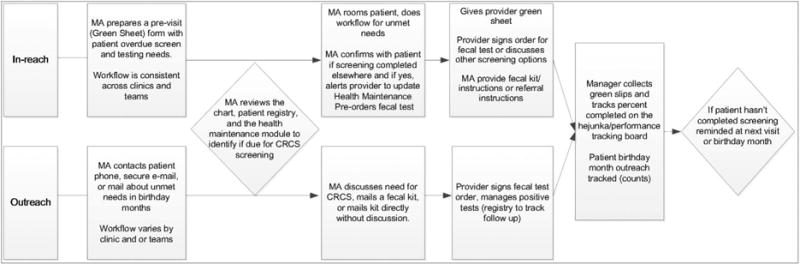
The patient-centered medical home (PCMH) includes comprehensive chronic illness and preventive services, including identifying patients who are overdue for colorectal cancer screening (CRCS). The association between PCMH implementation and CRCS during the Systems of Support to Increase Colorectal Cancer Screening Trial (SOS) is described.
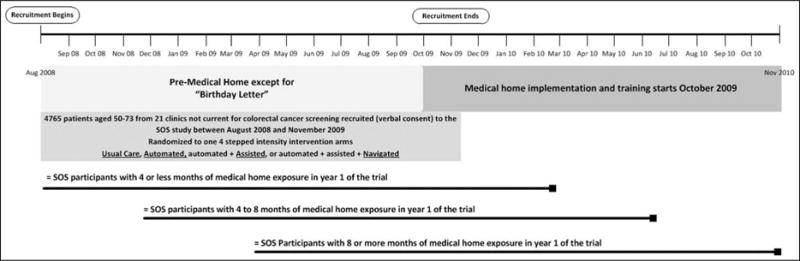
The SOS enrolled 4664 patients from 21 clinics from August 2008 to November 2009. Patients were randomized to usual care, mailed fecal kits, kits plus brief assistance, or kits plus assistance and navigation. A PCMH model that included a workflow for facilitating CRCS was implemented at all study clinics in late 2009. Patients enrolled early had little exposure to the PCMH, whereas patients enrolled later were exposed during most of their first year in the trial. Logistic regression models were used to assess the association between PCMH exposure and CRCS.
Usual care patients with ≥8 months in the PCMH had higher CRCS rates than those with ≤4 months in the PCMH (adjusted difference, 10.1%; 95% confidence interval, 5.7-14.6). SOS interventions led to significant increases in CRCS, but the magnitude of effect was attenuated by exposure to the PCMH (P for interaction = .01).
Exposure to a PCMH was associated with higher CRCS rates. Automated mailed and centrally delivered stepped interventions increased CRCS rates, even in the presence of a PCMH.
以患者为中心的医疗之家(PCMH)包括全面的慢性病和预防服务,其中包括识别结直肠癌筛查(CRCS)逾期未做的患者。本文描述了在增加结直肠癌筛查支持系统试验(SOS)期间PCMH实施与CRCS之间的关联。
SOS在2008年8月至2009年11月期间从21家诊所招募了4664名患者。患者被随机分配接受常规护理、邮寄粪便检测试剂盒、试剂盒加简短协助或试剂盒加协助及导航服务。2009年末,在所有研究诊所实施了一个包括促进CRCS工作流程的PCMH模式。早期入组的患者很少接触到PCMH,而后期入组的患者在试验的第一年大部分时间都有接触。使用逻辑回归模型评估PCMH接触与CRCS之间的关联。
在PCMH中接受≥8个月常规护理的患者的CRCS率高于在PCMH中接受≤4个月常规护理的患者(校正差异为10.1%;95%置信区间为5.7 - 14.6)。SOS干预导致CRCS显著增加,但接触PCMH会减弱这种效果的幅度(交互作用P值 = .01)。
接触PCMH与较高的CRCS率相关。即使在存在PCMH的情况下,自动邮寄和集中提供的逐步干预也能提高CRCS率。