Jankowska Magdalena, Kaczynski Piotr, Hrynko Izabela, Lozowicka Bozena
Laboratory of Pesticide Residues, Plant Protection Institute-National Research Institute, Chelmonskiego 22, 15-195, Bialystok, Poland.
Environ Sci Pollut Res Int. 2016 Jun;23(12):11885-900. doi: 10.1007/s11356-016-6260-x. Epub 2016 Mar 9.
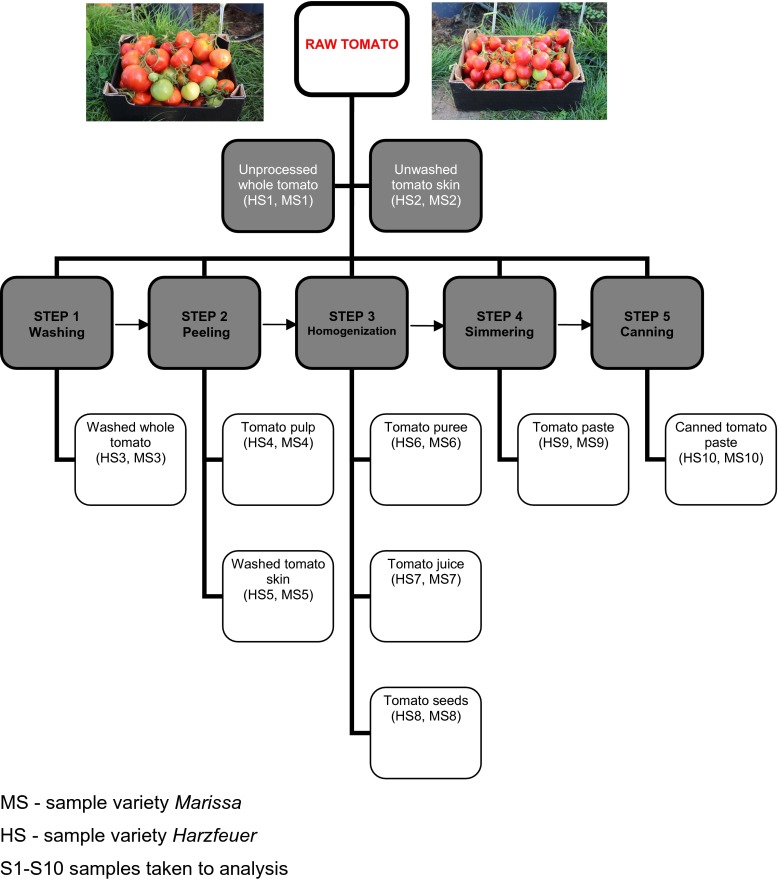
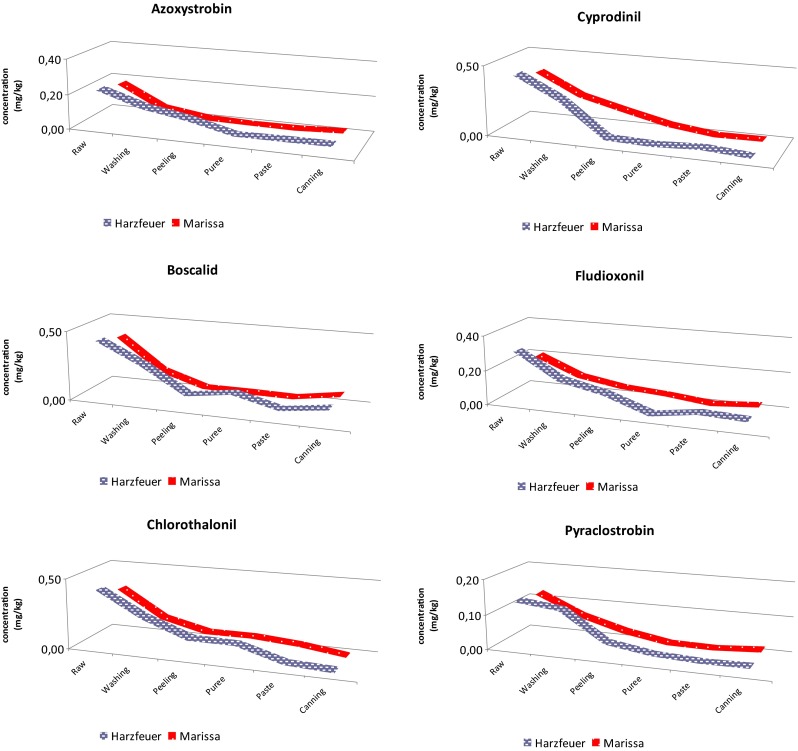
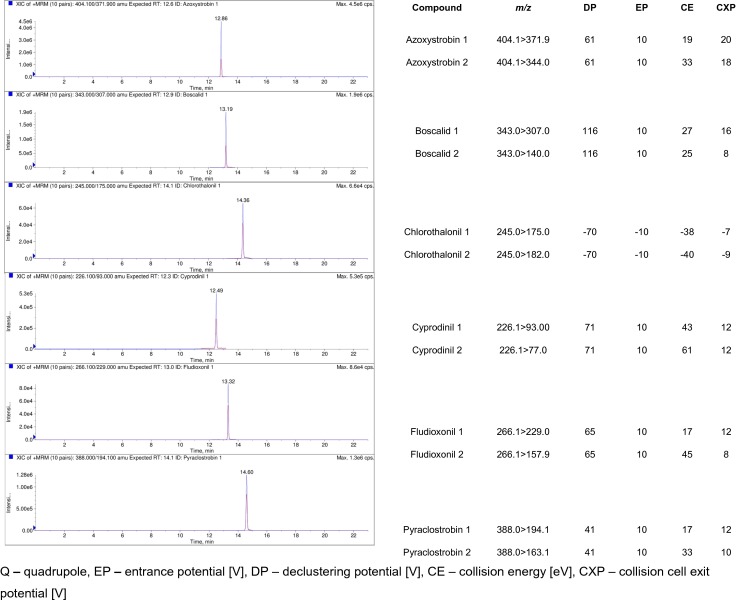
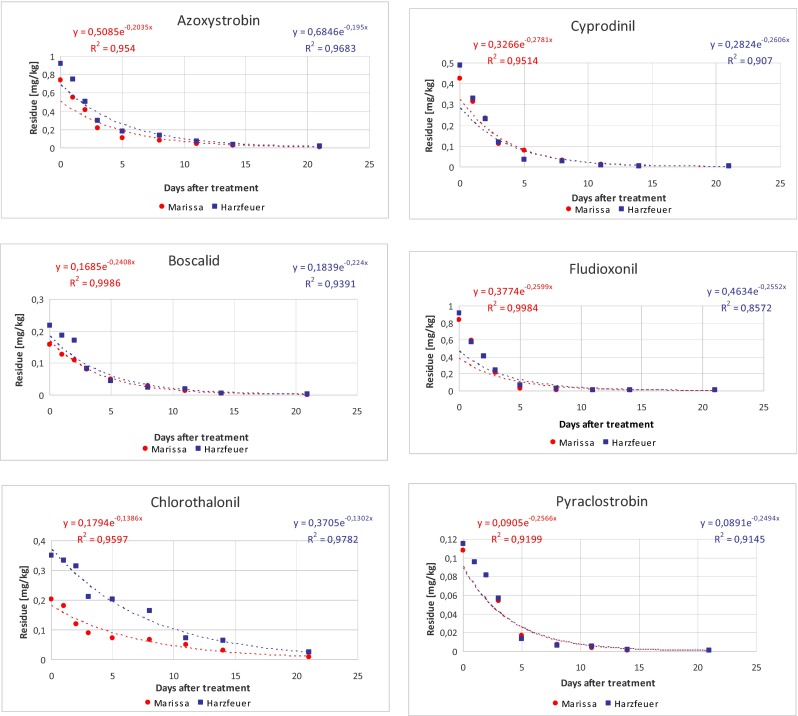
Greenhouse studies were conducted to evaluate the dissipation rate kinetics and estimate the behavior of selected pesticides after washing, peeling, simmering, and canning of tomato expressed as processing factor (PF). Two varieties (Marissa and Harzfeuer) were treated by six fungicides: azoxystrobin, boscalid, chlorothalonil, cyprodinil, fludioxonil, and pyraclostrobin at single and double dose and risk assessment defined as hazard quotient was performed. The QuEChERS method was used for sample preparation followed by liquid chromatography coupled with tandem mass spectrometry (LC-MS/MS). The dissipation of fungicides approximately fitted to a first-order kinetic model, with half-life values ranging from 2.49 and 2.67 days (cyprodinil) to 5.00 and 5.32 days (chlorothalonil) for Marissa and Harzfeuer variety, respectively. Results from processing studies showed that treatments have significant effects on the removal of the studied fungicides for both varieties. The PFs were generally less than 1 (between 0.01 and 0.90) and did not depend on variety. The dietary exposure assessed based on initial deposits of application at single and double dose on tomatoes and concentration after each process with PF correction showed no concern to consumer health. Our results would be a useful tool for monitoring of fungicides in tomatoes and provide more understanding of residue behavior and risk posed by these fungicides.
进行了温室研究,以评估选定农药在番茄洗涤、去皮、慢炖和罐装后以加工因子(PF)表示的消散速率动力学,并估计其行为。用六种杀菌剂(嘧菌酯、啶酰菌胺、百菌清、环丙唑醇、咯菌腈和吡唑醚菌酯)以单剂量和双剂量处理两个品种(玛丽莎和哈茨费厄),并进行了定义为危害商的风险评估。采用QuEChERS方法进行样品制备,随后进行液相色谱-串联质谱联用(LC-MS/MS)分析。杀菌剂的消散大致符合一级动力学模型,玛丽莎和哈茨费厄品种的半衰期值分别为2.49至2.67天(环丙唑醇)和5.00至5.32天(百菌清)。加工研究结果表明,处理对两个品种中所研究杀菌剂的去除有显著影响。加工因子通常小于1(在0.01至0.90之间),且不依赖于品种。基于单剂量和双剂量施用于番茄的初始沉积量以及经加工因子校正后的各加工过程后的浓度评估的膳食暴露对消费者健康无影响。我们的结果将成为监测番茄中杀菌剂的有用工具,并有助于更深入了解这些杀菌剂的残留行为和风险。