Weißmüller Sabrina, Kronhart Stefanie, Kreuz Dorothea, Schnierle Barbara, Kalinke Ulrich, Kirberg Jörg, Hanschmann Kay-Martin, Waibler Zoe
Junior Research Group "Novel Vaccination Strategies and Early Immune Responses", Paul-Ehrlich-Institut, Langen, Germany.
Division of Immunology, Paul-Ehrlich-Institut, Langen, Germany.
PLoS One. 2016 Mar 9;11(3):e0149093. doi: 10.1371/journal.pone.0149093. eCollection 2016.
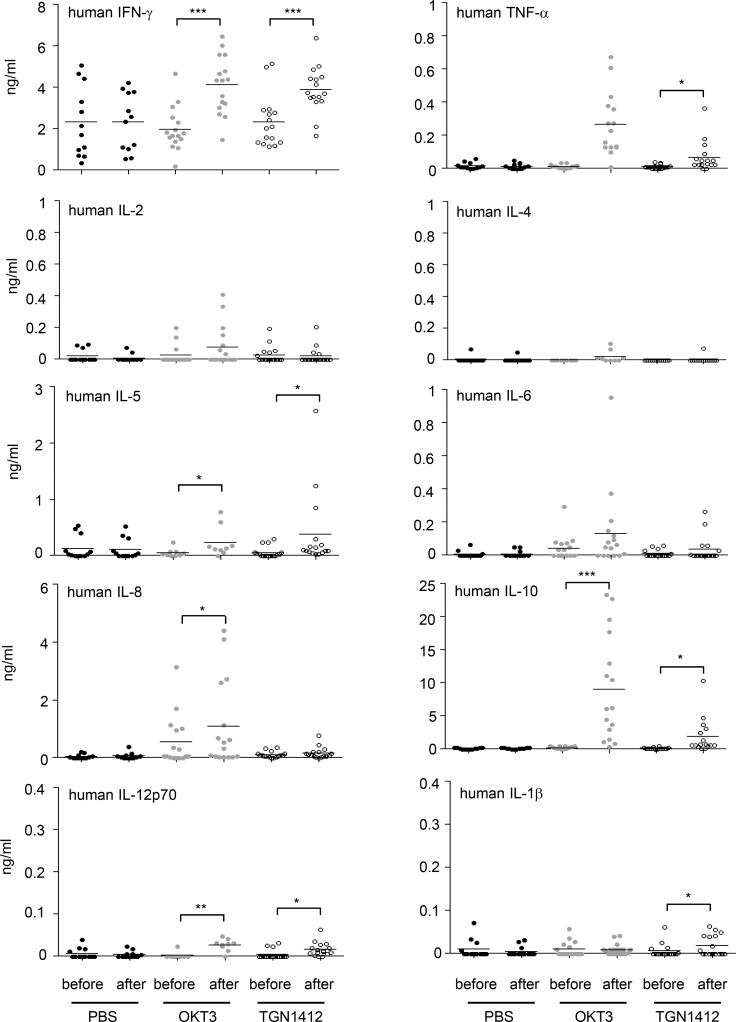
Therapeutic monoclonal antibodies (mAbs) such as the superagonistic, CD28-specific antibody TGN1412, or OKT3, an anti-CD3 mAb, can cause severe adverse events including cytokine release syndrome. A predictive model for mAb-mediated adverse effects, for which no previous knowledge on severe adverse events to be expected or on molecular mechanisms underlying is prerequisite, is not available yet. We used a humanized mouse model of human peripheral blood mononuclear cell-reconstituted NOD-RAG1-/-Aβ-/-HLADQ(tg+ or tg-)IL-2Rγc-/- mice to evaluate its predictive value for preclinical testing of mAbs. 2-6 hours after TGN1412 treatment, mice showed a loss of human CD45+ cells from the peripheral blood and loss of only human T cells after OKT3 injection, reminiscent of effects observed in mAb-treated humans. Moreover, upon OKT3 injection we detected selective CD3 downmodulation on T cells, a typical effect of OKT3. Importantly, we detected release of human cytokines in humanized mice upon both OKT3 and TGN1412 application. Finally, humanized mice showed severe signs of illness, a rapid drop of body temperature, and succumbed to antibody application 2-6 hours after administration. Hence, the humanized mouse model used here reproduces several effects and adverse events induced in humans upon application of the therapeutic mAbs OKT3 and TGN1412.
治疗性单克隆抗体(mAb),如超激动性、CD28特异性抗体TGN1412或抗CD3单克隆抗体OKT3,可导致包括细胞因子释放综合征在内的严重不良事件。目前尚不存在一种针对单克隆抗体介导的不良反应的预测模型,该模型需要对预期的严重不良事件或潜在分子机制没有先验知识。我们使用了一种人外周血单个核细胞重建的NOD-RAG1-/-Aβ-/-HLADQ(tg+或tg-)IL-2Rγc-/-小鼠的人源化小鼠模型,以评估其在单克隆抗体临床前测试中的预测价值。在TGN1412治疗后2-6小时,小鼠外周血中的人CD45+细胞减少,而在注射OKT3后仅人T细胞减少,这让人联想到在接受单克隆抗体治疗的人类中观察到的效应。此外,在注射OKT3后,我们检测到T细胞上的CD3选择性下调,这是OKT3的典型效应。重要的是,在应用OKT3和TGN1412后,我们在人源化小鼠中检测到了人细胞因子的释放。最后,人源化小鼠出现了严重的疾病迹象,体温迅速下降,并在给药后2-6小时死于抗体应用。因此,这里使用的人源化小鼠模型再现了治疗性单克隆抗体OKT3和TGN1412应用后在人类中诱导的几种效应和不良事件。