Wang Yanqun, Li Yamin, Lu Roujian, Zhao Yanjie, Xie Zhengde, Shen Jun, Tan Wenjie
Key Laboratory of Medical Virology, Ministry of Health; National Institute for Viral Disease Control and Prevention, China CDC, Beijing 102206, China.
Key Laboratory of Major Diseases in Children and National Key Discipline of Pediatrics Capital Medical University, Ministry of Education, Beijing Pediatric Research Institute, Beijing Children's Hospital, Capital Medical University, Beijing 100045, China.
Sci Rep. 2016 Mar 10;6:23014. doi: 10.1038/srep23014.
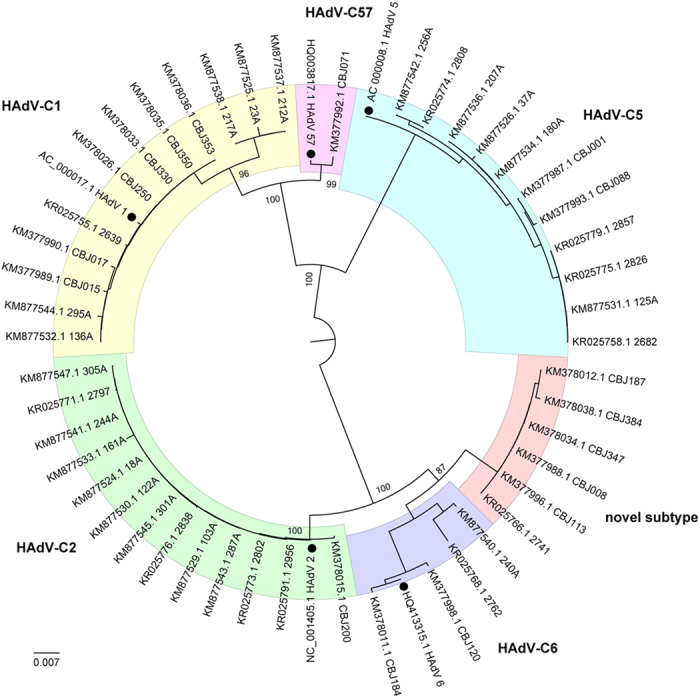
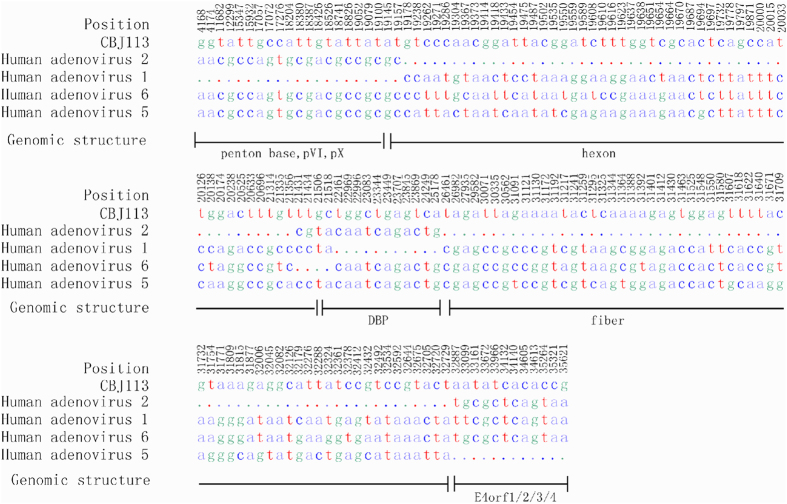
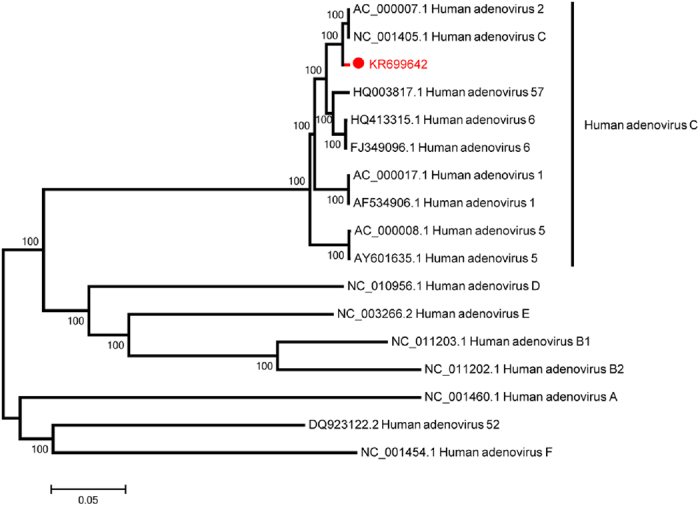
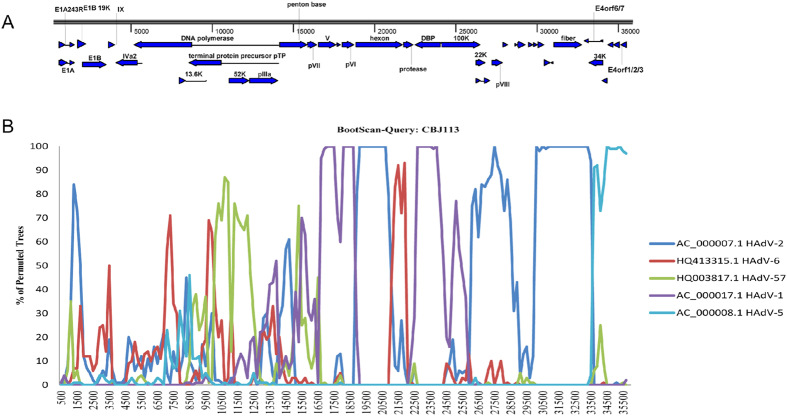
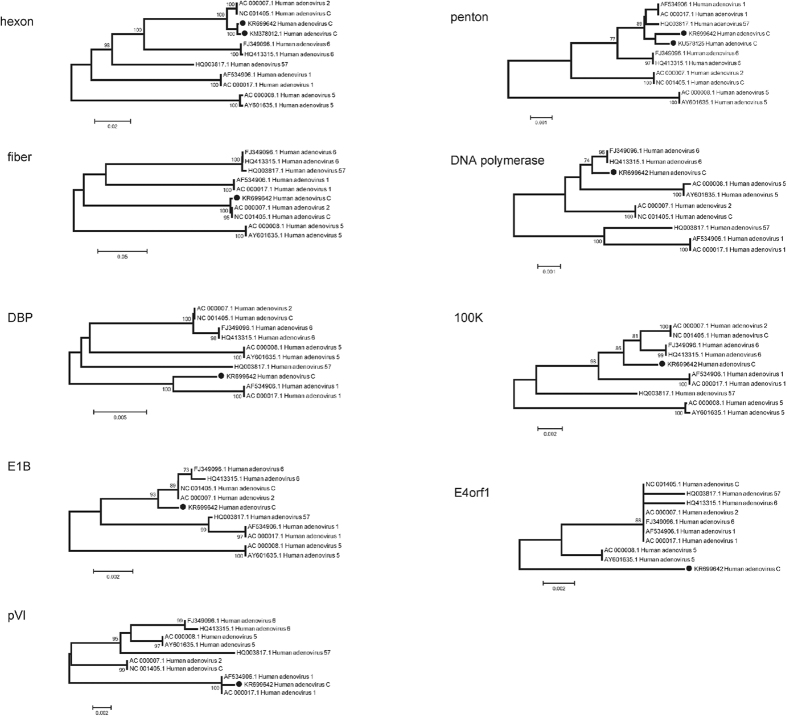
Human adenoviruses (HAdVs) are prevalent in hospitalized children with severe acute respiratory infection (SARI). Here, we report a unique recombinant HAdV strain (CBJ113) isolated from a HAdV-positive child with SARI. The whole-genome sequence was determined using Sanger sequencing and high-throughput sequencing. A phylogenetic analysis of the complete genome indicated that the CBJ113 strain shares a common origin with HAdV-C2, HAdV-C6, HAdV-C1, HAdV-C5, and HAdV-C57 and formed a novel subclade on the same branch as other HAdV-C subtypes. BootScan and single nucleotide polymorphism analyses showed that the CBJ113 genome has an intra-subtype recombinant structure and comprises gene regions mainly originating from two circulating viral strains: HAdV-1 and HAdV-2. The parental penton base, pVI, and DBP genes of the recombinant strain clustered with the HAdV-1 prototype strain, and the E1B, hexon, fiber, and 100 K genes of the recombinant clustered within the HAdV-2 subtype, meanwhile the E4orf1 and DNA polymerase genes of the recombinant shared the greatest similarity with those of HAdV-5 and HAdV-6, respectively. All of these findings provide insight into our understanding of the dynamics of the complexity of the HAdV-C epidemic. More extensive studies should address the pathogenicity and clinical characteristics of the novel recombinant.
人腺病毒(HAdVs)在患有严重急性呼吸道感染(SARI)的住院儿童中普遍存在。在此,我们报告了一株从一名患有SARI的HAdV阳性儿童中分离出的独特重组HAdV毒株(CBJ113)。使用桑格测序和高通量测序确定了全基因组序列。对完整基因组的系统发育分析表明,CBJ113毒株与HAdV-C2、HAdV-C6、HAdV-C1、HAdV-C5和HAdV-C57有着共同的起源,并在与其他HAdV-C亚型相同的分支上形成了一个新的亚分支。BootScan和单核苷酸多态性分析表明,CBJ113基因组具有亚型内重组结构,并且包含主要起源于两种流行病毒株:HAdV-1和HAdV-2的基因区域。重组毒株的亲本五邻体基座、pVI和DBP基因与HAdV-1原型毒株聚类,而重组毒株的E1B、六邻体、纤维和100K基因聚类在HAdV-2亚型内,同时重组毒株的E4orf1和DNA聚合酶基因分别与HAdV-5和HAdV-6的基因具有最大的相似性。所有这些发现为我们理解HAdV-C流行复杂性的动态变化提供了见解。更广泛的研究应关注这种新型重组体的致病性和临床特征。