Ishii Hiroaki, Hata Keisuke, Kishikawa Junko, Anzai Hiroyuki, Otani Kensuke, Yasuda Koji, Nishikawa Takeshi, Tanaka Toshiaki, Tanaka Junichiro, Kiyomatsu Tomomichi, Kawai Kazushige, Nozawa Hiroaki, Kazama Shinsuke, Yamaguchi Hironori, Ishihara Soichiro, Sunami Eiji, Kitayama Joji, Watanabe Toshiaki
Department of Surgical Oncology, Faculty of Medicine, The University of Tokyo, Tokyo, 113-0033, Japan.
World J Surg Oncol. 2016 Mar 9;14:75. doi: 10.1186/s12957-016-0833-5.
The incidence of neoplasia after surgery has not been sufficiently evaluated in patients with ulcerative colitis (UC), particularly in the Japanese population, and it is not clear whether surveillance endoscopy is effective in detecting dysplasia/cancer in the remnant rectum or pouch. The aims of this study were to assess and compare postoperative development of dysplasia/cancer in patients with UC who underwent ileorectal anastomosis (IRA) or ileal pouch-anal anastomosis (IPAA) and to evaluate the effectiveness of postoperative surveillance endoscopy.
One hundred twenty patients who received postoperative surveillance endoscopy were retrospectively reviewed for development of dysplasia/cancer in the remnant rectal mucosa or pouch.
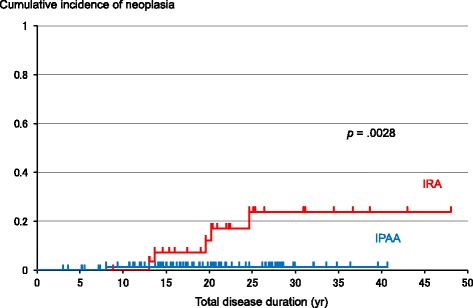
Three hundred seventy-nine endoscopy sessions were conducted for 30 patients after IRA, while 548 pouch endoscopy sessions were conducted for 90 patients after IPAA. In the IRA group, 5 patients developed dysplasia/cancer during postoperative surveillance and in all cases, neoplasia was detected at an early stage. In the IRA group, no patient developed neoplasia within 10 years of diagnosis; the cumulative incidence of neoplasia after disease onset was 7.2, 12.0, and 23.9% at 15, 20, and 25 years, respectively. In one case after stapled IPAA, dysplasia was found at the ileal pouch; a subsequent 9 endoscopy sessions in 8 years did not detect any dysplasia. Neoplasia was found more frequently during postoperative surveillance in the IRA group than in the IPAA group (p = .0028). The cumulative incidence of neoplasia after IRA was 3.8, 8.7, and 21.7% at 10, 15, and 20 years, respectively, and that after IPAA was 1.6% at 20 years.
The cumulative incidence of neoplasia after IPAA was minimal. Those who underwent IRA had a greater risk of developing neoplasia than those who underwent IPAA, although postoperative surveillance endoscopy was able to detect dysplasia/cancer at an early stage. IRA can be the surgical procedure of choice only in selected cases in which it would be of benefit to the patient, with more careful surveillance.
溃疡性结肠炎(UC)患者术后肿瘤形成的发生率尚未得到充分评估,尤其是在日本人群中,而且尚不清楚监测性内镜检查在检测残留直肠或储袋中的发育异常/癌症方面是否有效。本研究的目的是评估和比较接受回肠直肠吻合术(IRA)或回肠储袋肛管吻合术(IPAA)的UC患者术后发育异常/癌症的发生情况,并评估术后监测性内镜检查的有效性。
对120例接受术后监测性内镜检查的患者进行回顾性研究,以观察残留直肠黏膜或储袋中发育异常/癌症的发生情况。
IRA术后30例患者进行了379次内镜检查,而IPAA术后90例患者进行了548次储袋内镜检查。在IRA组中,5例患者在术后监测期间发生发育异常/癌症,且所有病例的肿瘤均在早期被检测到。在IRA组中,没有患者在诊断后10年内发生肿瘤;发病后15、20和25年时肿瘤的累积发生率分别为7.2%、12.0%和23.9%。在1例吻合器IPAA术后,在回肠储袋中发现发育异常;随后8年的9次内镜检查未发现任何发育异常。IRA组术后监测期间发现肿瘤的频率高于IPAA组(p = 0.0028)。IRA术后10、15和20年时肿瘤的累积发生率分别为3.8%、8.7%和21.7%,IPAA术后20年时为1.6%。
IPAA术后肿瘤的累积发生率极低。接受IRA的患者发生肿瘤的风险高于接受IPAA的患者,尽管术后监测性内镜检查能够在早期检测出发育异常/癌症。IRA仅在对患者有益的特定病例中可作为首选手术方式,并需更仔细的监测。