van Rijt Leonie, von Richthofen Helen, van Ree Ronald
Department of Experimental Immunology, Academic Medical Center, University of Amsterdam, Room KO-104, Meibergdreef 9, 1105 AZ, Amsterdam, The Netherlands.
Department of Otorhinolaryngology, Academic Medical Center, University of Amsterdam, Amsterdam, The Netherlands.
Semin Immunopathol. 2016 Jul;38(4):483-96. doi: 10.1007/s00281-016-0556-2. Epub 2016 Mar 10.
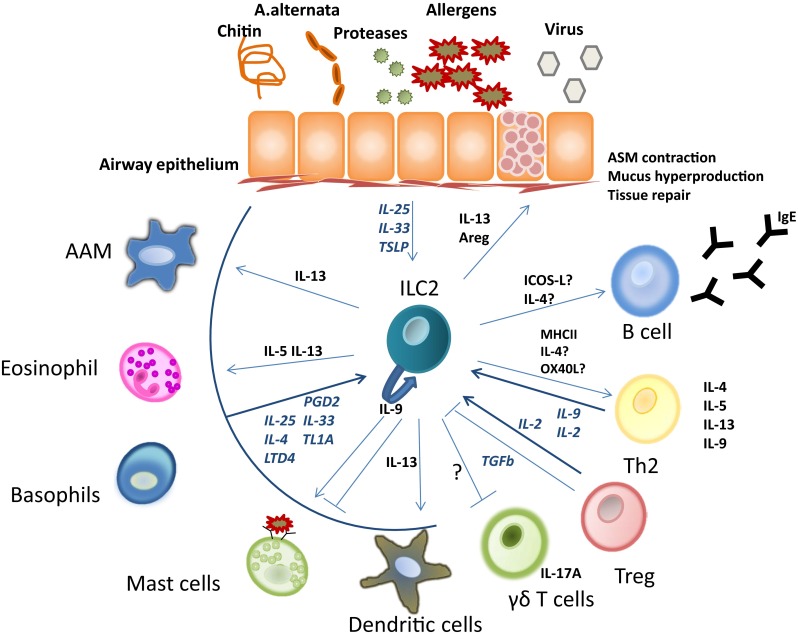
Allergic asthma is a chronic inflammatory disease of the lower airways that affects millions of people worldwide. Allergic asthma is a T helper 2 cell (Th2)-mediated disease, in which Th2 cytokines interleukin (IL)-4, IL-5, and IL-13 are closely associated with the symptoms. IL-4 is needed by B cells to switch toward an IgE response, IL-5 recruits and activates eosinophils while IL-13 increases mucus production. The identification of type 2 innate lymphoid cells (ILC2), which are able to rapidly produce large amounts of IL-5 and IL-13 in response to epithelial derived cytokines, implicated a new key player besides Th2 cells. ILCs constitute a family of innate lymphocytes distinct from T and B cells. ILC2s are located in various epithelial compartments in mice and human, including the lung. The recent finding of increased numbers of ILC2s in the airways of severe asthma patients prompts further research to clarify their immunological function. Murine studies have shown that ILC2s are an early innate source of IL-5 and IL-13 after allergen exposure, which induce airway eosinophilic infiltration, mucus hyperproduction, and airway hyperresponsiveness but not allergen-specific IgE production. ILC2s contribute to the initiation as well as to the maintenance of the adaptive type 2 immune response. Here, we review the recent progress on our understanding of the role of ILC2s in the immunopathology of allergic asthma, in particular by studies using murine models which have elucidated fundamental mechanisms by which ILC2s act.
过敏性哮喘是一种下呼吸道慢性炎症性疾病,全球数百万人受其影响。过敏性哮喘是一种由辅助性T细胞2(Th2)介导的疾病,其中Th2细胞因子白细胞介素(IL)-4、IL-5和IL-13与症状密切相关。B细胞需要IL-4来转向IgE反应,IL-5募集并激活嗜酸性粒细胞,而IL-13增加黏液分泌。2型固有淋巴细胞(ILC2)能够响应上皮来源的细胞因子迅速产生大量IL-5和IL-13,这表明除了Th2细胞外还有一个新的关键角色。ILC构成了一类不同于T细胞和B细胞的固有淋巴细胞家族。ILC2存在于小鼠和人类的各种上皮区室中,包括肺。最近在重症哮喘患者气道中发现ILC2数量增加,这促使进一步研究以阐明其免疫功能。小鼠研究表明,ILC2是变应原暴露后IL-5和IL-13的早期固有来源,可诱导气道嗜酸性粒细胞浸润、黏液过度分泌和气道高反应性,但不会诱导变应原特异性IgE产生。ILC2有助于启动和维持适应性2型免疫反应。在此,我们综述了对ILC2在过敏性哮喘免疫病理学中作用的最新认识进展,特别是通过使用小鼠模型的研究,这些研究阐明了ILC2发挥作用的基本机制。