Schmitz-Valckenberg Steffen, Göbel Arno P, Saur Stefan C, Steinberg Julia S, Thiele Sarah, Wojek Christian, Russmann Christoph, Holz Frank G
Department of Ophthalmology, University of Bonn, Bonn, Germany.
Carl Zeiss AG, Oberkochen, Germany.
Transl Vis Sci Technol. 2016 Mar 4;5(2):3. doi: 10.1167/tvst.5.2.3. eCollection 2016 Mar.
To develop and evaluate a software tool for automated detection of focal hyperpigmentary changes (FHC) in eyes with intermediate age-related macular degeneration (AMD).
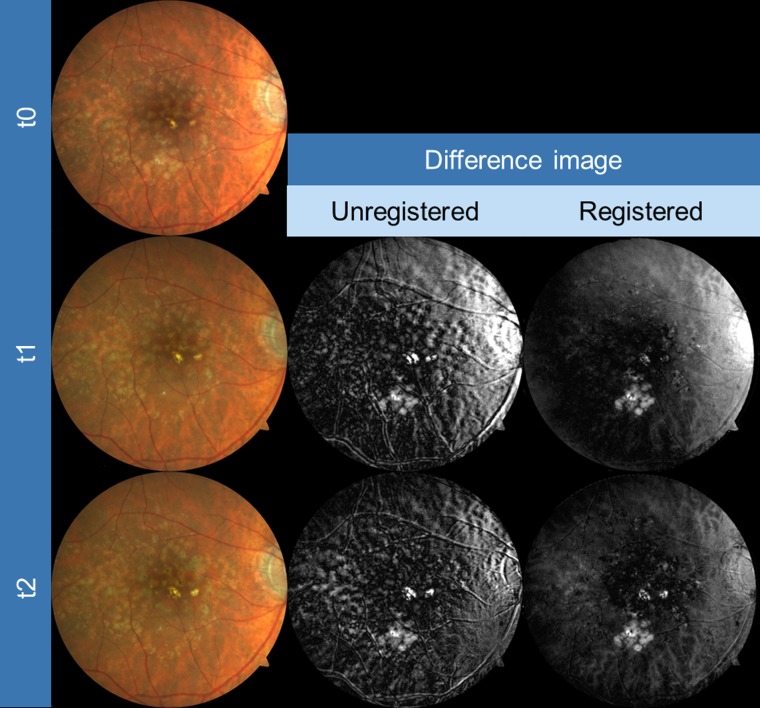
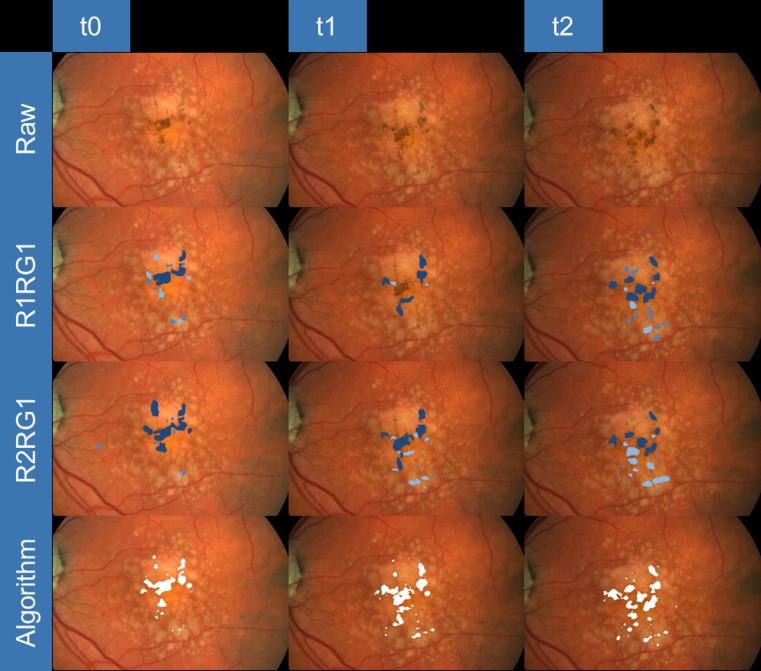
Color fundus (CFP) and autofluorescence (AF) photographs of 33 eyes with FHC of 28 AMD patients (mean age 71 years) from the prospective longitudinal natural history MODIAMD-study were included. Fully automated to semiautomated registration of baseline to corresponding follow-up images was evaluated. Following the manual circumscription of individual FHC (four different readings by two readers), a machine-learning algorithm was evaluated for automatic FHC detection.
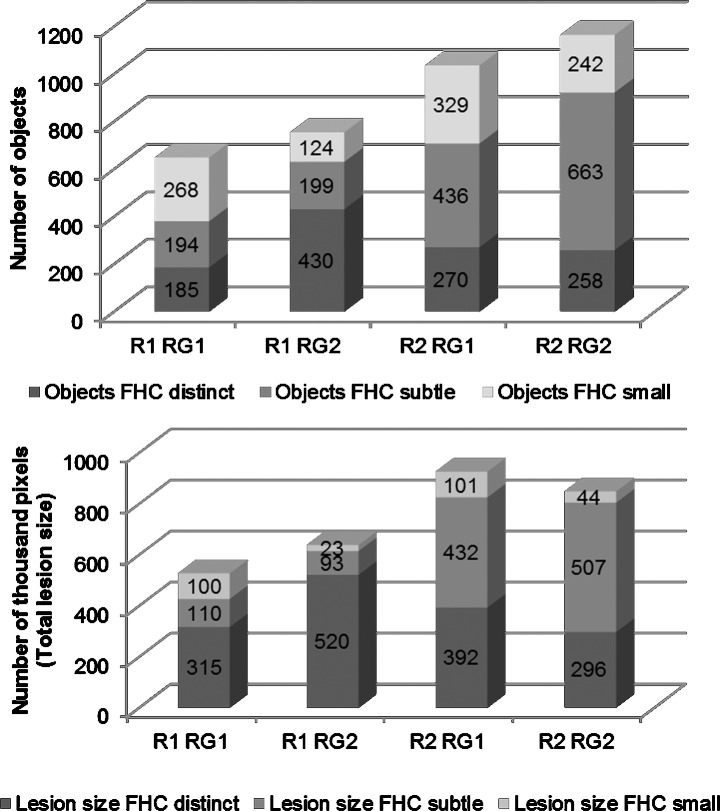
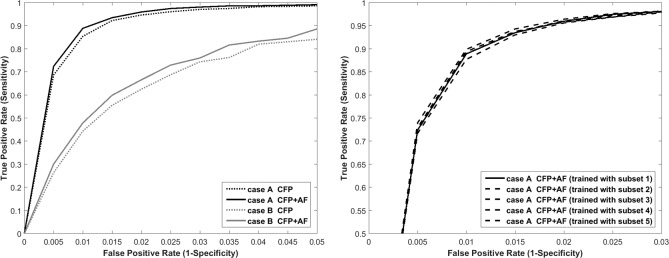
The overall pixel distance error for the semiautomated (CFP follow-up to CFP baseline: median 5.7; CFP to AF images from the same visit: median 6.5) was larger as compared for the automated image registration (4.5 and 5.7; < 0.001 and < 0.001). The total number of manually circumscribed objects and the corresponding total size varied between 637 to 1163 and 520,848 pixels to 924,860 pixels, respectively. Performance of the learning algorithms showed a sensitivity of 96% at a specificity level of 98% using information from both CFP and AF images and defining small areas of FHC ("speckle appearance") as "neutral."
FHC as a high-risk feature for progression of AMD to late stages can be automatically assessed at different time points with similar sensitivity and specificity as compared to manual outlining. Upon further development of the research prototype, this approach may be useful both in natural history and interventional large-scale studies for a more refined classification and risk assessment of eyes with intermediate AMD.
Automated FHC detection opens the door for a more refined and detailed classification and risk assessment of eyes with intermediate AMD in both natural history and future interventional studies.
开发并评估一种软件工具,用于自动检测中度年龄相关性黄斑变性(AMD)患者眼睛中的局灶性色素沉着改变(FHC)。
纳入了来自前瞻性纵向自然史MODIAMD研究的28例AMD患者(平均年龄71岁)的33只患有FHC的眼睛的彩色眼底(CFP)和自发荧光(AF)照片。评估了从基线到相应随访图像的全自动至半自动配准。在对个体FHC进行手动划定边界后(两名读者进行四次不同的读数),评估了一种机器学习算法用于自动检测FHC。
与自动图像配准相比,半自动配准的总体像素距离误差更大(CFP随访至CFP基线:中位数5.7;同一就诊时CFP至AF图像:中位数6.5)(分别为4.5和5.7;<0.001和<0.001)。手动划定边界的对象总数和相应的总面积分别在637至1163个以及520,848像素至924,860像素之间变化。使用来自CFP和AF图像的信息并将FHC的小区域(“斑点外观”)定义为“中性”,学习算法的性能在特异性水平为98%时显示出96%的灵敏度。
FHC作为AMD进展至晚期的高风险特征,可以在不同时间点进行自动评估,其灵敏度和特异性与手动勾勒相似。随着研究原型的进一步开发,这种方法可能在自然史和介入性大规模研究中都有用,以便对中度AMD患者的眼睛进行更精细的分类和风险评估。
自动检测FHC为在自然史和未来介入性研究中对中度AMD患者的眼睛进行更精细和详细的分类及风险评估打开了大门。