Bolaños Juan P
Institute of Functional Biology and Genomics (IBFG), University of Salamanca-CSIC-IBSAL, Salamanca, Spain.
J Neurochem. 2016 Oct;139 Suppl 2(Suppl Suppl 2):115-125. doi: 10.1111/jnc.13486. Epub 2016 Mar 10.
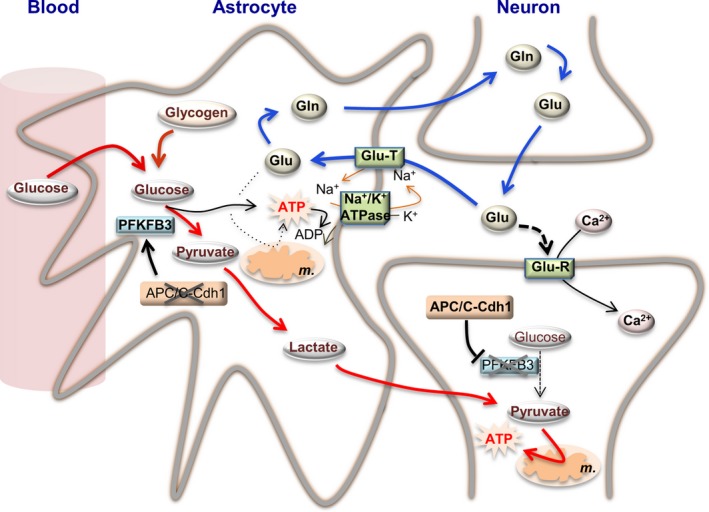
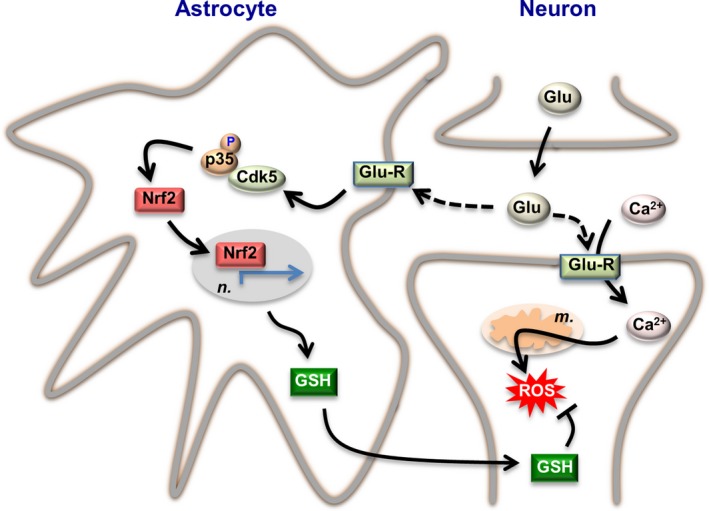
Neuronal activity is a high-energy demanding process recruiting all neural cells that adapt their metabolism to sustain the energy and redox balance of neurons. During neurotransmission, synaptic cleft glutamate activates its receptors in neurons and in astrocytes, before being taken up by astrocytes through energy costly transporters. In astrocytes, the energy requirement for glutamate influx is likely to be met by glycolysis. To enable this, astrocytes are constitutively glycolytic, robustly expressing 6-phosphofructo-2-kinase/fructose-2,6-bisphosphatase-3 (PFKFB3), an enzyme that is negligibly present in neurons by continuous degradation because of the ubiquitin-proteasome pathway via anaphase-promoting complex/cyclosome (APC)-Cdh1. Additional factors contributing to the glycolytic frame of astrocytes may include 5'-AMP-activated protein kinase (AMPK), hypoxia-inducible factor-1 (HIF-1), pyruvate kinase muscle isoform-2 (PKM2), pyruvate dehydrogenase kinase-4 (PDK4), lactate dehydrogenase-B, or monocarboxylate transporter-4 (MCT4). Neurotransmission-associated messengers, such as nitric oxide or ammonium, stimulate lactate release from astrocytes. Astrocyte-derived glycolytic lactate thus sustains the energy needs of neurons, which in contrast to astrocytes mainly rely on oxidative phosphorylation. Neuronal activity unavoidably triggers reactive oxygen species, but the antioxidant defense of neurons is weak; hence, they use glucose for oxidation through the pentose-phosphate pathway to preserve the redox status. Furthermore, neural activity is coupled with erythroid-derived erythroid-derived 2-like 2 (Nrf2) mediated transcriptional activation of antioxidant genes in astrocytes, which boost the de novo glutathione biosynthesis in neighbor neurons. Thus, the bioenergetics and redox programs of astrocytes are adapted to sustain neuronal activity and survival. Developing therapeutic strategies to interfere with these pathways may be useful to combat neurological diseases. Our current knowledge on brain's management of bioenergetics and redox requirements associated with neural activity is herein revisited. The astrocyte-neuronal lactate shuttle (ANLS) explains the energy needs of neurotransmission. Furthermore, neurotransmission unavoidably triggers increased mitochondrial reactive oxygen species in neurons. By coupling glutamatergic activity with transcriptional activation of antioxidant genes, astrocytes provide neurons with neuroprotective glutathione through an astrocyte-neuronal glutathione shuttle (ANGS). This article is part of the 60th Anniversary special issue.
神经元活动是一个高能量需求的过程,它需要所有神经细胞参与,这些神经细胞会调整自身代谢以维持神经元的能量和氧化还原平衡。在神经传递过程中,突触间隙中的谷氨酸先激活神经元和星形胶质细胞中的受体,然后通过耗能的转运体被星形胶质细胞摄取。在星形胶质细胞中,谷氨酸内流所需的能量可能通过糖酵解来满足。为此,星形胶质细胞组成性地进行糖酵解,大量表达6-磷酸果糖-2-激酶/果糖-2,6-二磷酸酶-3(PFKFB3),由于泛素-蛋白酶体途径通过后期促进复合物/细胞周期体(APC)-Cdh1持续降解,该酶在神经元中含量极少。其他有助于星形胶质细胞糖酵解框架的因素可能包括5'-AMP激活蛋白激酶(AMPK)、缺氧诱导因子-1(HIF-1)、丙酮酸激酶肌肉亚型-2(PKM2)、丙酮酸脱氢酶激酶-4(PDK4)、乳酸脱氢酶-B或单羧酸转运体-4(MCT4)。与神经传递相关的信使,如一氧化氮或铵,会刺激星形胶质细胞释放乳酸。因此,星形胶质细胞衍生的糖酵解乳酸维持了神经元的能量需求,与主要依赖氧化磷酸化的星形胶质细胞不同,神经元主要依赖氧化磷酸化。神经元活动不可避免地会触发活性氧的产生,但神经元的抗氧化防御能力较弱;因此,它们通过磷酸戊糖途径利用葡萄糖进行氧化以维持氧化还原状态。此外,神经活动与星形胶质细胞中红细胞衍生的2样2(Nrf2)介导的抗氧化基因转录激活相关联,这会促进相邻神经元中谷胱甘肽的从头生物合成。因此,星形胶质细胞的生物能量学和氧化还原程序经过调整以维持神经元的活动和存活。开发干扰这些途径的治疗策略可能有助于对抗神经系统疾病。我们在此重新审视了目前关于大脑对与神经活动相关的生物能量学和氧化还原需求的管理的知识。星形胶质细胞-神经元乳酸穿梭(ANLS)解释了神经传递的能量需求。此外,神经传递不可避免地会触发神经元中线粒体活性氧的增加。通过将谷氨酸能活动与抗氧化基因的转录激活相耦合,星形胶质细胞通过星形胶质细胞-神经元谷胱甘肽穿梭(ANGS)为神经元提供神经保护作用的谷胱甘肽。本文是第60周年特刊的一部分。